

Every missed repayment chips away at your institution’s ability to lend. And when defaults pile up without a clear recovery process, the damage goes beyond money. It hits your operations, your compliance and your growth.
To tackle this, lenders need a systematic loan recovery process. It refers to the step-by-step process lenders follow to recover an outstanding loan when a borrower fails to fulfil their payment obligations under the loan agreement.
In this blog, we will examine the loan recovery process in India, RBI guidelines, recovery mechanisms and the best recovery strategies for banks, lenders and other financial institutions.
“Loan recovery” is the process lenders use to recover outstanding debt from borrowers who stop or delay payments and do not comply with the terms of the loan agreement.
From personal loans to business loans, every loan account is created with agreed-upon terms and conditions of the repayment process, including the repayment schedule. A loan is considered unpaid or outstanding when a borrower fails to make payments in accordance with these rules. In such a case, the lender then initiates the loan recovery process.
A good loan recovery process enables lenders to recover funds while maintaining fair practices and regulatory compliance.
There can be 2 methods of loan recovery:
| Method | Characterstics |
| Non-judicial method | Direct communication Negotiation Modifying repayment structure Using loan recovery agents |
| Judicial method | Debt recovery tribunal Civil court |
The loan recovery process starts only after repeated missed payments. If the borrower fails to repay the remaining overdue amount or respond to reminders, a review of the loan account is conducted, and formal recovery proceedings begin.
The borrower’s repayment capacity and financial situation are also evaluated. Temporary relief or a revised repayment schedule may be implemented for borrowers facing financial difficulties, such as job loss or medical emergencies.
The loan recovery process is a structured approach. It starts with simple communication, but can escalate to legal proceedings if the debt remains unpaid.
Lenders need to understand each step of the loan recovery process to recover dues efficiently, while ensuring compliance with RBI guidelines to maintain fair practices in India.
Let’s break it down step by step.
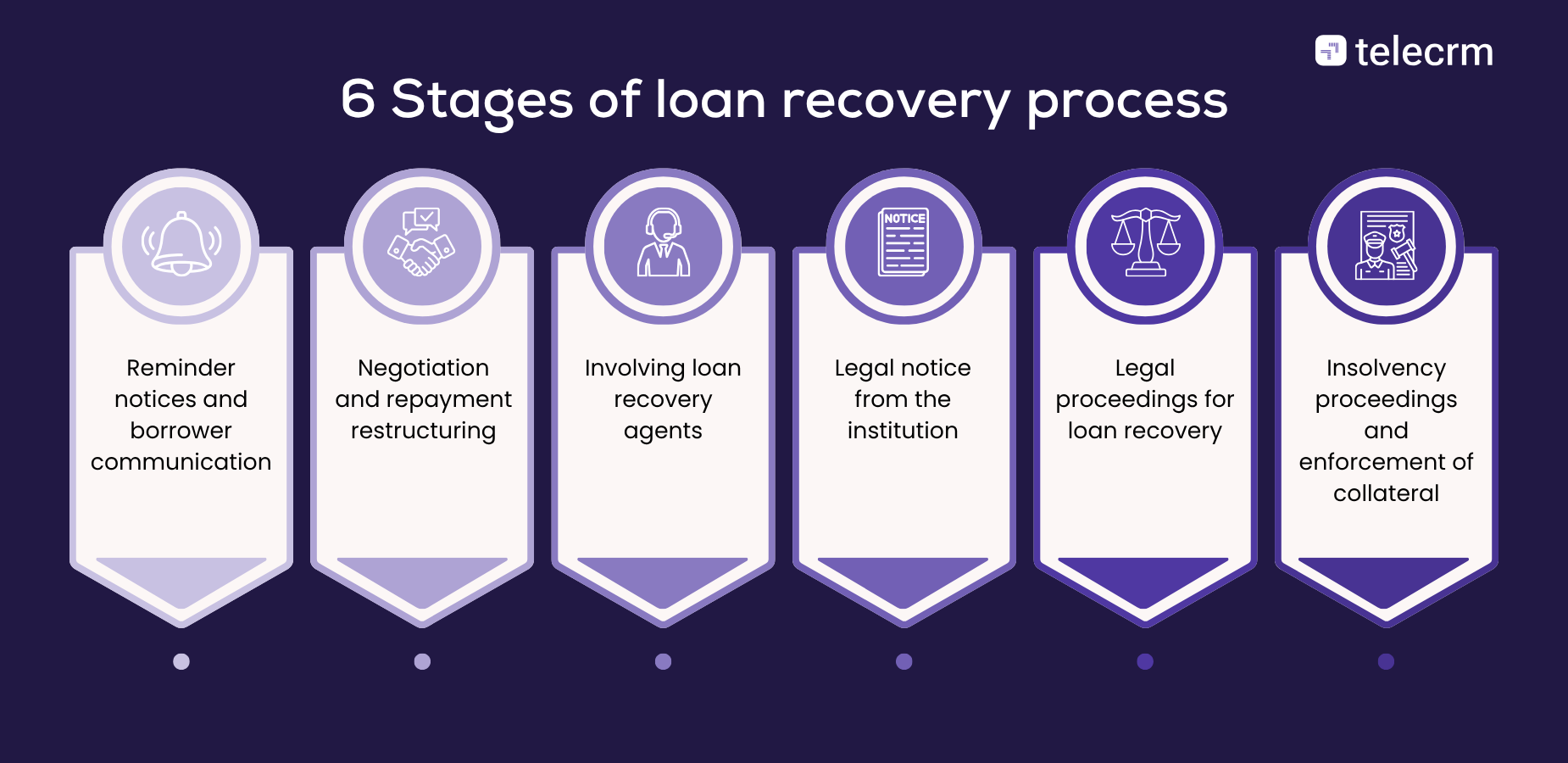
Once a payment is missed, the recovery process begins with communications and soft reminder notices. The lender reaches out to the borrower via phone calls, messages, e-mails or even formal notices.
This initial stage generally lasts for the first 30 days past due. The intent is to inform the person that they have a pending loan payment instead of immediate recovery. The lender tries to understand why the borrower failed to pay the loan through clear and honest communication.
This is a crucial step because the majority of the cases are resolved in this stage, without escalation, due to open communication.
If the borrower is still unable to clear their outstanding debt between 30 and 90 days overdue, lenders move to the negotiating stage. In this stage, lenders carefully analyse the borrower’s financial situation, repayment capacity and financial health.
After this, a new repayment schedule is designed. This may include:
A well-structured settlement process helps both parties reach a workable solution, avoiding unnecessary legal proceedings.
If the borrower fails to respond even after 90 days, the loan is classified as a Non-Performing Asset (NPA). After all these efforts and multiple follow-ups, lenders may involve authorised loan recovery agents, who are responsible for contacting the borrower and recovering the overdue payment.
These agents must:
The RBI requires banks and financial institutions to monitor the conduct of these agents, ensuring compliance with fair practices and preventing any form of harassment.
If the debt still remains unpaid even after involving recovery agents, a formal legal notice is issued by the financial institution. This notice clearly outlines the total outstanding loan, pending payments and the final deadline.
This notice warns the borrower about the potential legal action if the dues are not cleared within the specified time.
This step is the final chance for the borrower to take an action by either clearing the dues or by attempting to negotiate repayment terms.
After the numerous attempts, if the debt still remains unpaid, lenders reach the final stage of loan recovery, legal proceedings. Depending on the case, the lenders may:
If the borrower still fails to repay despite legal proceedings, lenders may proceed with insolvency actions or enforce collateral, depending on the nature of the loan under the Insolvency and Bankruptcy Code (IBC).
For secured loans, lenders have the right to take control of the asset pledged as collateral under laws such as the SARFAESI Act. This means they can seize assets like property, vehicles or other valuable items and sell them (usually through auction) to recover the unpaid loan amount.
Whereas in cases of insolvency, the borrower’s assets are examined and sold through a formal legal process. The money collected is then transferred to the lender or distributed among them based on legal priority (if multiple lenders are involved). However, lenders may not always recover the full amount, so this step is usually taken as a last option after all other recovery efforts have failed.
Read more: How CRM simplifies the loan recovery process?
The Reserve Bank of India does not stop lenders from recovering dues, but clearly defines how it should be done the right way.
They have designed guidelines for loan recovery to ensure that the process remains fair, transparent and respectful, while still allowing financial institutions to recover their outstanding loan.
Let’s understand what these guidelines really are:
As per the master circular “RBI/2010-11/73” from RBI, every lender needs to have a transparent and compliant loan recovery policy. It needs to include how recovery will happen, how recovery agents will be used and how communication between lender and borrower will be taken care of.
No part of this can be unstructured. Every action must have a well-defined process to ensure accountability and consistency.
Before engaging recovery agents or a recovery agency, lenders must perform a proper background investigation, including financial status, credibility, past behaviour and compliance of the borrower.
The RBI makes it clear that the responsibility for the actions of these agents lies completely in the hands of the lenders.
Lenders must pre-define a code of conduct for loan recovery agents. This code includes how these agents will communicate, which actions they can take and which are prohibited.
All actions of the agents must be ethical practices and there should be no misuse of authority or pressure on borrowers.
The lenders are required to monitor each recovery activity closely. The RBI directs lenders to track complete borrower communication, loan accounts and recovery actions.
It becomes difficult to ensure compliance with the RBI guidelines without proper tracking.
If the recovery agents violate any of the guidelines, such as contacting borrowers after contact hours or harassment, lenders need to take strict action against the agents.
Such action may include imposing penalties and termination. This ensures that the recovery process remains controlled and compliant.
The RBI encourages lenders to identify if the borrowers face any financial difficulties early. It suggests that lenders initiate communication in this early stage rather than when defaults escalate.
Early communication improves the recovery process and reduces the need for strict legal proceedings later.
Commonly, borrowers default on loans due to changes in their financial condition or difficulty in managing their regular loan payments.
Before involving recovery agents or taking any action against them, lenders should keep these reasons in mind and act accordingly.
Some of the most common reasons include:
In most cases, defaulters do not intentionally miss payments. Mostly, their inability to manage repayments effectively stems from financial stress or unforeseen circumstances.
But not all defaults stem from financial hardship. Some borrowers have the means to repay but choose not to. These are called “wilful defaulters” and they require a fundamentally different approach.
The RBI defines a wilful defaulter as a borrower who:
For such cases, lenders can take stricter legal action, report to credit bureaus and in serious cases, initiate criminal proceedings. Identifying wilful default early through financial audits, asset tracking and borrower behaviour patterns is critical to protecting the institution’s interests.
An effective loan recovery process is not only about chasing missed payments, but is also about timely action, transparent communication and structured workflows. For lenders, loan recovery strategies significantly improve recovery rates while complying with the RBI guidelines at the same time.
Some strategies that financial institutions can use are:
Identifying and responding to missed payments immediately is an important task. This helps prevent the outstanding amount from turning into a non-performing asset (a loan where the borrower has stopped making payments for at least 90 days). Early intervention means better chances of successful recovery.
Regular follow-ups and transparent conversations help lenders understand the borrower’s financial situation and encourage faster repayment. The goal isn’t pressure but, clarity. When borrowers feel heard, they’re more likely to cooperate.
Default does not always mean a dead end. Offering revised repayment terms or a negotiated settlement schedule gives borrowers a realistic path forward. Doing so also provides lenders a better shot at recovery without entering legal proceedings.
Another important strategy is to know when to involve recovery agents, ensure that they follow ethical practices, carry a valid authorisation letter and operate within defined contact hours within RBI guidelines.
A recovery team that understands RBI guidelines, borrower psychology and communication best practices will always outperform one that doesn’t. Regular training on ethical practices, negotiation techniques and compliance ensures that recovery efforts are both effective and legally sound.
Categorising borrowers based on the overdue duration, loan size, repayment history and financial profile helps recovery teams prioritise high-risk accounts and tailor their approach. A borrower 15 days overdue needs a different conversation than one who is 90 days past due.
Relying on just phone calls is not enough. Borrowers respond differently to different channels. A combination of calls, WhatsApp messages, SMS and emails increases the chances of getting a response, especially in the early stages. Timely and consistent outreach across channels keeps reminding the lender, without being intrusive.
Maintaining visibility into every loan account, borrower interaction and recovery action helps improve accountability and ensure compliance.
Managing recovery across hundreds of borrowers manually is where things fall through the cracks. Using a CRM like telecrm allows lenders to automate follow-up reminders, track every borrower interaction, assign cases to recovery agents and monitor progress in real time, all from one dashboard. This keeps the entire process organised, compliant and scalable.

Loan recovery isn’t just about chasing payments. It’s about having the right process, the right communication and the right tools to recover dues fairly, consistently and in full compliance with RBI guidelines.
The earlier you act, the better your chances. And with a platform like telecrm, you can manage borrower communication, track every recovery action and keep your entire team aligned — all from one place.
Ready to streamline your loan recovery process? Book a free demo today!



© Copyright 2026 telecrm.in - All Rights Reserved • Privacy Policy • T&C



© Copyright 2025 Telecrm.in - All Rights Reserved • Privacy Policy • T&C