

In every growing organisation, sales executives sit at the centre of revenue, customer trust and long-term business growth. They engage with customers and business partners at critical moments and provide them with the right solutions for their needs.
As customer buying behaviour becomes more informed and expectations continue to rise, the sales executive’s role is no longer limited to selling. Executives now manage longer decision cycles and higher scrutiny across digital and offline channels.
So whether you want to grow in this sales career or hire someone reliable, it’s essential to understand what really makes a sales executive effective in today’s market.
This blog explores what sales executive skills truly mean and outlines the most essential ones that influence performance and conversions. By understanding these skills, you will gain a clear view of what defines effective selling and what it takes to consistently close deals in a competitive landscape.
Sales executive skills are the abilities that help an executive take raw information, buyer concerns and scattered requirements and turn them into a clear, convincing direction. These skills support both idea creation and idea selling, allowing the executive to connect with individual customers as well as business partners in ways that feel structured, relevant and solution-driven.
For instance, in B2B (business-to-business) environments, these skills help the executive navigate complex discussions, shape ideas with the internal sales team and present those ideas in a way that aligns with the company’s goals. This makes it possible to bring multiple stakeholders together and create strong business relationships that support well-considered decisions rather than rushed agreements.
Whereas with customers, the sales executive’s skills enable the executive to explain products or services simply, handle concerns calmly and lead buyers from interest to action. They help the executive sell with clarity, not pressure and create supportive customer experiences.
So together, these skills fuel both relationship-building and revenue generation. They allow sales reps to sell effectively and turn well-shaped ideas into opportunities that move the business forward.
Here are the essential skills that reflect what top sales representatives rely on a daily basis to achieve sales targets, build credibility and consistently drive business success:
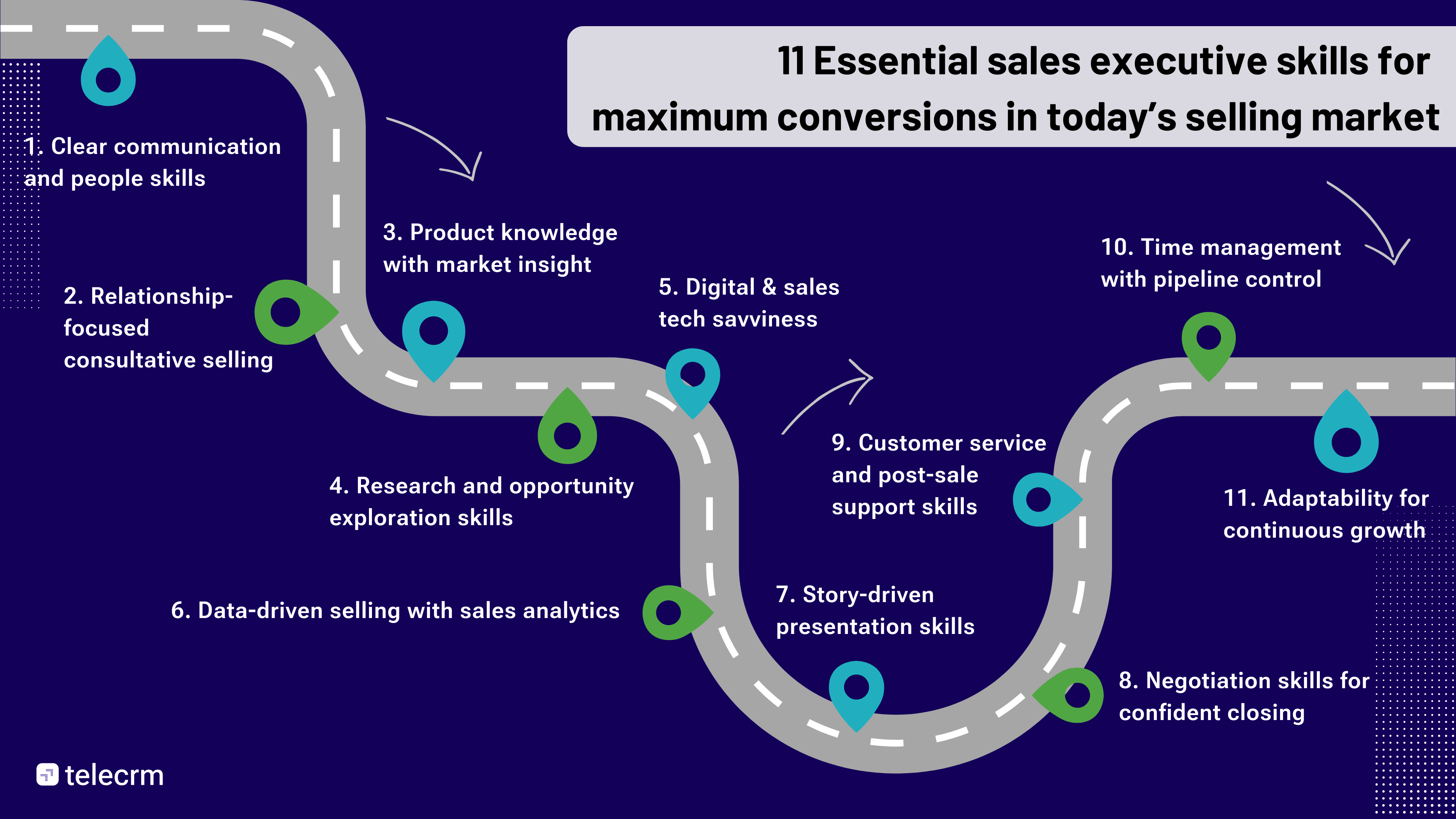
Sales executives guide conversations in a way that helps both customers and business partners understand the value of what is being discussed. They explain products, proposals and requirements in simple terms, making it easier for people to compare options and make decisions without confusion. Moreover, by paying attention to how someone responds, they recognise what information matters most and adjust their explanation so the conversation stays practical and relevant.
These soft sales skills also help keep discussions organised. Sales executives are able to bring structure to meetings, summarise key points and highlight the next steps clearly. This prevents discussions from becoming scattered and keeps both customers and partners aligned on what needs to happen, whether it is evaluating a product, reviewing a demo or finalising a deal.
While strong communication skills indicate how to communicate effectively, consultative selling starts with understanding what matters most to the client. Sales executives spend time learning the business’s goals, challenges and decision pressures so they can see the situation from the client’s point of view. Once they understand this context, they can suggest solutions that feel genuinely helpful rather than transactional.
This approach naturally builds a strong relationship. Because when clients see that the executive’s recommendations align with their long-term interests, trust grows. The executive further reinforces this trust through consistent check-ins, thoughtful insights and steady support. As a result, the relationship turns into a reliable partnership that continues to create new opportunities for both sides.
Sales executives are experts in their products and understand how they fit into the market trends. They can explain features, benefits, alternatives and competitor comparisons clearly and confidently. This knowledge allows them to show clients and business partners how a product solves real problems or creates additional value.
In B2B situations, executives often discuss profitability, integration with existing systems or how a product can open new opportunities. They combine product expertise with market insight to successfully:
Successful sales executives look beyond surface-level information. They study the client’s environment, understand what influences buying decisions and analyse how different factors—such as budgets, timelines, internal priorities or competitive pressures—shape the conversation. This research gives them a clearer picture of what the client is really trying to solve, not just what they initially ask about.
This depth of understanding also helps the executive spot opportunities others might miss. Their research often focuses on:
With this information, sales executives make their recommendations far more credible and compelling.
Sales executives skilled in technology don’t just track what happens during a one-on-one conversation. They monitor client activity in the background using engagement trackers and proposal platforms to see which emails are opened, which links are clicked and how often documents are reviewed. These insights give them a sense of the client’s intent and readiness before the next interaction, allowing them to re-engage at the right moment with precision.
To act on these insights, they often see:
By observing these behind-the-scenes behaviours, executives can time their follow-ups strategically and tailor their messaging to match the client’s current mindset.
While digital tools show what clients are doing in the moment, data-driven selling helps executives see the bigger picture over time. By analysing patterns across multiple interactions, deal stages and client behaviours, they can identify which sales strategies consistently move deals forward and which areas need adjustment. This approach ensures that every action is backed by insight rather than guesswork.
telecrm takes this a step further by providing in-depth sales analytics. Executives can track trends in engagement, monitor deal progression and compare outcomes across accounts to pinpoint high-potential customers.

Using these valuable insights, sales executives prioritise their efforts, anticipate challenges and turn raw data into actionable steps.
Even when a sales executive has all the sales data and insights, that alone is rarely enough to move a decision forward. The next step is shaping those inputs into a clear story that explains the problem, the impact of inaction and the value of change. By arranging information in a logical sequence, the executive helps stakeholders see how each detail connects to the larger business outcome. This approach makes complex offerings easier to understand and positions the solution as a natural next step.
As the story develops, it follows how people naturally absorb information. Decision-makers find narratives easier to process than disconnected facts because a story reduces effort, builds familiarity and lowers perceived risk. When the message flows as cause and effect, it feels credible and memorable. This is why storytelling skills often influence decisions more strongly than direct explanations.
Negotiation plays a direct role in deal closure and skilled sales executives stay actively in control at this stage. They manage conversations around price, scope and timelines with intent, knowing exactly where flexibility is possible and where value must be protected. Each move is aimed at progressing the deal rather than reopening resolved discussions.
Sales executives further sense when a deal is nearing conversion and step in to resolve friction before it slows things down. They reframe objections, clarify trade-offs and anchor discussions to business outcomes so the client wants to commit rather than postpone.
So in short, executives typically focus on:
Know More Here: How to Close a Sale: 30 Proven Sales Closing Techniques to Win More Deals
Once a deal is closed, the sales executive job does not end. At this stage, customer service and post-sale support become critical to protecting the value of the sale and strengthening client relationships.
Sales executives stay involved to ensure expectations set during the sales process are met in reality, helping the client transition smoothly from agreement to delivery. This continuity reassures customers that the commitment made during negotiation carries through after conversion.
Strong customer relationship management after the sale directly secure repeat business. By staying aware of service progress and checking in at the right moments, sales executives prevent small issues from turning into dissatisfaction. This ongoing support further keeps the relationship active and encourages customers to return for future purchases, renewals or expansions that sustain long-term revenue.
Time management skills become truly effective when sales executives connect their daily actions to pipeline movement. Sales executives understand that every call, follow-up and meeting should push a deal closer to the next stage. Instead of reacting to tasks as they come, they plan their time around deal priority, buyer readiness and revenue potential. This clarity helps them avoid last-minute rushes and keep sales productivity consistent.
telecrm makes this possible by giving sales executives a live, working view of the pipeline. It does not just show where deals stand but also why they are moving or slowing down. Sales executives typically rely on telecrm to:
Adaptability in a sales executive job is the ability to adjust quickly when internal tools or processes change. When a new CRM system or an updated sales workflow is introduced, adaptable sales executives learn it early and use it quickly in their daily work. This prevents disruption and allows them to stay focused on selling rather than struggling with change.
Over time, this adaptability skill leads to better performance. By working smoothly with new systems, sales executives gain insights into their own sales techniques and improve execution at every stage. This consistency helps them stay productive, refine their approach and exceed sales targets even as the business continues to evolve.
Becoming a top sales executive requires more than natural talent. It demands intentional growth.

The following are the practical ways to develop the abilities that make a sales executive effective in driving deals and building lasting client relationships:
Focused research strengthens how sales executives think and respond during conversations. When you understand a customer’s past interactions, current setup and decision flow, you rely less on improvisation and more on informed judgement. This sharpens your questioning skills and helps you respond with relevance instead of reacting on the spot.
Over time, this habit improves core sales skills such as preparation, active listening and control of the conversation. You learn to address client concerns, guide discussions with purpose and move deals forward without back-and-forth, making each interaction more effective than the last.
A clear action plan helps sales executives take ownership, not just execute. When you map out next steps in advance, you stop waiting for the client to lead.
For example, after a discovery call, you might schedule a demo, share relevant case studies and set a follow-up discussion. This makes you the driver of the deal, giving each interaction a clear purpose.
Following an action plan sharpens planning skills. You learn which actions matter most and reduce reactive selling. As a result, clients stay engaged, decisions happen faster and deals progress without unnecessary delays.
Sales skills develop faster when you take ownership beyond assigned tasks. Working closely with business partners, internal teams or senior stakeholders exposes you to real decision-making and complex situations. As responsibility increases, so does your ability to handle pressure, manage expectations and contribute meaningfully to outcomes.
Data and CRM tools directly sharpen how sales professionals work, think and prioritise. When every interaction, follow-up and deal movement is visible, executives learn what actions actually move deals forward.
Check Out: 11 CRM Tools for Sales Teams in 2025: Features and Pricing
By regularly reviewing CRM insights, sales executives improve key skills such as prioritisation, timing and decision-making. They become quicker at spotting stalled deals, more precise with follow-ups and more intentional with their daily effort. This habit eventually improves overall sales performance, not just outcomes.
Improvement does not come from repetition alone but from reflection too. Seeking feedback highlights what is working and what needs adjustment, while varied selling experiences expose you to different buying behaviours and challenges. Over time, this continuous learning sharpens judgment and builds the ability needed to perform consistently in changing sales situations.
High-performing sales skills are best understood through outcomes. KPIs help translate day-to-day selling behaviour into measurable impact, showing what actually closes deals and drives revenue.
For executives, these sales metrics clarify where their skills are creating results and where improvement is needed. And for sales managers, they provide a practical way to assess performance fairly, identify strengths early and support focused development across the team.
The following are the KPIs that highlight the specific areas where right sales skills consistently make the biggest difference:
Fast responses signal an executive’s ability to act decisively and manage priorities under pressure. Prompt engagement keeps prospects interested and demonstrates attentiveness, turning initial enquiries into actionable conversations. Executives who master this show discipline and a proactive mindset, which are crucial for high-performing sales.
High performers maintain a rhythm in following up, making sure no lead goes cold. Each follow-up is planned to progress the deal, address questions or clarify next steps. Consistency here reflects control over the pipeline and reinforces the executive’s reliability in managing client relationships.
Key indicators to monitor high-performing follow-up skills:
High conversion rates indicate an executive’s:
This means that the executive can recognise potential clients, engage them meaningfully and generate real impact without wasting energy on low-probability contacts.
Closing deals consistently and at higher value reflects strategic thinking and negotiation strength. Executives who maintain this KPI understand client needs, frame solutions persuasively and guide conversations toward mutually beneficial outcomes. Strong performance here directly links to revenue growth and business influence.
Efficient sales cycles indicate skill in moving opportunities forward without unnecessary delays. Executives who control cycle speed anticipate objections, plan next steps and keep discussions focused. Faster cycles show that the executive can balance urgency with accuracy, increasing overall productivity.
High retention reveals an executive’s ability to deliver sustained value beyond the initial sale. By understanding client priorities, addressing emerging needs and supporting long-term sales goals, they encourage repeat business. So retention rates actually highlight relationship and sales management skills that underpin consistent revenue streams.
Also Read: 9 Sales Management Strategies to Optimise Your Sales Process
Predicting outcomes accurately reflects a deep understanding of the sales pipeline and client behaviour. Executives who excel here allocate sales effort wisely, anticipate obstacles and plan with assurance. Reliable forecasting shows both analytical capability and practical insight into how deals progress in real-world conditions.
Related Read: Build & optimise sales pipeline for business growth
The sales industry has evolved, and so has the role of sales executives. Today, sales success is measured not just by effort but by the ability to close deals and generate revenue. This blog highlighted the key modern skills that help executives navigate complex buying cycles and drive higher conversions.
Also, these skills work best when backed by data and analytics. Knowing what is happening across leads, follow-ups and deal stages helps sales executives apply the right skill at the right time.
This is where systems like telecrm support real impact. By bringing sales calls, customer interactions on messages, deal progress and analytics into one view, telecrm enables sales executives to use their strong skills based on predictable outcomes instead of relying on memory or guesswork.
Understanding how these tools strengthen real-world skills can make a tangible difference. Book a free demo today with telecrm to discover how it helps sales executives convert skills into business impact.



© Copyright 2026 telecrm.in - All Rights Reserved • Privacy Policy • T&C



© Copyright 2025 Telecrm.in - All Rights Reserved • Privacy Policy • T&C