

In any business, sales performance needs clear sales targets to deliver consistent results. Without clear expectations, even skilled teams struggle to prioritise efforts.
However, many business leaders fail to set effective sales targets because they rely on past performance without considering market changes, team capacity or customer behaviour. Also, in other cases, their targets lack structure or ownership, leaving teams unclear about priorities and success measures. These gaps, in turn, weaken the entire team’s accountability and limit the organisation’s growth.
To address these challenges, let’s explore with this blog how targets can be structured, measured and achieved in a practical way to support long-term business growth. But first, we’ll understand what sales targets actually represent, their purpose and role within the sales function.
Sales targets represent a commercial commitment, not just a number to be chased.
Firstly, they define the exact business objective the sales function is responsible for delivering within a set period, such as revenue booked, value of pipeline converted or customers secured. From a deeper business perspective, a sales target forces leadership to be explicit about what growth looks like in financial terms and what level of contribution is expected from the sales and marketing efforts to support that growth.
And secondly, sales targets also act as a control mechanism for decision-making inside the sales function. They shape how deals are prioritised, which accounts receive focus and how time and effort are distributed across opportunities.
In practice, this clarity and control only work when the right type of sales targets are used for the right purpose, which makes it essential to understand the different types of sales targets and how each one shapes sales performance in a distinct way.
Sales targets take different forms based on how a business drives revenue and manages sales execution.

Here are the key types of sales targets, each addressing a specific commercial need:
Revenue-based targets set the total sales value the business aims to achieve within a defined period. They give the sales team a clear financial outcome to work towards and connect sales performance with business planning. Because these targets influence forecasting, budgets and investment decisions, they are based on realistic deal values.
While revenue targets focus on value, volume-based targets focus on scale. They track the number of deals, customers or units sold and are useful when market reach is a priority. By spreading results across many transactions, volume targets reduce reliance on a few large deals and support steady sales performance.
Pipeline targets define how many active opportunities need to be in progress to support future revenue. They shift attention earlier in the sales cycle, where risks can be managed more effectively. This helps teams spot gaps in opportunity creation before they lead to missed sales results.
But before setting pipeline targets, you must know: What are pipeline stages and how to build them effectively
Weighted sales targets improve pipeline accuracy by adjusting deal values based on how likely they are to close. Instead of treating every opportunity the same, they reflect deal maturity and confidence. This leads to more reliable forecasts and better decisions around hiring, marketing process and growth timing.
Waterfall targets break a revenue goal into the steps required to achieve it, such as pipeline creation, conversion rates and deal size. This makes it easier to see how sales results are built. When performance falls short, teams can identify the exact stage that needs improvement instead of guessing.
Activity-based targets focus on sales actions such as outreach, meetings or demos. They ensure consistent effort towards customer acquisition regardless of market conditions and keep the sales process moving. Over time, these targets help build strong sales habits and improve execution quality.
Account-based targets enable your sales force focus on specific customers that offer the greatest long-term value. They help teams prioritise customer accounts with expansion and retention potential rather than spreading effort too thin. This leads to more focused selling and stronger customer relationships.
Sales targets are rarely introduced without a trigger. Let’s understand what usually prompts businesses to put them in place.
When sales targets are not defined, organisations struggle to form a reliable view of how much revenue is expected. Finance teams are forced to plan budgets, cash flow and investments using estimates rather than committed figures. This makes it difficult to align spending decisions with actual income.
Over time, this uncertainty limits confident decision-making. So hiring plans are delayed, investments are postponed or rushed and growth initiatives lose momentum.
Whereas clear sales targets reduce this risk by setting revenue expectations early, allowing financial planning to move from assumption-driven to controlled and predictable.
Without sales targets, sales teams often treat all opportunities as equally important. This leads to time being spent on deals that are easy to pursue but contribute little to meaningful growth.
Here, setting sales targets introduces focus by defining which outcomes matter most. They help teams decide where to invest effort, which opportunities to deprioritise and how to structure daily work around high-value outcomes. This shift improves efficiency without increasing workload or pressure.
When sales targets are missing, performance reviews often depend on visible effort rather than actual outcomes. Managers may judge results based on activity levels, confidence or short-term wins, which makes it difficult to compare performance fairly across individuals or teams.
Sales targets introduce a common reference that helps leaders clearly see:
This shared view improves transparency and supports more objective decisions.
As business priorities evolve, sales execution does not always evolve with them. Even when leadership communicates a strategic approach, sales teams often continue selling the same way because their success is still measured using old or unclear criteria.
For example: If a company wants to increase long-term customer value but continues to reward quick deal closures, sales behaviour will not change.
Here again sales performance targets linked to deal value, account growth or retention become significant. This attention towards the right outcomes ensures that everyday sales activity supports what the business actually wants to achieve.
Without clear targets, sales professionals often lack a clear sense of what they are personally responsible for delivering. Pipelines become reactive, progress tracking becomes inconsistent and accountability varies across the team.
Clear sales targets strengthen ownership by enabling:
This clarity also reduces dependence on constant managerial intervention.
In the absence of sales targets, organisations lack a consistent benchmark for reviewing performance. Results are assessed in isolation, making it hard to understand whether outcomes were driven by strong execution or favourable conditions. This limits the ability to learn from past cycles.
Sales targets provide a stable reference point for review. By comparing expected and actual results, experienced reps can identify patterns, adjust assumptions and improve future planning. Over time, this creates a disciplined feedback loop that supports steady improvement through structural continual improvement processes rather than repeated trial and error.
Follow these steps to set sales targets that make sense on paper and hold up in real business conditions:
Begin by defining what success looks like for the organisation.
Are you aiming to grow market share, improve profitability, expand into new segments or increase customer retention?
Think of this as choosing a destination on a map before planning a route — without knowing where you want to go, any target is guesswork.
Look closely at past sales analytics data to understand what the business has achieved under real conditions.
Start by reviewing metrics like the previous year’s revenue, conversion rates, sales cycle length and average deal size. Then assess whether current capacity can support higher or different targets. This means evaluating available sales headcount, ramp-up timelines and workload, while also accounting for external factors such as market competition or economic shifts.
This grounded analysis helps avoid setting sales targets that are either too ambitious or too modest.
Once you have a top-level number, break it into meaningful milestones. For example, quarterly, monthly or by region/product. This makes large targets more manageable and enables ongoing monitoring and course correction.
You must use both leading and lagging indicators:
This means each target should be:
For example, instead of “increase sales”, using “grow enterprise deal revenue by 15% in Q3.” SMART targets ensure expectations are concrete and performance is trackable.
Involve sales reps and frontline teams in reviewing proposed targets. Their insights on market conditions, customer sentiment and execution realities help refine targets so they are both ambitious and believable. This collaboration improves execution once targets are published.
Pro tip: Treat this like a final quality check — if the team feels a target is unreachable, morale and performance will suffer before you even start.
Every target should be paired with key assumptions (e.g., expected conversion rates, staffing levels, seasonal impacts). Documenting assumptions makes it easier to:
Schedule regular reviews (monthly or quarterly) to revisit targets in light of current performance and market shifts. Realistic sales targets aren’t static; they evolve with insight and feedback.
As we discussed, sales targets describe what the business wants to achieve from sales within a given time. While they set a clear end goal, such as a revenue number or customer count, they do not explain how progress towards that goal should be tracked day to day.
This is where sales KPIs become essential. KPIs or key performance indicators, are the measurable sales signals that show how effectively the sales process is operating on a daily basis. They track inputs and conversion points such as pipeline value, win rates, deal velocity and activity levels. So sales managers can easily navigate whether the ongoing sales effort is sufficient and correctly aligned to meet the target.
Together, good sales targets and KPIs create a structured performance system in the following way:
Even well-intended sales targets can fail if they are not designed or managed carefully. Below are some of the most common challenges businesses face at a core level, along with practical ways to address them without adding unnecessary complexity:
A frequent challenge is that targets are built using last year’s numbers, while the market has already changed. Customer buying behaviour shifts, deal cycles lengthen or shorten, competition intensifies and pricing pressure increases. When targets ignore these realities, sales teams feel disconnected from expectations.
How to solve it:
Targets should be reviewed against present-day signals, not just historical data. This means factoring in current pipeline quality, recent win rates and visible changes in customer demand. So a short validation cycle before finalising targets helps ensure they reflect what the market can realistically support today.
Applying the same targets to all teams leads to uneven performance outcomes. Sales teams working in mature markets, high-intent segments or established accounts naturally perform differently from those building new territories or serving price-sensitive customers.
So when targets ignore these differences, individual rep performance comparisons become misleading.
How to solve it:
Adjust targets based on operating context such as market maturity, account potential or role responsibility. This keeps targets challenging while remaining fair and comparable, improving morale and accuracy in performance evaluation.
Frequent changes to sales targets, even with good intentions, can reduce trust. When targets are repeatedly revised, teams struggle to plan pipelines confidently and may wait for adjustments instead of executing consistently.
How to solve it:
Set targets with clear assumptions and commit to them for a defined period. Instead of changing targets mid-cycle, use KPIs to manage performance and address gaps. This stability builds confidence and encourages disciplined execution.
In many cases, targets and KPIs are tracked but not actively used to guide decisions. This means sales reports are generated but patterns are not analysed deeply enough to influence sales strategies or behaviour.
How to solve it:
Shift the focus from reporting to interpretation. Regularly review target performance alongside key KPIs to identify root causes, not just symptoms. This ensures targets drive learning, continuous improvement in process and smarter planning over time.
When responsibility for achieving targets is diffused across teams or roles, accountability weakens. Targets may exist but no one feels directly responsible for closing gaps or driving corrective action.
How to solve it:
Assign clear ownership at every level. Individual contributors, managers and sales leaders should each understand what part of the target they influence and how business success is measured.
Most companies track sales activity, pipeline updates and follow-ups across multiple tools or spreadsheets. Calls may sit in one system, WhatsApp conversations in another and deal updates in yet another place.
As a result, managers lack a single, reliable view of progress against targets and sales reps spend more time updating tools than selling.
How to solve it:
Centralise sales tracking through a CRM that captures activity, builds & optimises pipeline movement and displays outcomes in one place. telecrm, for instance, brings calling, messaging and tracking sales targets together. It helps ensure that target progress is visible in real time. With such consolidated data, managers can monitor performance accurately, identify risks early and guide teams based on actual selling behaviour rather than incomplete reports.
Also check out: 11 CRM Tools for Sales Teams in 2026
To hit sales targets at scale, you don’t need to push harder. You need to sell smarter. The strategies below show how to accelerate sales momentum that compounds results:
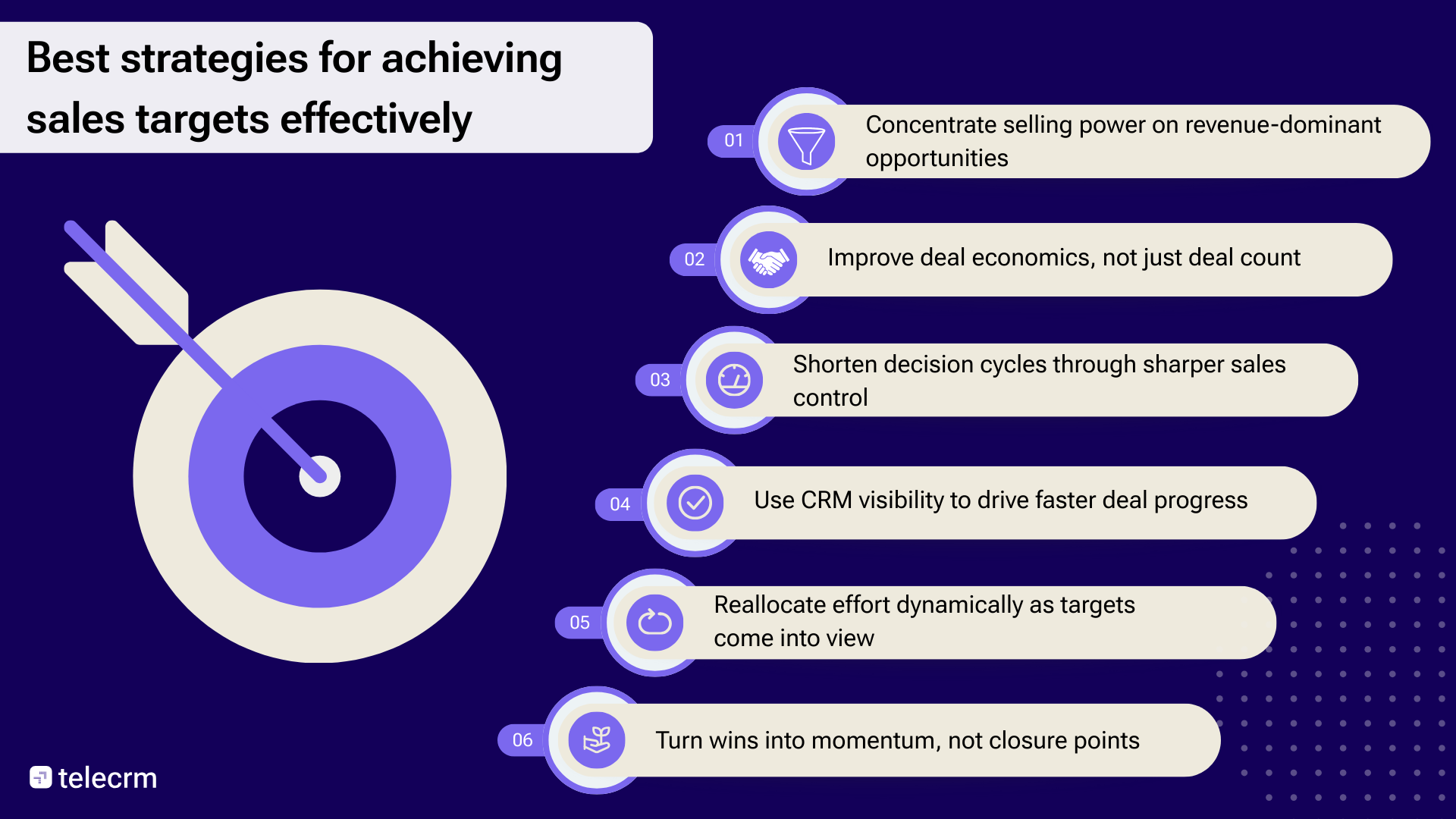
Sales goals are exceeded when selling effort is concentrated on the few opportunities that materially influence revenue outcomes. Thus, high-performing sales teams’ skills deliberately involve focus on opportunities that can shift the revenue number in a meaningful way.
Key execution actions:
This focused execution increases average deal value without increasing team size.
Improving the value of each closed deal rather than increasing the number of deals closed is what helps surpass sales target every time. This matters even more when team members manage both inbound and outbound sales where deal readiness and urgency vary.
Strong sales execution focuses on pricing discipline and justified scope expansion. When sellers anchor discussions around business value, revenue per deal improves without eroding margins.
Revenue-focused execution includes:
Long decision cycles delay revenue and increase the risk of deals slipping beyond the target period. Teams that exceed targets actively manage deal momentum instead of waiting for buyer action.
Implement follow-through to keep opportunities moving and reduce uncertainty at each stage:
This faster progression allows more deals to close within the same target window.
A CRM helps you reach sales team’s targets faster when it shows, in real time, which deals are moving forward and which are stuck. Its real value lies in giving sales teams early visibility into risk, so action can be taken before opportunities slip.
With CRM system, the sales team can:
telecrm adds a practical edge to this process by using sales automation that highlights deal risk and priority automatically. Instead of manually tracking every opportunity, your team gets a clear, real-time view of what needs attention right now.
Ready to see it in action? Book a free demo and see how you can start driving faster deal progress today.
Teams that outperform targets continuously adjust execution as the target period progresses. Effort is reassigned based on closing likelihood, not initial pipeline assumptions.
This ensures attention remains on opportunities that can realistically convert within the timeframe.
Sales reps’ effort must:
Teams continue to easily beat targets when closed deals create momentum instead of ending the sales engagement. Each win should support future growth and stretch the next revenue outcome into a stretch goal, not a reset point.
Thus high-performing teams treat closure as the start of the next revenue motion.
This includes:
This helps in sustaining growth beyond target achievement.
Throughout this blog, we have seen that sales targets are a structured way to convert business strategy into measurable outcomes. You learned how targets work, the different types and how to create realistic targets based on capacity, market realities and measurable KPIs.
The real value of sales targets shows up when they guide daily sales execution. That is why setting realistic targets is only the first step. What makes targets effective is using them to:
When targets are supported by clear KPIs, accurate pipeline tracking and consistent monitoring, they stop being a “monthly number” and become a daily performance system. This is what helps businesses not just meet targets but build predictable growth over time.



© Copyright 2026 telecrm.in - All Rights Reserved • Privacy Policy • T&C



© Copyright 2025 Telecrm.in - All Rights Reserved • Privacy Policy • T&C