
Every dealership wants quicker test drives, faster follow-ups and more closed deals.
So many try WhatsApp broadcasts, hoping it will solve everything. One click, hundreds of customers reached—sounds simple, right?
But in reality, if you’re blasting messages without the right system, it quickly gets scattered. Leads get missed, teams still do manual work and customers stop replying because the experience doesn’t feel personal.
Why? Because WhatsApp alone isn’t the solution. The real impact comes when you use a WhatsApp broadcast for dealerships through the right CRM — where calling, WhatsApp and lead management all work together.
WhatsApp broadcasts help dealerships send offers, test-drive reminders, launch updates, service reminders, and follow-up messages to many customers at once while keeping each conversation private. When used with an automotive CRM, broadcasts become more effective because leads, replies, follow-ups, customer preferences, and campaign performance stay connected in one place.
In this blog post, we’ll show you how using WhatsApp broadcasts inside an automobile CRM fixes slow follow-ups, keeps customers engaged and turns more leads into sales without overwhelming your team.
Reaching car buyers today means connecting with them on the platforms they use most. For dealerships, WhatsApp has become one of the simplest and most effective ways to stay in touch.
A WhatsApp broadcast is a feature that lets you send one message to many contacts at once without creating a WhatsApp group. Each person receives it as a private one-to-one chat, as if the message was written only for them.
Imagine sharing early access to offers, product launch announcements or even a quick back-in-stock alert — all without losing that personal touch.
For dealerships, this can include new car launch alerts, test-drive reminders, exchange offers, insurance renewal reminders, service due messages, festive offers, and follow-ups for interested buyers.
For dealerships, this makes communication both wide-reaching and private. Instead of calling every lead or managing multiple chats, you can share updates with hundreds of customers instantly, while still keeping the interaction private.
It’s simple, quick and helps you avoid the awkwardness of group chats where everyone sees each other’s replies. With broadcasts, your team stays efficient and your customers feel valued.
Let’s further look at why it’s such a powerful tool for car dealerships.
Using the WhatsApp Business app or the official WhatsApp API to send broadcast messages gives you a structured way to engage buyers through bulk messages, without losing the personal touch.
WhatsApp broadcast messages are especially impactful when used alongside seasonal car sales campaigns, helping you reach the right buyers at the right time with timely offers.
Key reasons WhatsApp broadcasts work for dealerships:
Car buyers often compare options quickly. If your follow-up is late, they move to another dealer. With the WhatsApp broadcast list, you can share offers, discounts or event invites instantly with hundreds of leads at once. No more missed opportunities just because your team couldn’t call in time.
One of the biggest challenges for sales reps is giving every customer a personal experience. Broadcasts solve this by delivering the same message as a private chat. You can send welcome messages or a free gift coupon to new enquiries, creating a stronger bond from day one.
Customers feel you’re talking to them directly, not spamming a group, which builds trust, strengthens brand recognition and improves response rates.
Sellers know the pain of emails left unread and SMS messages ignored. WhatsApp messages often feel more immediate and conversational than email or SMS. That makes broadcasts useful for updates like new model launches, test-drive reminders, finance offers, and service alerts, especially when the message is relevant to the buyer.
Following up is crucial but often time-consuming. Broadcasts make it easy to remind customers about scheduled test drives, financing options or appointment reminders for service visits. Instead of calling one by one, your team can focus on the conversations that actually move deals forward.
Selling a car isn’t just about information—it’s about showing value. WhatsApp broadcasts let you share high-quality images, brochures, walkaround videos or even directions to your showroom with a call to action. This makes it easier for customers to picture themselves owning the car and speeds up decision-making.
A common issue in dealerships is that different sales reps say different things to the same customer. Broadcasts let you ensure messages are standardised and clear. This consistency improves professionalism and avoids confusion for buyers.
Dealers often struggle with the rising costs of calls, SMS packs or ad campaigns. WhatsApp broadcasts let dealerships scale outreach to many leads without calling each person manually. When connected to a CRM, teams can also track important metrics like delivery, replies, clicks, test-drive bookings, and conversions.
Often, buyers lose interest when the process feels complicated or time-consuming. Broadcasts can include quick reply buttons, direct call links or forms so leads don’t have to search or wait. With one tap, they can confirm a test drive, request financing details, ask for more information or even give valuable feedback, which speeds up conversions.
WhatsApp broadcasts are a great way to reach buyers quickly, but dealerships often struggle to manage them effectively at scale. Without the right system in place, the process becomes messy, time-consuming and far less effective than it should be.
Here’s what happens without the right system in place:
Leads often get scattered across devices and accounts.
Managers have little insight into team activity.
Manual handling delays replies to prospects.
Without tracking, you don’t know what’s working.
Related read: How to use customer feedback to improve car sales
Untargeted broadcasts fail to connect with buyers.
When dealerships rely only on sending WhatsApp broadcast messages, these gaps pile up, hurting both customer experience and sales. This is where an automotive CRM with WhatsApp integration makes all the difference.
Let’s next explore how an automotive CRM really helps turn broadcasts into real conversions.
As discussed, the real challenge isn’t about whether WhatsApp broadcasts work; it’s about how you manage them.
Automotive CRM is a customer relationship management platform that brings all your WhatsApp conversations and broadcasts into one organised system.
The role of CRM in managing customer data goes beyond just simple storage and organisation. An automotive CRM helps you monitor your team’s activity and track every stage of the sales cycle. Managers get clear visibility into performance, while sales reps have the tools to respond quickly and build stronger buyer relationships.
And because it’s designed specifically for dealerships, the CRM helps you send broadcasts that actually matter. Instead of blasting generic updates, you can target buyers with messages relevant to their car preference, stage in the journey or recent interaction.
At its core, automotive CRM transforms WhatsApp from a simple messaging app into a structured sales tool.
It also helps dealerships assign lead owners, track buyer stage, record previous conversations, schedule follow-ups, and connect every WhatsApp reply to the right customer profile.
Sending messages without structure, data or control only creates more noise.
What you really need is a system built to handle the volume, complexity and personalisation that auto sales demand.
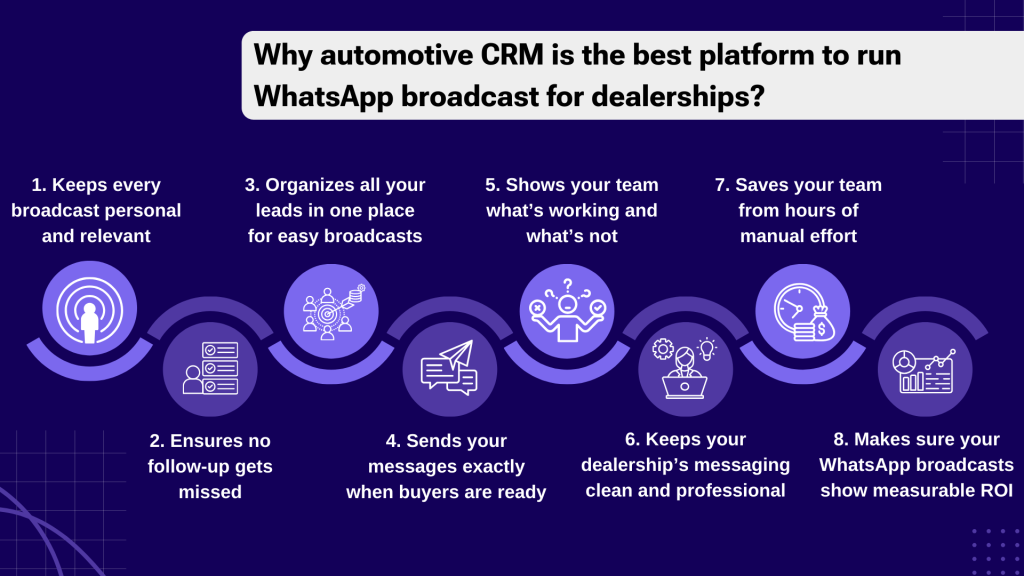
Let’s see why automotive CRM is the best solution for your dealership:
Car buyers don’t want to feel like they’re just another name on a bulk list. A CRM makes your WhatsApp campaigns feel tailored, driving stronger trust and action.
Most sales are lost because a buyer wasn’t contacted at the right time. CRM automation makes sure every WhatsApp reminder and nudge goes out when it matters most.
Leads pour in from calls, walk-ins and web forms and without a system, they get scattered. A CRM brings everything into one place, so your WhatsApp campaigns stay precise.
The right message sent too late is a missed sale. A CRM times every WhatsApp broadcast perfectly so buyers get nudges when they’re most likely to act.
Without clear insights, sales teams chase leads blindly. A CRM shows exactly what’s working on WhatsApp so your team can focus on proven strategies.
One careless or irrelevant broadcast can break trust. CRM ensures every WhatsApp campaign looks polished, on-brand and free of confusion.
Dealership teams already handle calls, walk-ins and test drives. A CRM automates WhatsApp broadcasts so your staff spends time selling, not typing.
Broadcasting is easy, but proving results is what matters. A CRM links your WhatsApp campaigns directly to revenue, test drives and bookings.
Your CRM is the engine that makes WhatsApp business API and broadcast messages work at scale.
When used with the right practices, it helps you segment leads, time your messages perfectly and personalise conversations so that every broadcast feels like it was meant for the person receiving it. That’s how you turn a simple message into a meaningful interaction that drives customer satisfaction.
When you align your messaging strategy with smart CRM practices, you can avoid sending too many messages and instead focus on communications that encourage customers to take action. Each step becomes smoother, less manual and far more impactful.
Let’s walk through the exact steps to use CRM for maximising results:
Before you send broadcast messages, make sure your database is neat and reliable. Start by merging multiple contacts of the same person and removing junk numbers that will only waste effort. Then, structure your leads based on where they are in the journey — new enquiry, test drive booked or follow-up pending.
If you’re still managing leads manually, it’s a good time to migrate from Excel to CRM. This shift helps you centralise data, avoid duplication and keep every lead updated in real time.
Take it a step further by tagging buyers with relevant criteria like SUV, sedan or used cars. This ensures that when you’re ready to send messages, your contacts page is clean, organised and built for precision instead of guesswork.
Not every target audience wants to hear the same pitch. Break your list into smaller, meaningful groups so your message speaks directly to what each lead cares about. This could mean separating hot leads from cold ones or grouping them by budget, location or car model interest.
You can even plan promotional messages for upgrades or reactivation messages for past buyers. This approach helps you avoid spam and makes every message feel like a personalised message.
Even the best message can flop if it’s sent at the wrong moment. Plan your broadcasts to align with customer behaviour. For example:
Spacing your campaigns ensures compliance with WhatsApp’s policies while keeping engagement high.
Also make sure customers have opted in to receive WhatsApp messages from your dealership, and give them a clear way to stop receiving updates if they no longer want them.
A WhatsApp broadcast alone will not close the deal; timely follow-ups do. Build a follow-up sequence for every campaign. For example, if someone clicks a broadcast link but does not book a test drive, schedule a reminder or assign a sales rep to call them. Cold leads can be nurtured with slower touchpoints such as service updates, launch news, or helpful buying guides.
By automating these follow-ups, you stay consistent without relying on your team’s memory or messy manual tracking.
Never run a broadcast blindly. After each campaign, sit down with your CRM reports to gather feedback, review WhatsApp surveys and study the numbers. Look at open rates, response rates and test-drive bookings to see what’s actually moving the needle.
Compare campaigns against each other — was it the timing, the offer or the message that worked? This data tells you which online communication styles perform better — whether it’s cross-sell messages, upsells or reminders.
Ultimately, the success of your WhatsApp broadcasts depends on the CRM you use.
The best CRM to run WhatsApp broadcast for dealerships must:
A system built this way ensures that every message contributes to boosting sales instead of being just another notification. It helps you streamline customer inquiries, follow-ups and conversions while staying professional.
With the right platform, your broadcasts stop being random messages and start becoming strategic touchpoints that move leads closer to a purchase.\
telecrm is designed specifically for automotive dealerships, combining WhatsApp automation with powerful sales tools. It links messages directly to your sales pipeline so that no potential buyer slips past your team. From first enquiry to final deal, everything stays connected in one place.
The best part of telecrm is how simple it makes reporting and tracking. You don’t waste time on complicated reports. Instead of guessing, you see exactly which campaigns drive test drives and which conversations turn into bookings.
That’s how you get real, measurable ROI from every broadcast.
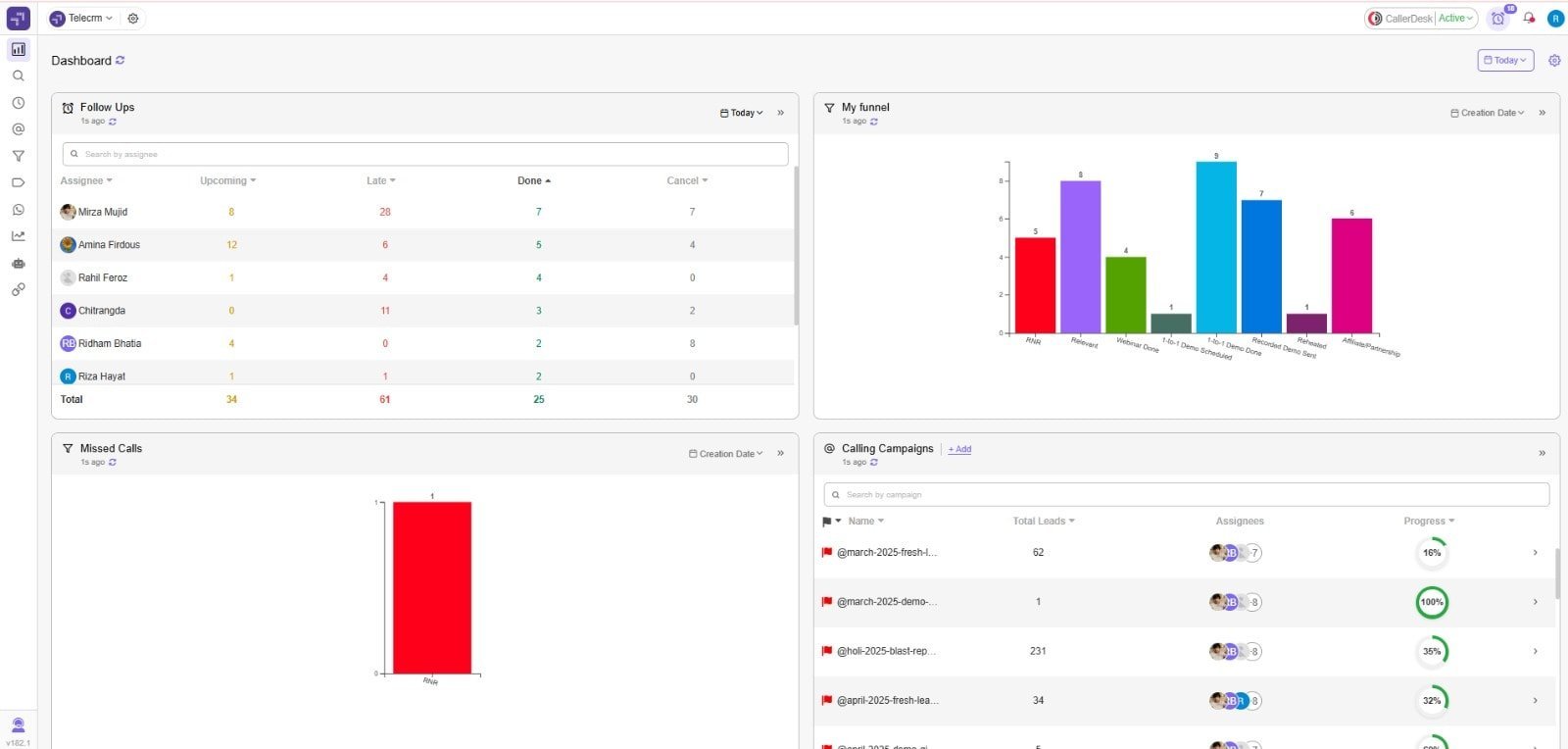
Check out the key features of telecrm that help you win more sales:
Try telecrm yourself: Book a free demo now and see how quickly your broadcasts can turn into real sales.
Sending out WhatsApp broadcasts is easy, but turning those replies into real sales is where most dealerships struggle. It feels like you’re working twice as hard but still losing good buyers to confusion and delays.
That’s why having the right CRM makes such a big difference. When you use it with the right practices, it removes the chaos of manual tracking, keeps conversations in one place and ensures no enquiry is missed.
telecrm helps dealerships combine WhatsApp automation, lead management, calling, follow-ups, campaign tracking, and sales visibility in one place. Instead of sending random broadcasts, teams can segment buyers, personalise messages, track replies, and turn more WhatsApp conversations into test drives and bookings.
Wish to see the difference it can make? Book your free demo today and find out how it can help you sell faster and with less stress.
A WhatsApp broadcast for dealerships lets sales teams send one message to many opted-in buyers while each customer receives it as a private one-to-one chat. It can be used for offers, test-drive reminders, new model launches, service alerts, finance updates, and follow-ups.
WhatsApp broadcasts help dealerships reach buyers faster, share visual car details, remind customers about test drives, follow up on offers, and move interested leads closer to booking or purchase
A CRM helps dealerships segment buyers, track replies, assign follow-ups, store WhatsApp conversations, avoid duplicate outreach, and measure which campaigns generate test drives, bookings, or sales.
Dealerships can send new car launch updates, festive offers, exchange offers, finance plans, test-drive reminders, service reminders, insurance renewal alerts, brochure links, walkaround videos, and showroom visit invites.
Dealerships should send messages only to opted-in contacts, segment buyers by interest, keep messages relevant, avoid excessive frequency, add a clear CTA, and give customers a way to opt out.
telecrm helps dealerships run WhatsApp broadcasts with lead segmentation, automated follow-ups, calling, customer history, campaign filters, WhatsApp replies, team activity tracking, and sales reports in one CRM.


© Copyright 2026 telecrm.in (Flamon Cloudtech Pvt Ltd) - All Rights Reserved • Privacy Policy • T&C



© Copyright 2025 telecrm.in - All Rights Reserved • Privacy Policy • T&C