
Most businesses assume WhatsApp Business API pricing is simple. Send a message, pay for a message.
But once you start exploring it, you quickly realise that pricing depends on message categories, conversation windows and the BSP you choose. Suddenly, something that looked simple starts feeling complicated.
But don’t worry. Whether you have already decided to start your WhatsApp API or are finding more reasons to decide so, you are at the right destination.
This blog explains what WhatsApp Business API is, simplifies WhatsApp and BSP pricing and covers everything you need to know before getting started with WhatsApp API.
WhatsApp Business API is a messaging solution designed for medium and large-sized businesses to communicate with customers on WhatsApp at a large scale, quickly and automatically.
But unlike the standard WhatsApp Business platform, the API lacks a front-end interface. Instead, it integrates directly with CRMs, marketing platforms and other tools, allowing your business to use automated bulk messaging, campaign management and more, at scale, all while complying with WhatsApp’s message-based pricing model.
Read more about WhatsApp API here.
If you want to upgrade your marketing communication game without increasing manual effort and sales reps, WhatsApp API is the solution!
It gives you a long list of features that you can use on the world’s most used messaging platform, with over 5 billion downloads worldwide. You can do this all while maintaining speed, personalisation and compliance.
From marketing to customer support and retention, using an API, you can turn WhatsApp into a powerful revenue and engagement platform.
All of this is possible because WhatsApp Business API has:
Automate your customers’ journey with scheduled marketing messages, drip marketing, reminders and instant replies, even after working hours, through WhatsApp chatbots.
You can send bulk broadcast messages to thousands of users at once while keeping your communication style personalised and timely.
Use pre-designed WhatsApp template messages to save time and hold conversations with your customers anytime without the hassle of manually typing messages.
This feature is ideal for sending promotional messages, order updates, reminders, OTPs, discount offers and more to thousands of different users simultaneously without slowing down.
All large businesses are green tick verified on WhatsApp. It builds customer trust and improves credibility, increasing the likelihood that customers will open and respond to your messages.
And this is only possible via WhatsApp Business API.
WhatsApp API allows you to track message delivery, read rates, response times and overall campaign performance through detailed analytics. These insights can be used to refine your messaging strategies and maximise ROI from your marketing communication campaigns.
In 2026, to run the WhatsApp API, there are two key cost components you need to take into account. Think of them as the engine and the fuel for your WhatsApp communication:
1. WhatsApp Business API message charges
2. Business Solution Provider (BSP) platform charges
Let’s break down these two core cost elements, so you know exactly where your money is going.
WhatsApp Business API follows a per-message pricing model. This means that you will be charged based on the category and the number of messages you send. The cost also varies depending on your country.
There are mainly four message types: marketing, utility, authentication and service messages.
These different message categories have different costs associated with them. Let’s read about these four message categories in a little detail:
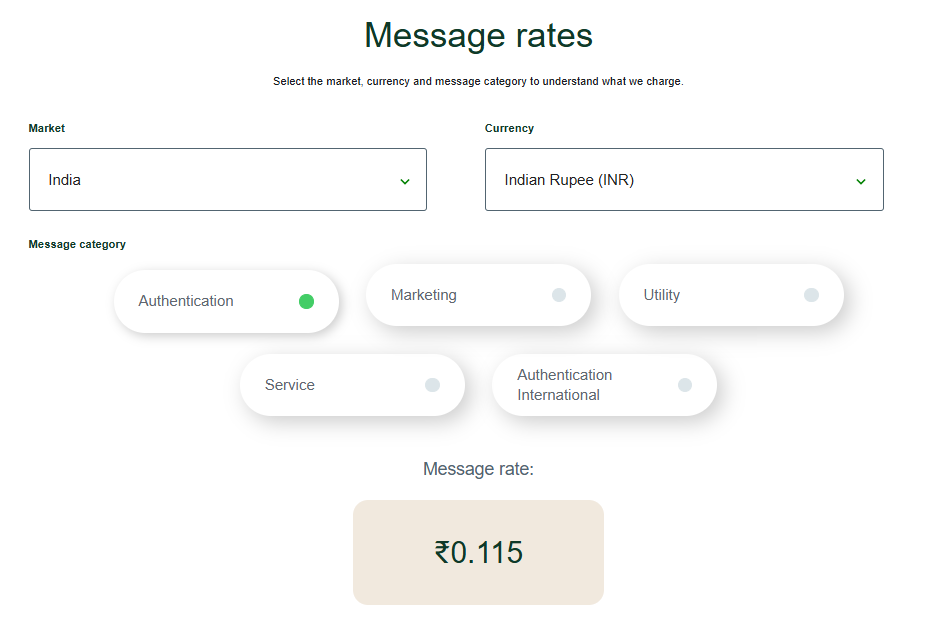
Authentication template messages are messages that are used to verify users. These include one-time passwords, login codes and account verification messages. These are mostly time-sensitive and transactional messages.
Example: when you receive an order from Amazon, an OTP is sent to you on your WhatsApp to confirm with the delivery person. That is exactly how authentication messages work!
Price (in India)- ₹0.115 per message
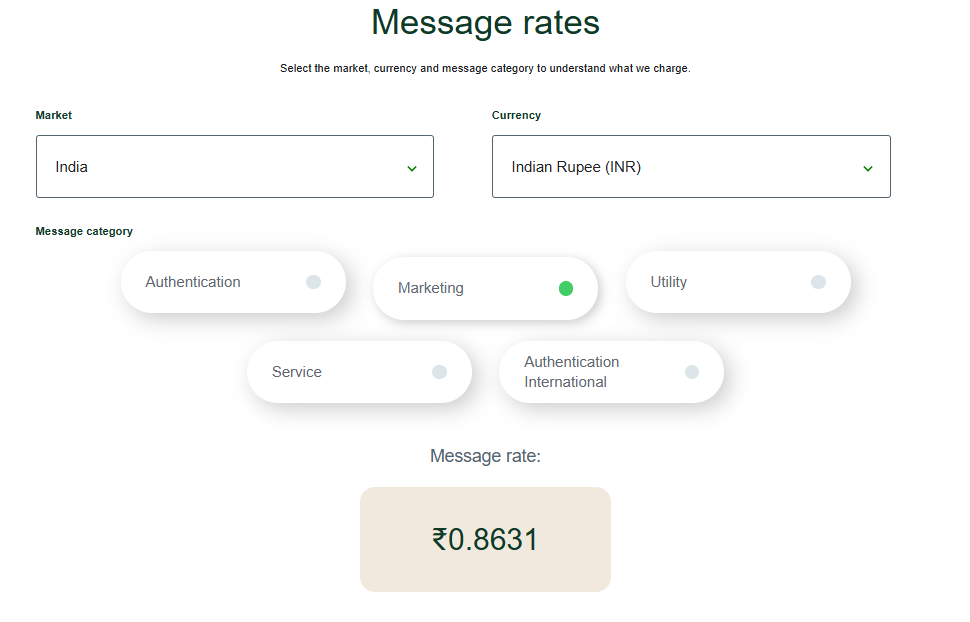
Marketing messages are promotional messages initiated by the business. These include offers, product launches, discounts, upsell/cross-sell messages and post-purchase notifications, often in the form of call-to-action buttons.
The reason why this category is priced a little higher is that it drives direct business growth and revenue.
If you want to explore examples, we have compiled some of the best promotional templates for you to look at!
Price (in India)- ₹0.8631 per message
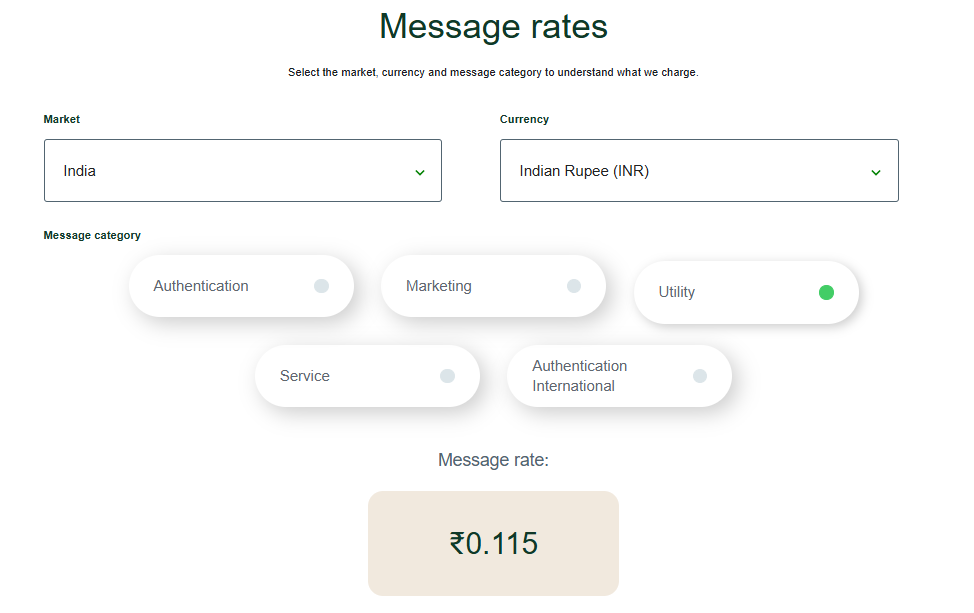
Utility messages businesses send are transactional updates related to a customer’s existing order. For example: order confirmations, payment receipts, delivery updates, abandoned cart reminders, appointment reminders, billing statements and more.
Utility conversations intend to provide value and information rather than promotion.
Price (in India)- ₹0.115 per message
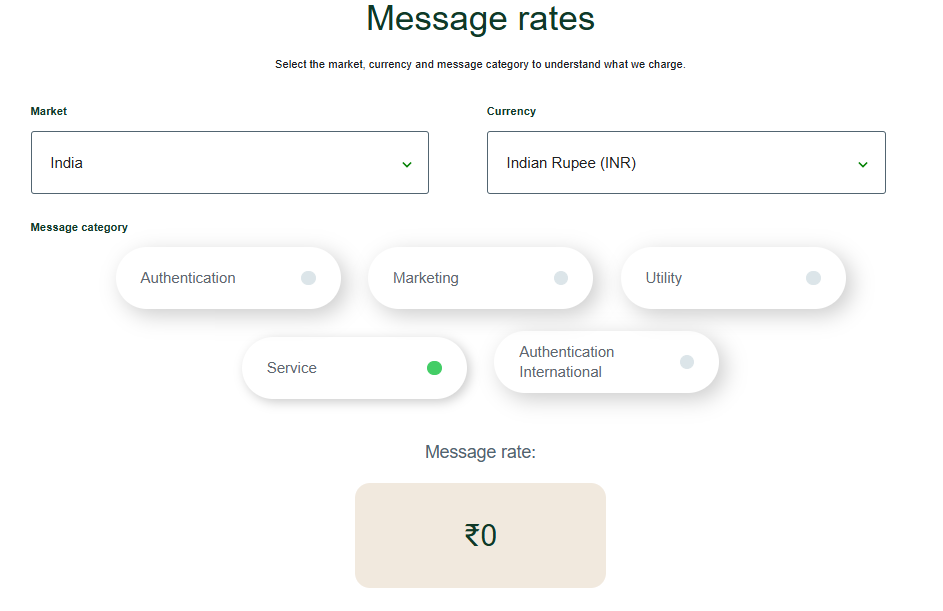
A message that a customer sends you to start a chat with your business is a service message. If you reply to such a WhatsApp user message within the first 24-hours, a customer service window (CSW) will open, and all messages sent or received in this window are called “free-form messages.”
Such free-form messages are non-template messages and work just like normal WhatsApp conversations. Such messages won’t even cost you a penny.
These messages are generally used for customer support, queries, complaints and assistance. So you can leverage these free entry points and make the most out of them!
Service messages are completely free.
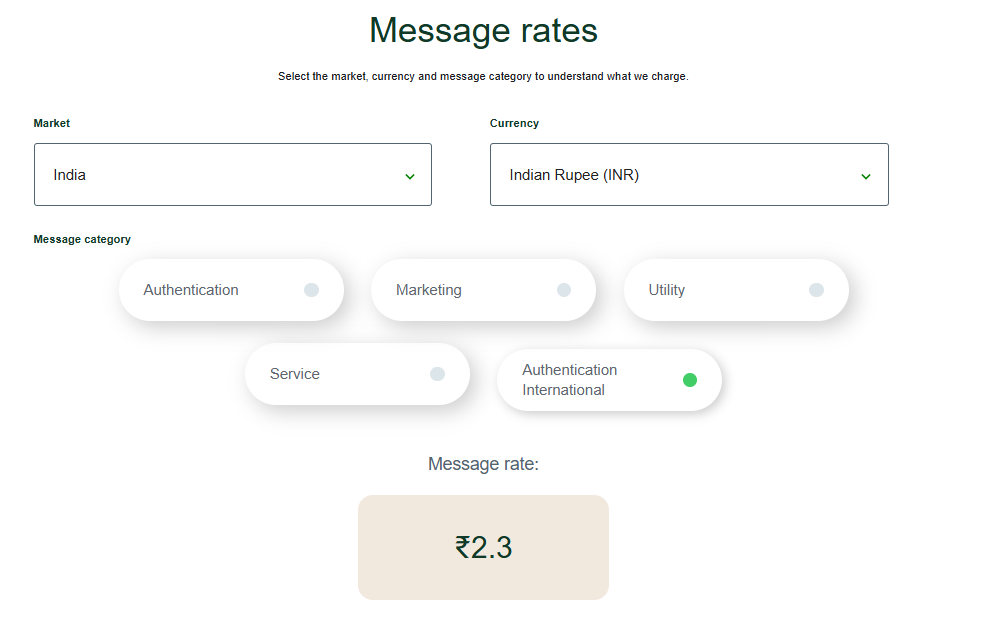
An authentication international message is when OTPs or verification messages are sent to users in an international market, where different authentication pricing may apply.
Price (in India)- ₹2.3 per message
Accessing WhatsApp API requires a middleman that will connect your business to WhatsApp. An official business service provider or BSP is that middleman!
It’s an authorised partner of WhatsApp that will provide you with access to the API for your business, alongside a platform where you can send messages, manage campaigns, automate workflows and track your performance. In simple terms, if WhatsApp is the highway, BSP is the vehicle that lets you drive on it.
While WhatsApp charges you per message, your BSP may charge you separately for providing the platform, tools, integrations and support that it will give to your business to run WhatsApp API at scale.
Typically, BSPs’ charges include:
Different BSPs have different pricing models. Some charge you simple one-time setup costs, while some charge you complex bundles with integrations, automations and support. So whenever you sit back to calculate your total WhatsApp API cost, do not forget:
WhatsApp Business API pricing = Charges based on WhatsApp message volume + BSP platform charges
Your WhatsApp automation journey starts by choosing your WhatsApp Business Solution Provider. A BSP essentially gives you access to your WhatsApp Business API, which allows you to use the extensive list of features that are available with it, like automations, integrations, analysis and more.
However, as we discussed earlier, API access alone is not enough. Managing leads, tracking conversations, assigning chats to sales teams and running follow-ups often requires additional tools such as a CRM.
Several well-known BSPs such as Twilio, Gupshup, WATI and 360dialog primarily focus on providing API access and messaging infrastructure. These platforms are typically suitable for companies that just need a simple core WhatsApp API and already have a CRM.
This is where telecrm takes a different approach.
Instead of acting only as a BSP, telecrm combines WhatsApp Business API access with a built-in CRM, so businesses can manage conversations, leads and sales activities from one platform.
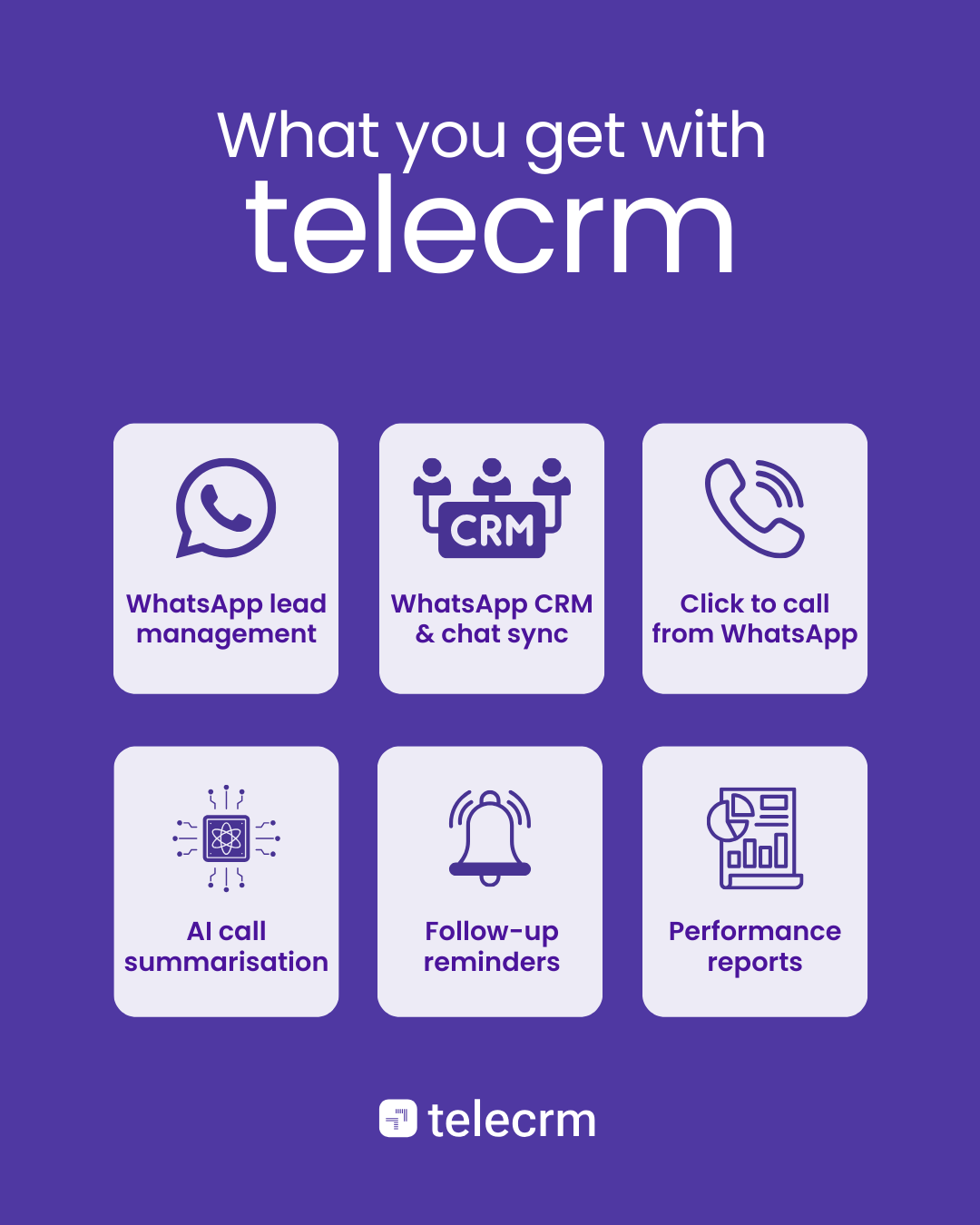
Here is why you should choose telecrm:
telecrm allows you to automatically capture and organise leads from your WhatsApp into your CRM. Fresh leads from your Facebook ads, as well as direct messages, are synced in your CRM without any manual work.
Also, it automatically assigns leads to team members, helps you track conversations and manages your sales pipeline from one central dashboard.
Manage your entire team’s WhatsApp conversations with clients (from their personal numbers) through a unified CRM dashboard. Monitor chats, track interactions and ensure every lead and customer conversation is properly handled.
telecrm is the only CRM company that provides WhatsApp chat sync with their WhatsApp CRM.
WhatsApp messages are not the only way to hold conversations with your leads. You can call your leads from WhatsApp, with a single click, directly through telecrm. You will be redirected to your phone’s dialler immediately when you click on call.
This feature speeds up the calling process and helps your team connect with prospects instantly.
With telecrm, you can review your call recordings using AI to understand how well your team interacts with leads and customers without manually listening to each and every call. This helps ensure quality conversations and consistent adherence to internal processes.
Never miss a hot lead again. Schedule follow-up reminders for calls and messages and get notified on time so your team can close deals faster and more efficiently.
Get your hands on detailed reports on chats, calls, deals won/lost and follow-ups. Use data-driven insights to evaluate your team’s performance, optimise strategies and improve your overall outcome.
WhatsApp Business API has become one of the most effective ways for businesses to communicate with customers in 2026. From marketing campaigns and automated updates to real-time customer support, it helps companies scale conversations while keeping them fast, personalised and compliant.
While WhatsApp Business API pricing structure may seem complex initially, it becomes easy to navigate once you understand its two core components: WhatsApp message charges and BSP platform costs. With clarity on both, you can plan your communication strategy better and make the most of every conversation.
With the right tools and partner, WhatsApp can evolve from just a messaging platform into a complete engine for lead generation, customer engagement and customer retention. If you’re ready to get started with WhatsApp API the smart way, book a quick demo with telecrm today.
WhatsApp Business API pricing structure is: ₹0.115 per message for utility and authentication messages, ₹0.8631 per message for marketing messages and does not charge anything for messages in the service window. Apart from that, business service providers (BSPs) charge separately for providing businesses with WhatsApp API setup, services and support.
WhatsApp Business comes with just a 256 contact limit for a single broadcast. So, to be able to send 1000+ messages, you need WhatsApp Business API through a third-party Business Solution Provider (BSP). For basic verified API users, the limit is 1000 messages, but it can get as high as unlimited messages as your communication game upgrades.
Not necessarily. You can start a new WhatsApp API from scratch, directly via your BSP. Or you can ask your BSP to switch your already existing account into the WhatsApp API account.
Infact, with Meta’s all new WhatsApp Coexistence feature, you can run a WhatsApp Business and a WhatsApp API account with the same number, simultaneously.
Know more about the differences between WhatsApp Business and WhatsApp API.
Generally, as far as WhatsApp API pricing is concerned, you will have to pay based on the total number of messages that are delivered from your end (based on their template category), regardless of whether they are opened by the WhatsApp user or not.



© Copyright 2026 telecrm.in - All Rights Reserved • Privacy Policy • T&C



© Copyright 2025 Telecrm.in - All Rights Reserved • Privacy Policy • T&C