

Looking to get more out of your CRM software or thinking about getting one to help streamline your business? You’re in the right place!
The CRM process is the set of steps a business follows to manage customer relationships, from first contact to repeat sales. It covers collecting customer data, analysing it, segmenting customers, managing interactions and improving their experience. A clear process matters because it stops leads leaking and keeps follow-ups on track. For Indian sales teams handling leads across calls, WhatsApp and ad platforms, it brings order to a busy pipeline.
We’re going to break down the CRM process into simple steps that you can follow. The journey from the first touchpoint to purchase is pivotal and mastering this process can give your business an edge in a rather crowded marketplace.
This guide covers:
A CRM (customer relationship management) process helps businesses manage and analyse customer interactions and data throughout the customer lifecycle by employing technology to organise, automate and synchronise data and operations across all departments (sales, marketing, customer and IT support).
The overall goals more or less are building customer relationships, improving customer retention and driving sales. Here’s what the CRM process entails:

This is the first and foundational step where all relevant customer data is collected. This could include everything from basic contact information to detailed interaction histories across various channels like email, phone, social media and more.
Once the data is collected, it’s analysed to extract meaningful insights. What do your customers like? What are their buying patterns? What are their pain points? Understanding these aspects allows your business to serve them better.
This step involves categorising customers into groups based on similar characteristics or behaviours, making your marketing efforts more targeted and personalised.
Using the insights from data, your team can now manage interactions with customers more effectively. This means sending them personalised messages at the right time, responding to their queries promptly and ensuring that every touchpoint adds value to their experience.
Finally, the ultimate goal of the CRM process is to enhance the overall customer experience. This involves offering customised solutions, improving your product offerings and ensuring customer satisfaction and loyalty.
Understanding these steps will not only improve the productivity of your marketing, sales and customer service efforts but also ensure you’re making the most of your CRM software. Here’s a breakdown of key CRM steps that can help you take your business to the next level:
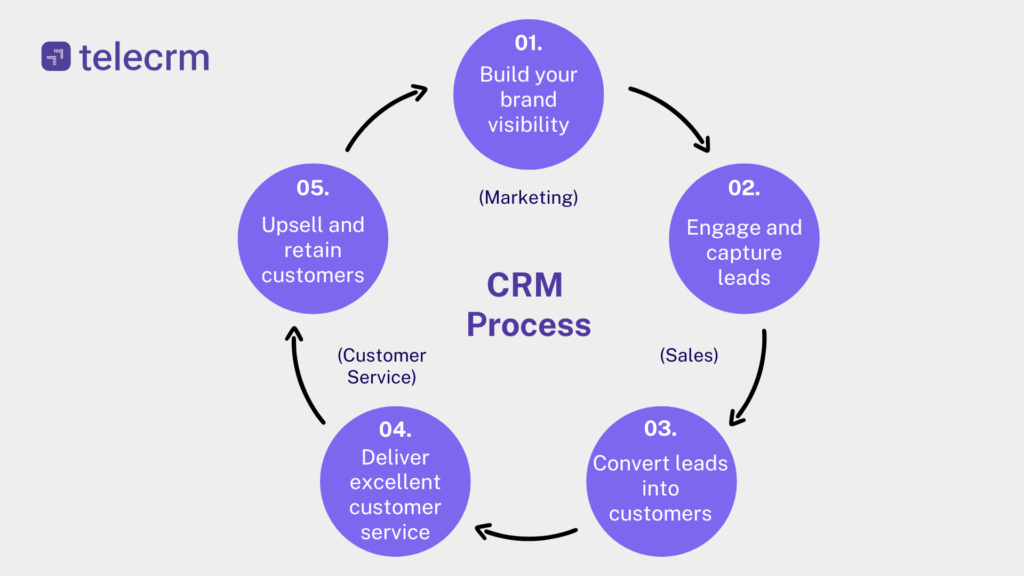

This initial step in the CRM process is all about putting your business on the map. The goal is not just to introduce your brand to potential customers but to make it resonate with them in a meaningful way. And a well-structured customer relationship management process plays a key role here.
Here’s how you can enhance your brand’s visibility using insights from your CRM software:
Use the customer data and behavioural insights from your CRM to plan targeted marketing. Personalised emails, social campaigns and blogs that speak to customer pain points help you reach the right audience and track which campaigns convert.
Thanks to CRM analytics, you can track what’s working and what’s not. By analysing performance metrics like conversion rates and campaign engagement, you can refine your marketing efforts and double down on what drives results.
Your website and social profiles should work together to build awareness. SEO, content and consistent branding help buyers find you, and the CRM tracks their journey from the first click so no early-stage lead is lost.
Use your CRM system to collect and review feedback from customer interactions. This data can help you improve your brand message and deliver more personalised customer experiences across all touchpoints.
Once your brand is visible, the next step in the CRM lifecycle is getting those eyeballs to convert into leads and capturing them effectively within your CRM software.
Here’s how to do it:
Your CRM tools should connect directly with lead forms across your site and landing pages. Keep the forms simple but effective, like name, email and interests. That’s all you need to start managing customer data intelligently.
These are great for value-first engagement and identifying potential customers. Every registration adds rich data to your CRM system, which helps you understand what your audience truly cares about.
A steady newsletter with helpful content is a smart way to stay top-of-mind. With the right CRM solution, you can segment your list, personalise content and track responses, all leading toward better customer engagement.
Connect your CRM platform with Facebook, Instagram and LinkedIn. This way, you automatically capture lead details from customer interactions like ad clicks, form submissions or post comments and retarget them based on real behaviour.

Turning interested leads into paying customers is a pivotal step in the CRM strategy. With the right process and tools, this part becomes less of a chase and more of a flow.
Here’s how to turn leads into loyal, satisfied customers:
Use insights from your CRM data to create personalised communication that feels human. Mention their last touchpoint. Reference their problem. Be specific. That’s what turns cold leads into warm conversations.
Within your CRM system, set up lead scoring based on behaviours, downloads, responses, page views, etc. This helps your sales teams focus on the most valuable prospects without wasting time on unqualified ones.
Automated workflows in your CRM software can remind reps to follow up at the right time. This consistency is what moves potential customers through the sales process without them slipping away.
Letting a lead experience your product builds trust and shows real value. Your CRM tool helps track trial activity and follow-up accordingly, increasing the chance of conversion.
Use feedback stored in your CRM platform to understand common objections. Prepare scripts, FAQs or one-pagers that help your team respond better and close faster.
Whether it’s a summary close or an assumptive close, your CRM system helps you log each touchpoint and monitor what closing techniques work best. This also contributes to enhancing customer retention, as you’re creating a smooth, confident purchase experience.

Once a lead becomes a customer, providing customer support isn’t just a nice-to-have; it’s essential. It’s what builds trust, strengthens loyalty and keeps new customers coming back. A well-structured CRM system helps you deliver top-notch service with ease and consistency.
Here’s how to use your CRM to support your customers better:
Your CRM gives your support team complete visibility into customer behaviours, preferences and past customer interactions, all in one place. This context helps your team deliver personalised customer experiences that feel relevant and thoughtful.
With CRM analytics and ticket tracking, you can quickly identify problems and act on them. Fewer delays mean fewer frustrated customers and higher customer satisfaction.
Your CRM makes it easy to collect, store and act on feedback. This shows customers that their voice matters and helps you improve both your product and service, contributing directly to building strong customer relationships.
Go beyond reacting. With analytical CRM tools, you can anticipate issues before they happen, like knowing when a customer might churn or when a service renewal is due. This kind of foresight enhances customer loyalty and shows that you genuinely care.

Closing a sale is great. But the real win? Keeping the customer. A powerful CRM process helps you do both, turn happy users into repeat customers and identify opportunities for upsells without being pushy.
Here’s how you use your CRM to drive long-term value:
By tracking customer behaviour and past purchases, your CRM helps you recommend the right product at the right time. No guesswork, just smart, timely offers that feel natural and relevant.
Segmenting based on purchase frequency, product usage or engagement level helps you build better engagement strategies. Whether it’s for existing customers or those at risk of churning, your message hits the mark.
CRM-integrated loyalty softwares let you reward satisfied customers with points, discounts or exclusive access. These small gestures build long-term customer relationships and keep people coming back.
Send out newsletters, updates and exclusive offers with the help of your business tools. With timely follow-ups and consistent value delivery, you not only stay top-of-mind, you also prove that you’re here to help, not just sell.
Most leads never convert, not because they weren’t interested, but because there was no process. Here’s how a proper CRM process brings clarity and makes sure missed follow-ups turn into actual growth:
You called. They didn’t pick up. You told yourself, “I’ll call tomorrow.” You forgot. Lead gone.
This is what happens when there’s no operational CRM system in place. But with the right CRM tool, every lead is captured, every follow-up is logged and no one’s left behind.
Sales is chasing one version of the truth, support is asking questions already answered and your marketing team is shooting in the dark.
With a collaborative CRM platform, your sales, marketing and support departments work together in sync.
Everyone knows what was said, where the lead is in the sales pipeline and what needs to happen next.
The result? A coordinated team and clear customer interaction at every stage.
When there’s no system, your team wastes hours figuring out next steps. But a good CRM solution gives them a ready roadmap, whether it’s a follow-up call, proposal or demo.
This cuts repetitive admin so reps spend more time calling and closing. Instead of working out the next step, a rep opens the CRM and sees which leads to call, which to message on WhatsApp and which to mark closed. Turn repeatable steps into CRM workflows so lead assignments and follow-ups happen consistently.
Nothing annoys a potential customer more than repeating themselves. “Sir, who gave you a demo?” “Ma’am, can you share your requirement again?”
With the help of CRM analytics, your team gets full context: what was discussed, who handled the lead and what they need next.
This level of insight leads to smoother customer engagement and shows both your current and potential customers that you’re actually listening.
Without structure, your CRM is just a database. But with the right data analysis, you can see exactly where leads are dropping off, during follow-up, after a demo or before closing.
These insights help in refining your marketing campaigns and lead generation strategies, so you stop wasting time and start making informed business decisions.
Hiring is easy; onboarding is hard. But when there’s a well-defined CRM process, new reps don’t have to ask “What now?”
They just follow the system; leads in this stage need follow-up, these are hot, these are closed.
This structured flow reduces confusion and speeds up productivity without constant manager check-ins.
Most businesses stop after they win the deal, but that’s just the start.
By including customer support, check-ins and upsell prompts in your process, you convert one-time buyers into repeat customers.
You also unlock more sales growth by identifying your most valuable prospects and offering them personalised deals, tailored content and proactive service.
Choosing the right CRM software is just as important as following the right CRM process. Depending on your business size, budget and industry needs, different tools offer different strengths.
Here’s a quick overview of some of the best CRM software options available for businesses today:
Tool | Best for | Key strength |
telecrm | Indian SMEs that run on calls and WhatsApp | Inbuilt autodialer, WhatsApp automation and lead capture |
Zoho CRM | Teams wanting marketing, sales and support in one suite | Highly customisable with deep Zoho integrations |
HubSpot CRM | Inbound and content-led teams | Free plan and strong email tools |
Salesforce CRM | Large enterprises with complex sales cycles | Deep customisation and enterprise scale |
Freshsales | SMBs wanting AI lead scoring and built-in phone | Telephony, email and WhatsApp in one place |
Pipedrive | Teams managing high deal volume visually | Simple drag-and-drop pipeline |
LeadSquared CRM | Education and real estate teams with high lead volume | Strong lead distribution engine |
If your business is driven by outbound calls, follow-ups and WhatsApp conversations (especially in the Indian market), telecrm is a strong choice. It’s built specifically for SMEs that need inbuilt calling, WhatsApp automation, and lead management without spending lakhs on setup.
Key strengths:
Zoho CRM offers extensive features suitable for marketing, sales and customer support—all under one roof. It’s highly customisable and works well for businesses of all sizes.
Key strengths:
HubSpot offers a great free plan and focuses heavily on inbound marketing and content engagement. If your strategy revolves around website leads, content forms and nurturing through email sequences, HubSpot fits well.
Key strengths:
Salesforce is the global leader in enterprise CRM. It’s built for complex sales cycles, detailed customer journeys and large-scale reporting needs.
Key strengths:
Freshsales offers a clean, modern interface with AI-based lead scoring and built-in phone, email and WhatsApp capabilities.
Key strengths:
If your focus is managing a high volume of deals and keeping track visually, Pipedrive is built for that. It offers an intuitive drag-and-drop pipeline view.
Key strengths:
LeadSquared is popular in India, especially among education and real estate businesses that handle a large number of leads daily.
Key strengths:
Every software has a CRM process which is unique to it, and it depends on you to choose the right software. For Indian teams that sell through calls and WhatsApp, telecrm captures every lead, assigns it to a rep and tracks each stage of the process captures every lead, assigns it to a rep and tracks each stage of the process automatically.
Don’t just take our word for it, book a demo today and see firsthand how you can smoothly implement the steps discussed in this blog using telecrm with barely any effort.
The CRM process is the set of steps a business follows to manage customer relationships, from collecting data to retaining customers. It usually covers data collection, analysis, segmentation, interaction management and improving the customer experience.
The five steps are data collection, data analysis, customer segmentation, interaction management and enhancing the customer experience. Together they take a customer from first contact through to repeat business.
The first step is data collection. The business gathers customer details and interaction history from channels like calls, WhatsApp, websites and ad platforms, so every later step works from accurate information.
The final step is enhancing the customer experience. The business uses customer data to improve service, send timely renewals and reduce churn, turning one-time buyers into repeat customers.
In marketing, the CRM process uses customer data to plan targeted campaigns, capture leads from ads and forms and track which sources convert. It links marketing activity to the sales pipeline so leads are not lost at handover.
A CRM is the software that stores leads, contacts and pipeline data. The CRM process is the set of steps a team follows inside that software to manage customers from first contact to retention.
CRM stands for customer relationship management. It refers to the software and practices a business uses to manage leads, customers, contact history and the sales pipeline in one place.
Capture every lead automatically, assign it to a rep, log calls and messages, set follow-up reminders and track each pipeline stage. Tools like telecrm run these steps for calling and WhatsApp-led teams.


© Copyright 2026 telecrm.in (Flamon Cloudtech Pvt Ltd) - All Rights Reserved • Privacy Policy • T&C



© Copyright 2026 telecrm.in - All Rights Reserved • Privacy Policy • T&C