
You bought a CRM. Is it making you money?
Most SMBs can’t answer this question. They pay subscription fees and expect the tool to generate returns on autopilot.
But when leads slip through gaps, follow-ups get missed and sales time doesn’t improve, you lose revenue.
Get this: how you use the software determines whether it will be profitable or become another expense.
So in this blog, I’ll show you how you can
No complex spreadsheets. Just clear steps to measure and improve your CRM’s ROI for SMBs.
It calculates how much return you’ll make from using a customer relationship management tool.
This helps you understand CRM’s monetary impact on your business.
The formula measures two things
CRM ROI = (Profit generated – Cost of investment) ÷ Cost of investment
The gain depends on what you want to improve. It could be increasing sales, reducing marketing costs, generating more leads, etc.
Calculating CRM ROI for SMBs is crucial because it shows where your money is going and what return it’s generating. Suppose you run a new Facebook ad campaign, but somehow the CRM fails to capture every lead that clicks on your ad. Chances are, the campaign won’t generate the expected positive ROI.
Before you start maximising CRM efficiency, it’s important to know the key metrics to measure. Each KPI is associated with a specific action performed using a particular feature.
For example, the lead conversion rate depends on your CRM software’s lead generation feature. Some metics are associated with one or more features. Like customer satisfaction metrics, for which you’ll have to look at messaging and data collection capabilities.
Moving on, all factors can be classified into two types: tangible and intangible.
Helps track direct CRM results. Such as
Counts the number of leads closed from the total leads generated.
The formula is closed leads/total leads × 100.
A higher close rate means the CRM implementation cost is generating a greater return on investment.
The number of days it takes a customer to convert. If your reps close 10 leads in a single month within 50 total days.
Using the formula, the total number of days to close deals/number of deals closed, your average lead-to-close time is five days.
Helps you prioritise leads based on various factors like

More high-intent leads mean your CRM software is doing a great job of filtering and nurturing the right prospects.
The time your team takes to respond to a new lead’s initial contact, like filling out a contact form or reaching out on your WhatsApp number.

For CRM performance tracking, the faster it captures a lead’s first action, the quicker you’ll be able to send the first message.
Using a CRM for business growth helps measure the average revenue a lead could generate if converted and analyse the effectiveness of your lead source.

It calculates the potential sales value of both types of leads: ones that might convert and ones that may not.
Apply this formula: total revenue/number of leads. If you generate ₹10,000 revenue from five leads from WhatsApp and the same ₹10,000 revenue from 10 leads from Facebook.
Then the channel with the highest ROI is WhatsApp, as its revenue per lead is ₹2,000 compared to ₹1,000 of Facebook.
Measures CRM sales forecast of only successfully closed leads.
A higher average deal size means the CRM is helping you convert more prospects into paid customers.
For example, if 10 leads visit your website, but only two buy something for ₹1,000 each, this means your:
Measure how much money you spend generating a single lead.
During CRM performance tracking, divide your total marketing spend by the total number of new leads generated. You’ll get the exact cost per lead.
A low CLP suggests your CRM’s actionable insights are accurate.
Calculates how much money you spend on acquiring a paying customer.
For most SMBs, maximising CRM efficiency means reducing CAC. So they get more customers without spending more.
To measure CAC, divide total marketing and sales spend by total new paid users acquired. Say you spend ₹10,000 on a marketing campaign to generate 100 leads and only 20 close.
But you also spend an additional ₹5,000 on each lead, your CAC is ₹750 (₹15,000 total cost ÷ 20 customers)
A higher rate means more leads actively interact with your marketing or sales content.
This proves the accuracy of your CRM’s customer data, which is required to create personalised messaging for nurturing leads.
Intangible CRM success factors are essentially byproducts, which you can only measure manually.
You can use CRM data to understand the numbers. However, you’ll still have to do the calculation by asking your sales, marketing and support teams about the improvements they experienced.
Compare how long it takes your salespeople to close a lead before and after CRM implementation.
If converting leads takes fewer days now, it means your decision to use a CRM for business growth turned out right.
If the CRM helps your customer team collect, categorise and allocate tickets to the right support person effortlessly and with speed, then it is working right.
Fewer data errors show that your CRM is capturing and entering correct information.
An increase in customer satisfaction rate suggests the CRM is helping you engage with customers better.
To measure employee satisfaction, compare the before and after improvements, like
For CRM cost benefit analysis, check improvements in your business processes, like lead generation, allocation, segmentation, etc.
A customer relationship management tool must help you collect, organise and analyse lead information better compared to a spreadsheet.
Your CRM investment compounds if customers stay with your business for a long time and their sales value grows over time.
If you already use a CRM or are planning to start using one, be sure to follow the CRM success factors mentioned below.
These are based on observations made from other SMB’s experience in maximising CRM efficiency.
The first step of using a CRM for business growth is to connect it with all your sales channels.
If you are a B2B company selling on multichannels like Indiamart or Justdial, integrate them to capture every single lead.
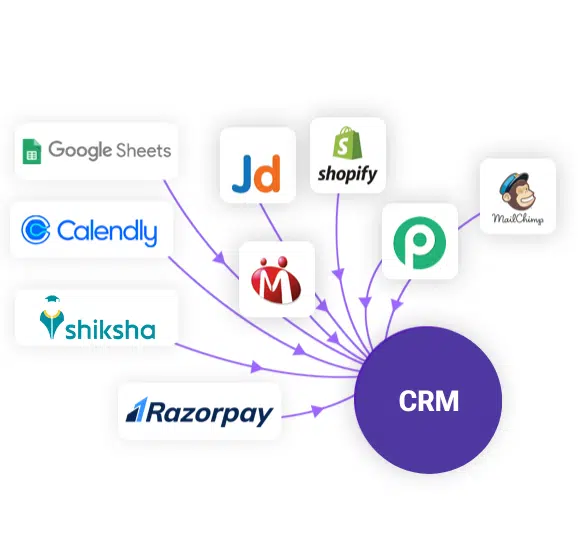
Similarly, if you are a DTC brand selling on Facebook, Shopify, WhatsApp or WooCommerce, ensure each customer who shows even the slightest interest, like visiting your website or browsing products, is captured.
This is crucial because the very purpose of CRM systems is to help you interact and engage with the maximum number of leads from whichever channel they come from, simultaneously.
But if you don’t integrate channels, you risk losing potential customers. This means fewer sales and reduced CRM ROI.
Start by categorising leads based on how they react to your marketing efforts, how often they respond to your calls and their intent (are they actively looking for a solution or just browsing randomly).
With CRM systems like Telecrm, document customer data, including phone conversations, chat, web activity and more. Then create the following segments.
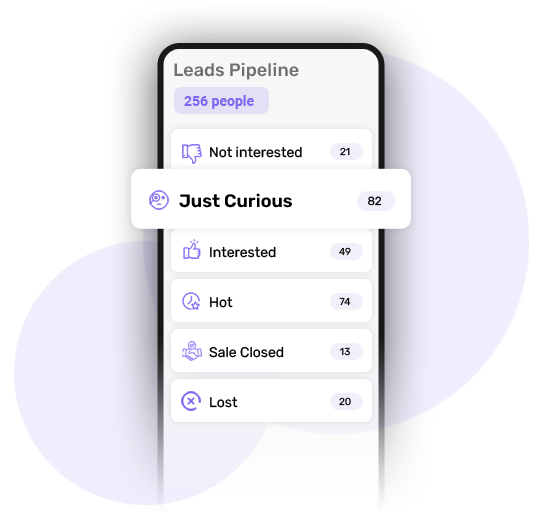
This CRM performance tracking provides clarity on leads likely to convert first.
It also helps you monitor sales team ROI, including how many leads each sales rep brings and how many convert and don’t convert.
CRM helps you analyse important CRM success factors such as customer behaviour. From call recordings, to what messages they mostly respond to and more.
These actionable insights show the actual needs, problems and requirements of prospects.
Review this data thoroughly and use the findings to create personalised content that makes customers feel heard.
For example, imagine a lead who showed interest initially by answering your calls, but then stopped responding suddenly.
In such cases, extract insights from Telecrm call recordings and create targeted messages to follow up with that lead.
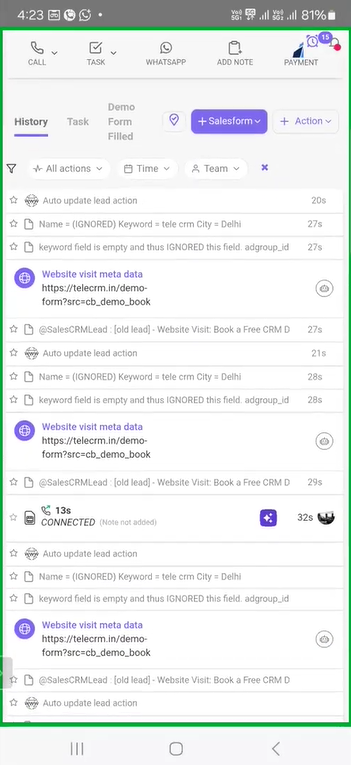
This way, you utilise CRM software to fulfil customer expectations, encourage them to convert and achieve return on investment.
In sales, you’re always one follow-up away from converting a lead into a paid customer.
And what separates top sales teams from average ones is that they never give up on a lead, regardless of how many follow-ups it takes..
But as an SMB, you probably work with a small team of sales reps who might struggle to follow up with leads individually, even if your lead list is small.
In such scenarios, having a CRM platform like Telecrm makes automating routine tasks, like follow-ups, no less than a game-changer.
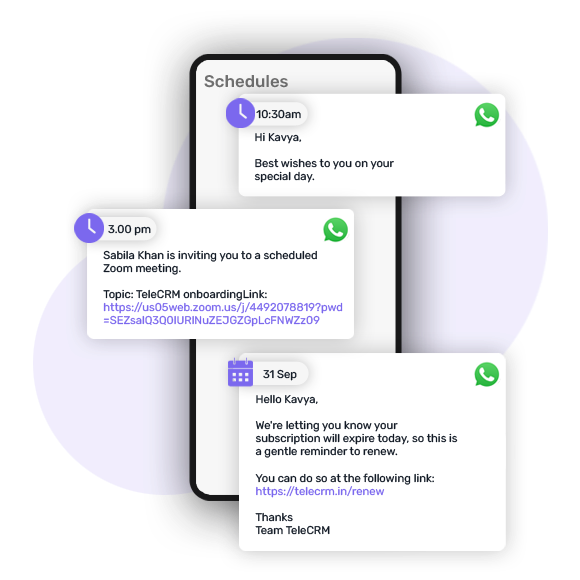
Your reps can set up follow-up messages at set intervals, so no potential lead is left in vain, just because they didn’t reply initially.
This way, you’re not only improving CRM efficiency, but also analysing sales team ROI to see who is putting their best effort and who’s not.
Tracking CRM ROI shows if your investment is driving any positive value. It helps you see whether the tool is helping you achieve your business goals or draining your budget.
Let me explain this in detail.
ROI calculation collects concrete numbers needed for your leadership to answer the fundamental question: “Is this investment making us money?
This helps your stakeholders and employees see measurable progress and financial returns from using CRM software.
So, they can make informed business decisions about further investments.
CRM performance tracking highlights how much ROI it generates and from what improvements. For example, increased sales revenue means your conversion rates have improved.
Similarly, growth in customer retention means CRM is helping you manage customers better.
Often, SMB’s like you get stuck in a features dilemma. They either buy a CRM subscription with all features or with limited ones. Tracking ROI helps you assess which features are bringing higher value to your business.
With this information, choosing the right plan becomes easy. This means no more underutilised features and complete usage of CRM.
Data isn’t enough to justify the investment cost because numbers alone don’t explain true returns; there are areas of your business that figures don’t account for, as mentioned below.
Many SMBs focus only on upfront costs without considering the total cost of CRM software ownership.
To measure the true cost, calculate the cost for
As mentioned earlier, tracking key metrics like customer experience, team speed, workflow improvements, etc., directly from CRM is challenging.
Because there is no specific data point that tells you if there is any change.
Communicate with your employees involved in CRM operations and ask about how their work changed before and after using CRM.
This exercise, although helpful, is equally time-consuming.
To know if a positive change is a result of CRM or some other business activity that didn’t involve CRM is difficult.
For this, consider A/B testing. For example, divide your salespeople into two groups. Allow one to use the CRM in their workflow and let the other group continue without the tool.
Compare the results of both in terms of total leads generated, nurtured and converted. This way of CRM performance tracking highlights the real impact of the software on your business.
Calculating the costs of a particular benefit from CRM, such as lead generation, can be confusing.
Continuing the above example on A/B testing, if you were to calculate how much ROI the group with CRM brings and at what price.
You’ll need to count all the associated costs, like subscription, rep’s salary, hardware, etc., along with the outcome, like an increase in conversion rates, to understand the complete cost of the tool.
Instead of treating CRM as just another business tool, think of it as a customer relationship enabler. Because that’s what it is.
By changing your outlook, you gain better control over the outcomes it generates, whether it be time saved, fewer missed leads, revenue growth or improved client relationships.
This ensures your investment pays for itself.
If it’s not, consider switching to Telecrm to get the most out of your investment by helping you
Book a demo today and make CRM work for you and not against you.



© Copyright 2026 telecrm.in - All Rights Reserved • Privacy Policy • T&C



© Copyright 2025 Telecrm.in - All Rights Reserved • Privacy Policy • T&C