
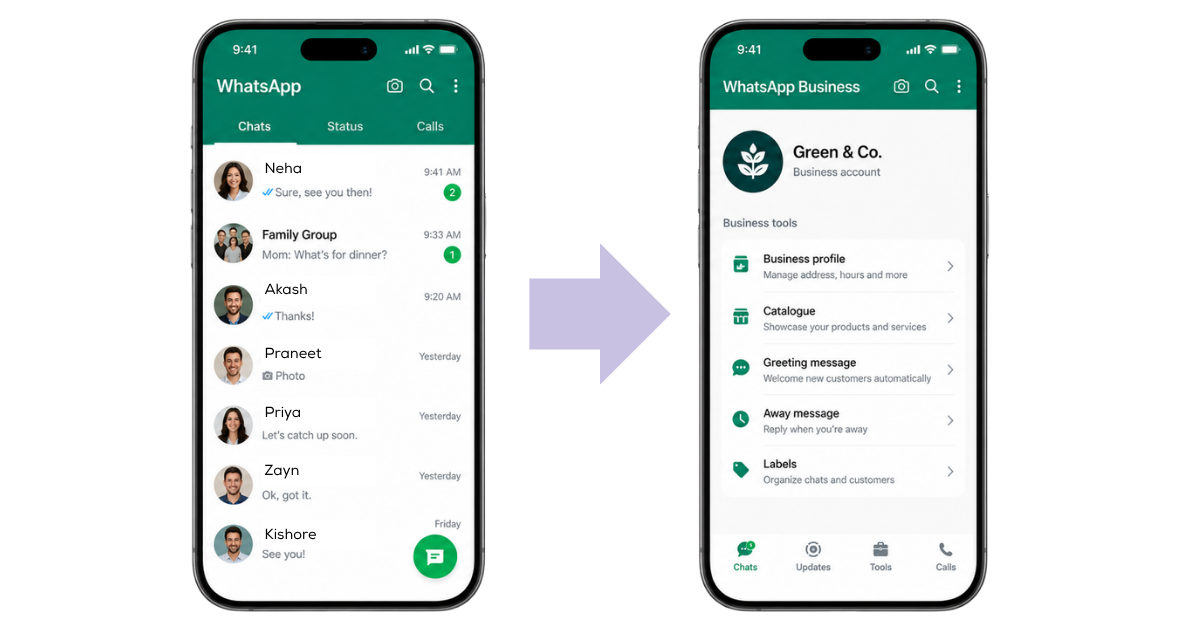
If you’re running a business in India and still using a personal WhatsApp account to talk to customers, you’re doing it the hard way.
WhatsApp Business gives you a proper business profile, automated messages, quick replies and tools that make customer communication far easier to manage. The switch usually takes only a few minutes. And you can move your existing chat history and media with you when you follow WhatsApp’s migration process correctly — but create a backup before you start as an extra precaution.
This guide covers everything: what changes, what to do before you start, the exact steps on both Android and iPhone and what happens when your team grows beyond what the Business app can handle.
In case you want to know what we’ll be discussing in the blog, read the summary below:
WhatsApp Messenger is for personal use only — group chats, voice calls, status updates. The WhatsApp Business app adds a layer of professional tools on top of the same network and the same end-to-end encryption.
Here’s what you get that you didn’t have before:
For a deeper look at what these tools add to your business communication, see the key benefits of a WhatsApp Business account.
What doesn’t change: your phone number stays the same, your chat history comes with you and your contacts see the same number they already have saved.
One rule to know before you start: a single phone number can only be registered on one WhatsApp app at a time. Once you move it to WhatsApp Business, it stops working on Messenger. If you need both — a personal account and a business account — you need two numbers. Many Android phones from brands such as Samsung, Xiaomi, Realme and Vivo include Dual Apps, Clone App or Parallel Apps features that can run WhatsApp Messenger and WhatsApp Business on the same device. However, WhatsApp still requires the two accounts to use different phone numbers. The second number does not necessarily have to be on another physical phone, but it must be a separate number that you can verify.
Before you switch, it helps to know where the Business app fits — and where it stops being enough.
WhatsApp Messenger | WhatsApp Business App | WhatsApp Business API | |
Best for | Personal Messaging | Small businesses managing customer conversations primarily through the app | Businesses that need CRM integration, advanced automation, programmatic messaging or larger-scale workflows |
Cost | Free | Free, with optional paid Meta subscriptions/features | Meta messaging charges apply; additional CRM (like telecrm) or provider fees may also apply depending on your setup |
Business profile | No | Yes | Yes |
Automation | None | Basic (greeting, away, quick replies) | Advanced (templates, chatbots, workflows) |
Max devices | 5 linked | 5 linked (10 with Meta Verified) | Unlimited |
CRM integration | No | Limited | Yes |
Verified blue tick | No | Via Meta Verified (paid) | Via Meta Verified or OBA (merit-based) |
The Business app is the right starting point for most small businesses if you are starting a business. The API becomes relevant once you have multiple agents sharing one number — more on that later.
No — if you follow the backup and restore process correctly, your chats, photos, videos, audio and regular contacts all transfer. Meta built the migration specifically to keep chat history intact when moving from a personal WhatsApp account to WhatsApp Business on the same phone number.
Two things to know:
Don’t skip this. Five minutes here prevents an hour of headaches later.
These steps work on Android 13/14, including Xiaomi, Samsung and Realme devices common in India.
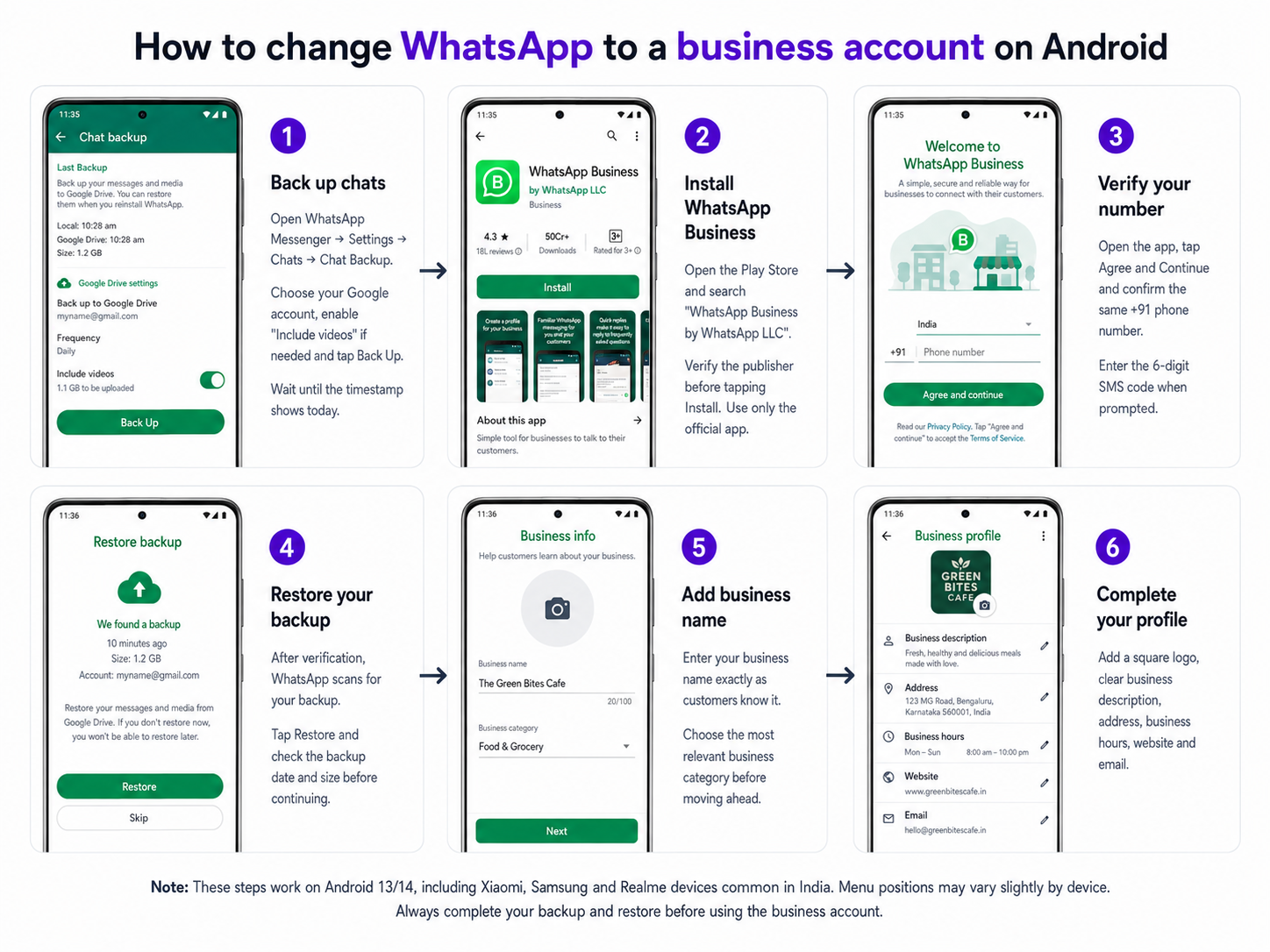
Backing up your chat history is the most important step — do not skip it.
Open WhatsApp Messenger → three-dot menu → Settings → Chats → Chat Backup. Select your Google account, toggle “Include videos” if you need them and tap Back Up. Wait until the timestamp shows today’s date and time. If it still shows yesterday’s date, the backup hasn’t completed — wait and try again.
Optional but worth doing: for any chats that contain critical customer information (orders, complaints, payments), export them individually as .txt files via email.
Open the Play Store and search “WhatsApp Business by WhatsApp LLC.” Verify the publisher name before tapping Install — there are clone apps with similar names and icons. The official app has a green icon with a “B” badge.
Avoid any unofficial APKs downloaded outside the Play Store. They risk data loss and can get your number permanently banned.
Open WhatsApp Business and tap Agree and Continue. The app should automatically identify the phone number currently used by WhatsApp Messenger. Select that number if you want to convert it, or choose Use a different number if you want a separate business account.
Tap Continue → Allow when WhatsApp asks for access to your chat history and media. WhatsApp may then send a six-digit SMS code to verify your number.
After verification, the app scans for a Google Drive or local backup linked to your number. You’ll see a screen showing the backup date and size.
Tap Restore. The green Restore button appears alongside the backup date and file size in MB or GB. If the date shown doesn’t match today, your backup from Step 1 didn’t complete — go back and redo it before continuing.
Messages restore quickly. Media (photos, videos, documents) continues downloading in the background — don’t close the app or switch it off during this process.
Once the restore is done, spot-check two or three chats, including a media-heavy group, to confirm nothing is missing.
If restore fails or shows “No backup found”: confirm you’re signed into the same Google account that was linked to WhatsApp on your old device. If you’ve switched Google accounts, change it in Drive settings and try again. Messages from the last 24 hours before your backup may not be recovered if the backup was older.
This is where WhatsApp Business starts earning its value. Fill in your business name and profile details — Use the business name customers already know and that accurately represents your business. Avoid nicknames or unrelated names. If you later apply for Meta Verified, make sure your business profile information is consistent with the information Meta asks you to verify.
Choose your business category carefully (Real Estate, Education, Financial Services, Healthcare, etc.). WhatsApp Business requires a business name and category before you can proceed.
Then fill in:
Your number is now a fully set-up WhatsApp Business account.
The process on iPhone mirrors Android with two differences: iCloud replaces Google Drive for the backup and the App Store replaces the Play Store. These steps apply to iOS 17 and above.
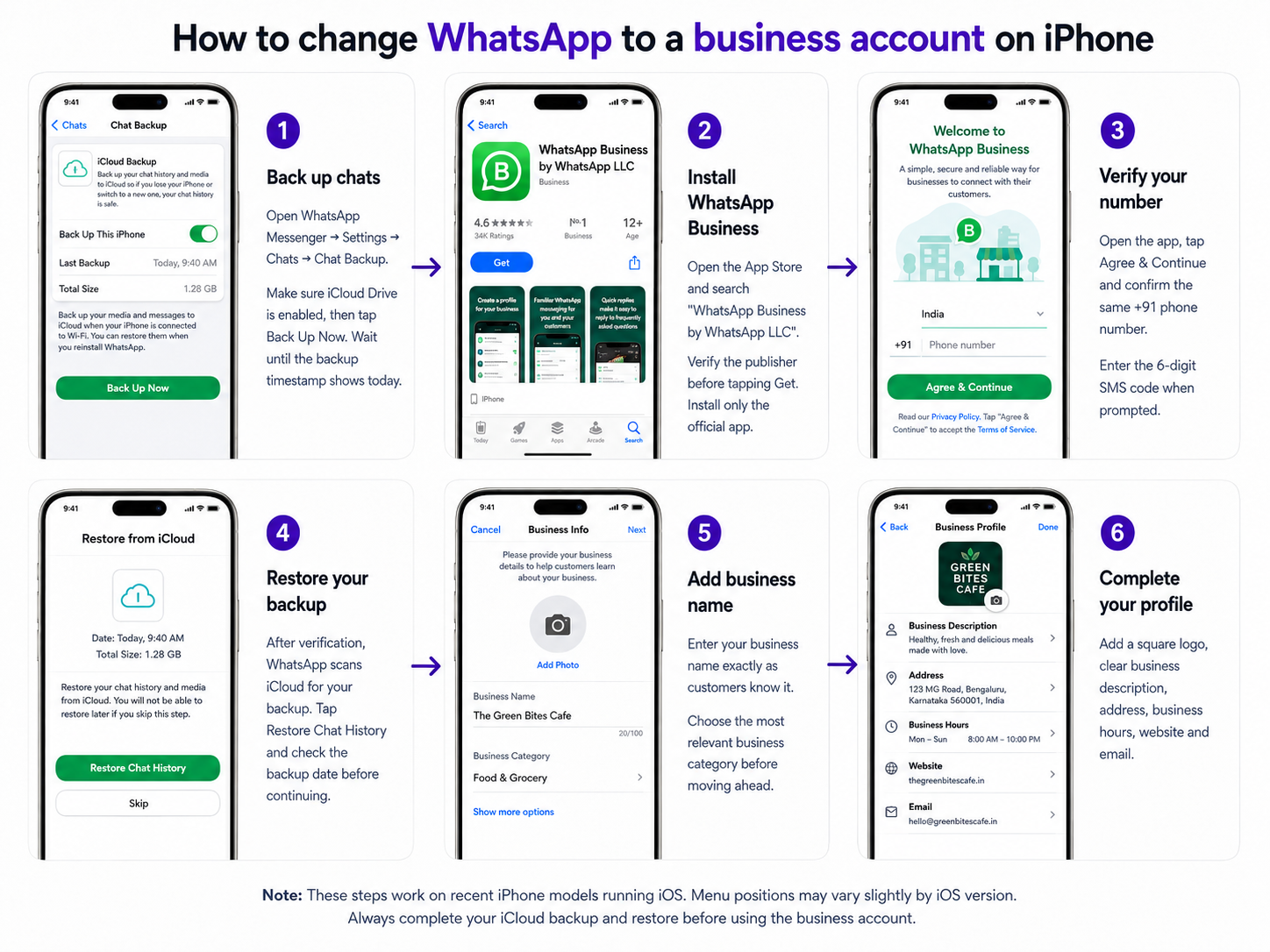
Go to WhatsApp Messenger → Settings → Chats → Chat Backup → Back Up Now.
Before tapping Back Up Now, confirm iCloud Drive is enabled: go to iPhone Settings → [your name] → iCloud → iCloud Drive and make sure WhatsApp has permission. Also, confirm you have enough iCloud storage — if your account is full, the backup will fail silently.
Wait until “Last Backup” shows today’s date. Toggle “Include Videos” only if you have the iCloud space for it.
Open the App Store and search “WhatsApp Business.” Select the official app by WhatsApp Inc. — green “B” icon. Tap the download icon and wait for installation to complete, then tap Open.
The app is free. Don’t install third-party clones; they risk account bans and data loss.
Open WhatsApp Business and tap Agree & Continue. WhatsApp Business should automatically identify the number currently associated with WhatsApp Messenger. Select it if you want to move that account.
WhatsApp may send a six-digit SMS verification code. If iCloud Keychain is enabled and the number was previously verified on the same iPhone, this verification step may be skipped automatically.
Tap Restore Chat History. Confirm the backup date and size match what you expect. Use a stable Wi-Fi connection — mobile data works but is slower for large backups.
Don’t force-quit the app or lock the screen during restore. Once complete, check a few chats and a media file to confirm the transfer worked.
If restore fails: check that iCloud Drive is enabled and that WhatsApp has iCloud permission (Settings → [your name] → iCloud). If your iCloud storage was full during the backup, the backup file may be corrupt — you may need to free up space and back up again.
Same as Android: enter your business name, select the right category, upload a logo as your profile picture and fill in your description, address, business hours, website and email.
Your iPhone now runs a full WhatsApp Business account with access to all business features.
Simply converting your account isn’t enough. These three tools take 10 minutes to configure and make an immediate difference to how customers experience you.
Set these up under Settings → Business Tools → Greeting Message and Away Message.
Your greeting message fires automatically when someone texts you for the first time or after 14 days of inactivity. Keep it short and tell them what to expect: “Hi, thanks for reaching out to [Business Name]. We typically respond within 2 hours. If this is urgent, call us at [number].”
Your away message should match your actual business hours. Include an alternative for genuinely urgent cases. WhatsApp Business supports automated greeting messages precisely for this — so no customer’s first message goes unacknowledged even when you’re offline.
Go to Business Tools → Quick Replies. Set up shortcuts for your five most common responses: pricing, demo booking, address, working hours and product details. Assign each a short command like /price or /demo.
This is the feature that saves the most time for small teams handling high message volumes. WhatsApp Business enables personalised customer service through quick replies — and when every agent uses the same shortcuts, your responses stay consistent regardless of who’s on duty.
Use labels to turn your inbox into a basic sales funnel: New Enquiry → Follow-Up → Proposal Sent → Closed. This maps cleanly to a CRM pipeline later if you upgrade.
The WhatsApp Business app works well when one person — or a very small team — manages all customer communication. The standard WhatsApp Business app supports one primary phone plus up to four linked devices. That may be enough for a small team, but the limits are no longer identical for every business.
Eligible Meta Verified or Meta One subscriptions can provide additional linked devices — up to the limit included in the selected plan — and Meta’s multi-agent functionality can include features such as assigning chats to individual agents and identifying which agent sent a message.
The point at which you should consider the WhatsApp Business Platform is therefore less about having exactly three or five agents and more about what your operation needs: CRM integration, automated workflows, programmatic messaging, advanced reporting and larger-scale customer communication.
The WhatsApp Business app is designed around one primary phone with a small number of additional linked devices — built for one operator working across phone and laptop, not for a team of agents sharing a number.
This is when the WhatsApp Business API becomes relevant. The WhatsApp Business Platform removes the Business app’s device-based operating model and can connect to CRM, shared-inbox and automation systems designed for larger teams. The exact number of agents, routing rules and workflows available depends on the software you connect to the API.
Switching to a WhatsApp Business account is step one. The real gains come when your WhatsApp conversations are connected to your sales process.
telecrm is built specifically for Indian businesses that sell over the phone and WhatsApp — real estate, education, insurance, finance and healthcare. Here’s what changes when you connect your WhatsApp Business account to telecrm:
The WhatsApp Business app gives you the tools. telecrm makes sure those tools are used consistently, at scale, by a team — not just one person on one phone.
With telecrm, every WhatsApp enquiry is automatically captured, assigned and tracked, so no lead slips through the cracks. Book a demo now to see how telecrm helps growing businesses stay on top of every conversation.
Yes. Back up your chats, install WhatsApp Business, verify with the same phone number and restore the backup. After migration, that number only works on WhatsApp Business — not the personal Messenger app — on that device. If you want both apps active, you need a second number or a dual-SIM/dual-app setup.
Yes, but the two accounts must use different phone numbers. Some Android phones support Dual Apps, Clone App or Parallel Apps, which can make it easier to run both apps on one device, but cloning the app does not remove WhatsApp’s requirement for a unique number for each account.
Yes. A standard WhatsApp Business account supports one primary phone and up to four linked devices. Eligible Meta Verified or Meta One subscriptions can provide additional linked devices and multi-agent features such as chat assignment. If your team also needs CRM integration, more advanced automation or large-scale messaging workflows, the WhatsApp Business Platform becomes the stronger option.
No, as long as you back up first and restore during setup. Regular chats, photos, videos and contacts transfer. Business-specific data, like catalogues and labels, does not transfer if you ever switch back to personal WhatsApp.
The WhatsApp Business app is free to download and use from the Play Store and App Store. Standard mobile data charges apply. Costs only come in if you later adopt the WhatsApp Business API through a provider like telecrm — that’s a separate, advanced tier for teams that need scale.
For a solo founder or a team of two, yes. Once you have three or more people handling customer conversations on the same number, you’ll hit the Business app’s limits — no routing, no agent assignment, no performance visibility. That’s when a CRM like telecrm becomes not just useful but necessary.
Yes. WhatsApp allows you to move your account information from the WhatsApp Business app back to WhatsApp Messenger. Regular account information and chat history can be moved, but Business-only information such as catalogues and collections does not transfer back. Create a backup before switching.



© Copyright 2026 telecrm.in (Flamon Cloudtech Pvt Ltd) - All Rights Reserved • Privacy Policy • T&C



© Copyright 2026 telecrm.in - All Rights Reserved • Privacy Policy • T&C