


If your sales team is still copying and pasting the same reply to every new lead, you already know the problem. It doesn’t scale. Things get missed. And while your rep is typing out a greeting for the fifteenth time that morning, a competitor with a smarter setup has already replied, qualified the lead and booked the demo.
WhatsApp automation fixes this — not by replacing your team, but by handling everything that doesn’t need a human so your team can focus on everything that does.
This guide covers what WhatsApp automation actually is, which features matter, how to set it up, what not to do and how combining it with a CRM like telecrm turns automated conversations into closed deals.
WhatsApp automation refers to using software to send and respond to WhatsApp messages automatically — based on rules, triggers or customer actions — instead of having someone type every reply manually.
That covers a wide range: a greeting message that fires the moment a new lead messages you, a follow-up sequence that runs over five days without anyone pressing send, a broadcast campaign that reaches thousands of contacts simultaneously and a chatbot that qualifies leads at midnight when your team is offline.
The common thread is that automation handles the repetitive, time-sensitive parts of customer communication — so your team isn’t stuck doing the same things 50 times a day.
What it is not: a way to blast unsolicited messages at purchased contact lists. That gets accounts banned and breaks both Meta’s policies and India’s DPDP Act. Done right, WhatsApp automation is personalised, consent-based and genuinely useful to the customer receiving it.
India has over 850+ million monthly active WhatsApp users — the largest WhatsApp market in the world. Most of the Indian SMBs have already started using WhatsApp for business and they have seen an increase in sales after adoption. Your customers are already on WhatsApp. The question is whether your sales process matches how they want to communicate.
The numbers make the channel impossible to ignore. WhatsApp messages achieve approximately 97% open rates compared to around 22% for email. Most of the consumers expect regular communication about their purchases and enquiries. And for Indian SMBs specifically — where sales cycles run through phone calls, WhatsApp follow-ups and personal relationships — automation is what allows a five-person team to operate like a 15-person one without the hiring cost.
Before getting into features, this distinction matters. The two tiers of WhatsApp for business are not interchangeable.
The free WhatsApp Business app gives you basic automation features that cover simple use cases. Setting up WhatsApp automation on the app takes about 15 minutes. You get:
This is the right starting point for solo founders and very small teams handling under 30–40 chats per day. It requires a personal Facebook profile linked to a Facebook Business Page to connect WhatsApp fully.
What the free app cannot do: build proper chatbot flows, send bulk broadcast messages beyond 256 contacts, integrate with a CRM, support multiple agents on one number or send pre-approved template messages for outbound campaigns.
The WhatsApp Business API is what enables serious WhatsApp automation — broadcast campaigns to unlimited opted-in contacts, multi-step drip sequences, chatbot qualification flows, CRM integration, multi-agent routing and analytics.
Access the API through an official WhatsApp Business Solution Provider (BSP) or through a CRM platform like telecrm that manages API access as part of the product.
Quick decision guide:
Capabilities | WhatsApp Business app | WhatsApp Business API |
Right for | Solo founders, teams under 3 | Teams of 3+, high lead volume |
Cost | Free | Paid (Meta per-message charges) |
Broadcast limit | 256 contacts | Unlimited opted-in contacts |
Chatbot flows | No | Yes |
CRM integration | Limited | Full |
Multi-agent access | No (5 linked devices only) | Yes |
Approved templates | No | Yes |
Setup time | 15 minutes | 1–5 days depending on the provider |
The three most common triggers for upgrading to the API: you’re hitting the broadcast limit, you need CRM integration and you need more than one agent managing the same number. If any of these apply to your business today, the API is where you need to be.
WhatsApp automation includes broadcast, drip and trigger-based messages. Each one serves a different purpose in a sales pipeline.
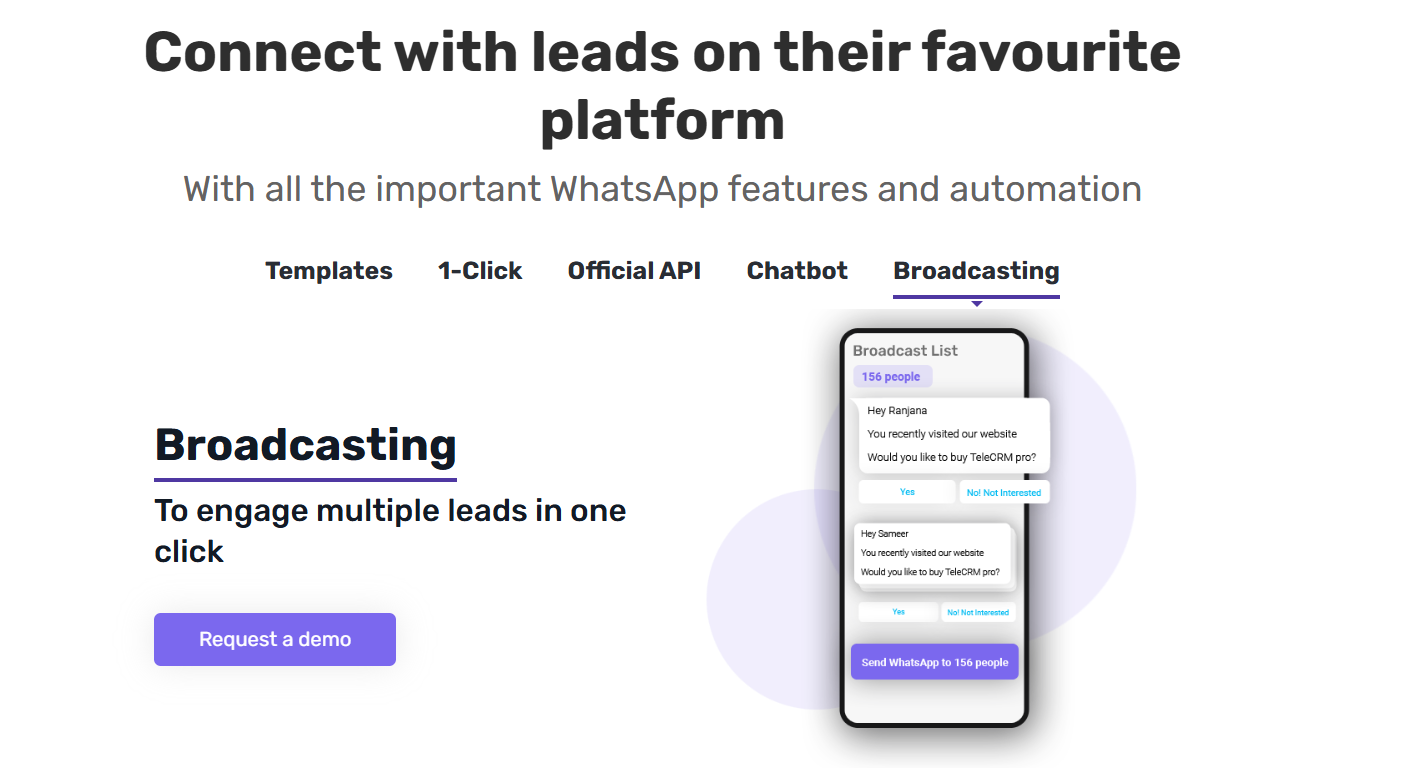
Broadcast automation can reach over 100,000 opted-in customers simultaneously with a single send. Broadcast campaigns are used for product launches, festival offers, price revisions, new batch announcements and promotional updates.
The important word is “opted-in.” Sending broadcast messages to contacts who haven’t agreed to hear from your business violates Meta’s policies and risks your account quality rating. Segment your lists, target by interest or stage and use broadcasts for messages that are actually relevant to the recipient.
Enhanced engagement through automation can deliver media-rich promotional offers — images, videos, PDFs and CTA buttons — all within a single WhatsApp message.
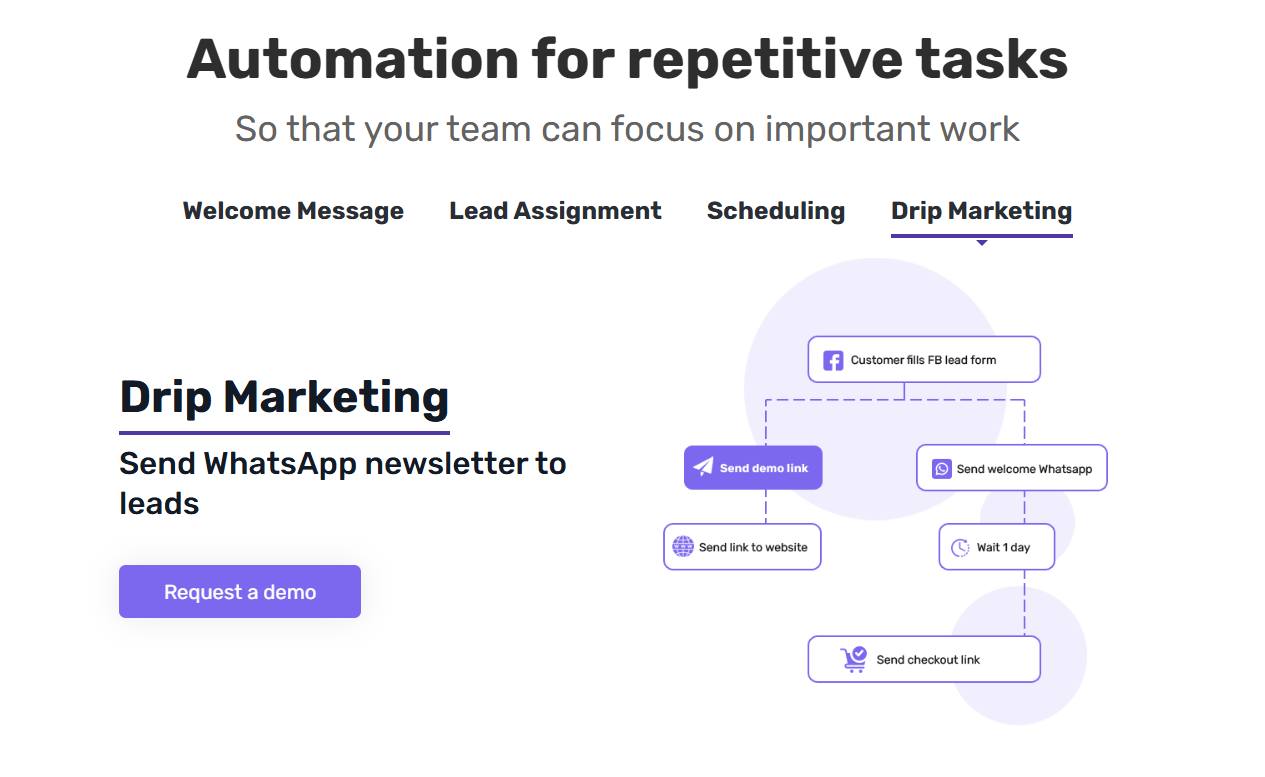
Drip campaigns send automated messages over time to nurture leads through a longer decision cycle. A prospect who enquired about a coaching programme but didn’t enrol might receive: course details on day one, a student testimonial on day three, a fee reminder and scholarship information on day five and a final deadline nudge on day seven.
Automated customer journeys enhance engagement through personalisation at every step — the message changes based on what the lead has done or not done, not just what day it is.
You can automate messages using preset rules or triggers that fire based on specific customer actions or events:
WhatsApp automation can send order confirmations instantly after purchase — no manual effort and no delay. Each of these triggers removes a task from your team’s to-do list while making the customer experience faster and more consistent.
Chatbot automation can handle about 70–80% of customer questions automatically — FAQs, pricing queries, availability checks, booking requests — without involving a human agent. Workflow automation uses if/then logic to guide customer interactions: if the customer selects “pricing,” show the pricing options; if they select “speak to someone,” route to an available agent.
Set up chatbots to resolve queries instantly, collect lead details and pass the conversation to a human when the query genuinely needs one. Maintaining a human touch is important for complex enquiries — chatbots handle the volume, your team handles the value.
When evaluating any WhatsApp automation tool, these are the features that determine whether it supports a sales process or just sends messages.
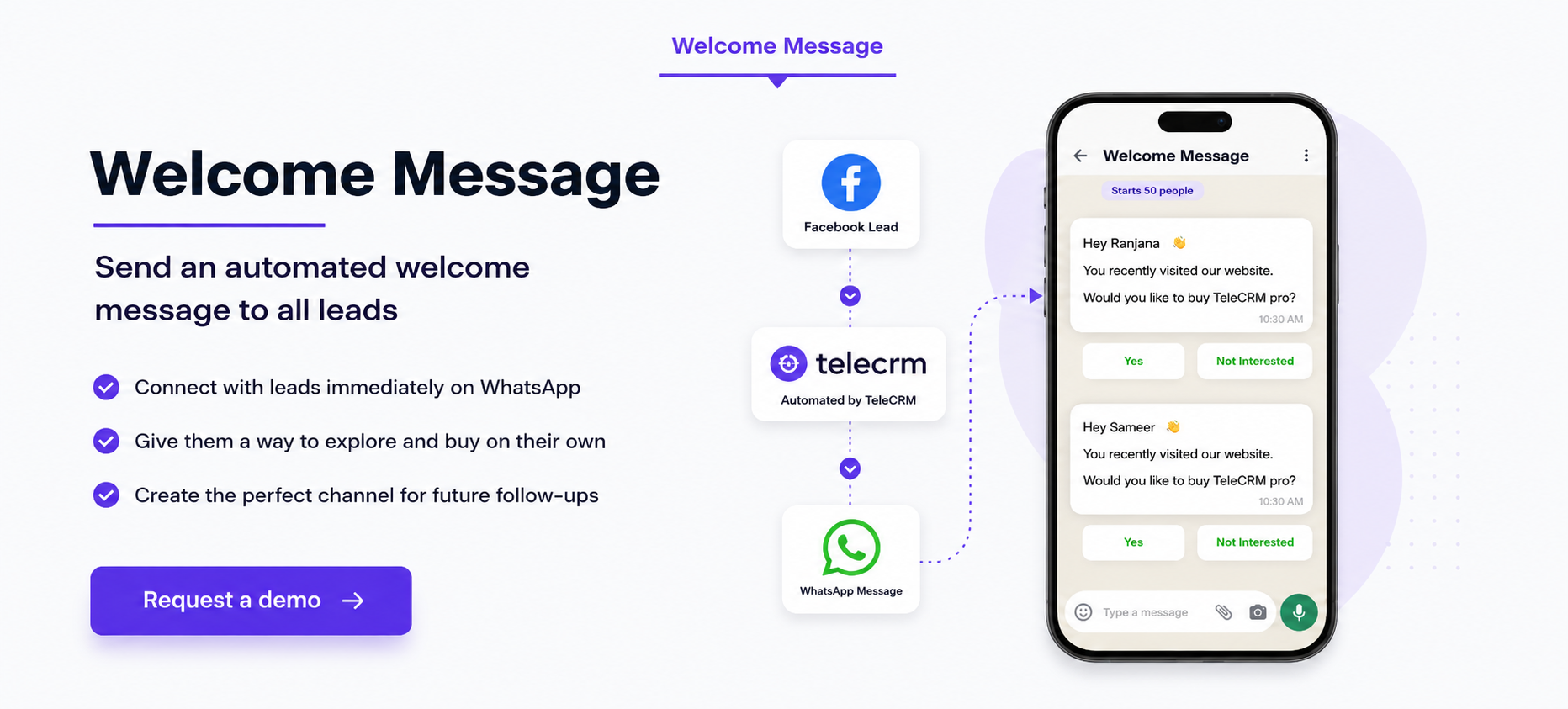
Automated welcome messages. Use automated welcome messages to greet new customers the instant they reach out — before they consider messaging a competitor. The first reply sets the tone. An instant, personalised response signals that your business is responsive and professional.
Away messages. Automatically tell customers your team is unavailable, with a clear expected response time. A customer who knows “we’ll call you back by 10 am tomorrow” is far less likely to go elsewhere than one who receives silence.
Broadcast messages. Reach large, segmented lists of opted-in contacts with targeted campaigns. Automated messages can be sent to over 100,000 customers simultaneously — a capability that would require a team of 20 doing it manually.
Drip sequences. Multi-message sequences that run automatically over days or weeks, keeping your business visible to leads who aren’t ready to buy yet. Businesses using WhatsApp automation report a 20–30% increase in recovered sales from leads that would otherwise have gone cold.
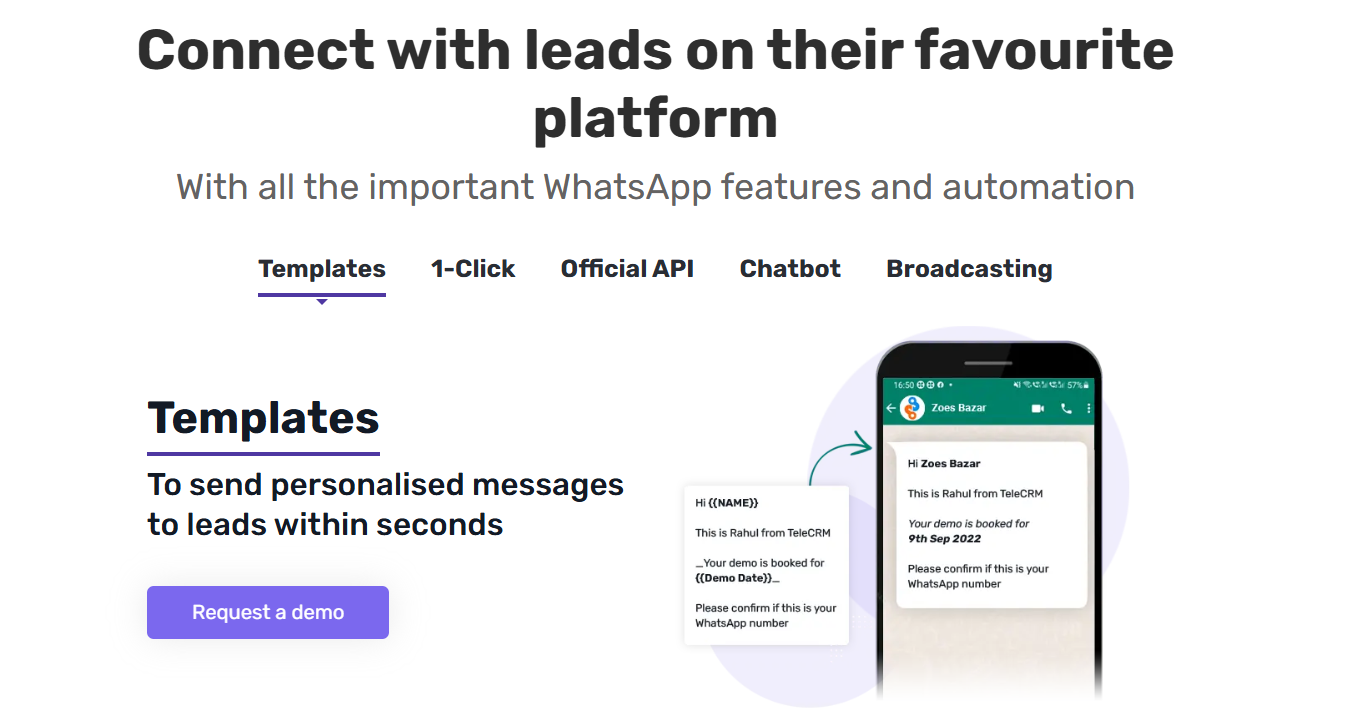
Approved message templates. Using approved message templates is required for initiating conversations on WhatsApp — messages your business sends first, outside the 24-hour conversation window. Templates cover marketing, utility, authentication and service categories and must be approved by Meta before use.
Human handoff. Any automation setup without a clean handoff to a human agent is incomplete. The system should know when to step aside — and when it does, the agent should receive the full conversation context, not a blank chat.
CRM integration. Every automated WhatsApp interaction should create or update a record in your CRM. Without this, your chatbot is a lead capture tool with no downstream action. Integrating WhatsApp with CRM platforms can automate workflows so every lead, call and WhatsApp conversation is tracked under one roof.
Analytics. Track key metrics to optimise automation performance — delivery rate, open rate, reply rate, drop-off point in chatbot flows and conversion per campaign. What you can’t measure, you can’t improve.
This is one of the most practically important rules in WhatsApp automation and most guides bury it or skip it entirely.
When a customer sends you a message, WhatsApp opens a 24-hour window during which your business can reply with any message — free-form text, images, documents, anything. Once that 24-hour window closes, you can only send pre-approved template messages to re-engage the customer.
What this means in practice: if a lead messages you on Monday at 2 pm and your team doesn’t respond until Tuesday at 4 pm, you’ve missed the free-form window. You can still send a template message, but you lose the ability to have a natural, unscripted conversation until the customer replies again.
For Indian sales teams, the implication is clear: your first response needs to happen fast. An automated welcome message that fires within seconds of the customer’s first message keeps the window open, captures their attention while they’re interested and gives your team a qualified lead to follow up on rather than a cold name on a list.
Meta requires that customers explicitly opt in before you send them template messages or add them to broadcast campaigns. This isn’t just a Meta requirement — it’s also aligned with India’s Digital Personal Data Protection (DPDP) Act requirements on consent.
Valid opt-in for WhatsApp in India looks like:
What doesn’t count: importing a purchased contact list, using leads from a portal that only agreed to be contacted about a property listing, or adding contacts to a broadcast list without their knowledge.
Ensuring compliance involves obtaining customer consent before sending promotional updates. Getting this right protects your account quality rating, keeps your number from getting flagged and builds the kind of customer trust that makes your messages welcome rather than intrusive.
The WhatsApp Business app is free. For API-based automation, costs fall into two categories.
Meta conversation charges are billed per conversation (a 24-hour window), not per message. In India, approximate current rates are:
A business sending 1,000 marketing broadcasts per month would pay Meta approximately ₹863 in conversation charges plus 18% GST — less than the cost of one cold calling session.
Platform or BSP fees vary by provider. In India, entry-level platforms start from approximately ₹1,500–₹3,000 per month. Mid-tier platforms with CRM integration, multi-agent support and analytics typically run ₹5,000–₹15,000 per month.
Free plans exist but are capped at 100–2,000 messages per month and often include provider branding in conversations. For a team handling more than 30–40 daily enquiries, a free plan is a proof-of-concept, not a business tool.
For current Meta conversation rates, check the WhatsApp Business Platform pricing page directly — they are updated periodically.
Note: telecrm provides a WhatsApp API platform completely FREE without any platform charges. All you have to do is pay a per-message charge to Meta and that’s it.
Good automation feels like a helpful business that’s on top of things. Bad automation feels like a company that bought a list and is using a robot to work through it. The difference comes down to a few simple rules.
WhatsApp automation is legal in India — when operated on the official WhatsApp Business API and in compliance with Meta’s policies and the DPDP Act.
The rules to know:
Learn how automated WhatsApp messages can be used in different industries:
Most property enquiries come in from portals, ads and referrals — often outside business hours. An automation setup sends project brochures, location maps and pricing details the moment a lead is created, books site visits automatically and sends reminders the day before. If a site visit is missed or cancelled, a rescheduling message goes out without anyone chasing it manually.
Automated reminders drive sales through personalised messages tied to each buyer’s stage — a buyer who requested a brochure gets different follow-ups than one who’s already done a site visit.
Enquiries about admissions, batch timings, fees and demo classes follow predictable patterns. A chatbot can answer 80% of these without a counsellor getting involved, collecting the student’s name, course interest and callback preference. Drip sequences run from first enquiry to admission — sharing syllabus details, student testimonials and fee deadlines on a schedule that matches the decision cycle.
Support teams report handling 60–70% fewer routine queries after implementing WhatsApp automation — which means counsellors spend their time on calls that actually convert, not repeating the same information to 40 enquiries per day.
These sales cycles are longer and trust-driven. Automation earns its place by handling the administrative layer: sending eligibility criteria and document checklists after a missed call, running renewal reminders at 30, 15 and seven days before premium due dates and collecting KYC documents via WhatsApp message before the advisor’s call.
Businesses from the insurance and finance industry that are using WhatsApp automation will have a much better increase in recovered sales from leads that would have otherwise gone cold — renewals not chased, callbacks not made, documents not collected. Automation captures this revenue without adding headcount.
Clinics, salons and home services use automation primarily for appointment reminders and booking confirmations. Clinics using automated reminders can significantly improve no-show rates. Post-service feedback collection via WhatsApp feeds rating data back into the CRM and creates upsell opportunities without any manual follow-up.
Here’s the gap that most WhatsApp automation setups don’t close: the chatbot captures the lead, the broadcast goes out, the customer replies — and then what?
If that conversation sits in WhatsApp with no connection to your calling system, no agent assignment and no follow-up reminder, you haven’t automated your sales process. You’ve automated your messaging.
telecrm is built specifically for Indian teams that sell through calls and WhatsApp — not a generic CRM with a WhatsApp integration added on. Here’s what the combination looks like in practice.
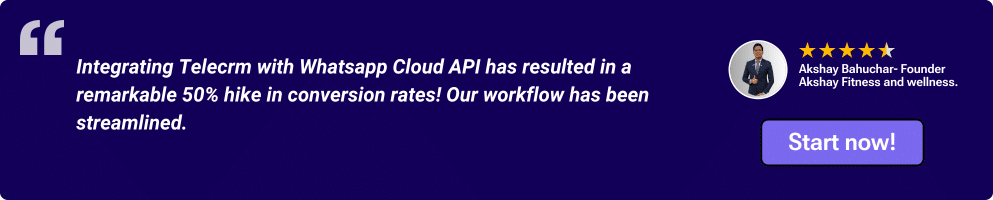
A WhatsApp chatbot can answer queries, qualify leads and keep conversations active. But telecrm helps businesses manage the complete sales process after that conversation starts.
With telecrm, businesses can capture leads from multiple sources, auto-assign them to the right sales rep, call them directly from the CRM, track every interaction and manage follow-ups without switching between tools.
One of telecrm’s biggest advantages is WhatsApp chat sync. It helps teams see customer WhatsApp conversations inside the CRM, so every chat is connected to the right lead. This means sales reps do not lose context, managers can track customer communication and the business does not depend on scattered personal WhatsApp chats.
Beyond WhatsApp chat sync, telecrm also supports WhatsApp Cloud API, templates, bulk broadcasts, automated message flows and chatbot-based engagement. So businesses can use WhatsApp not just for replies, but for structured sales communication.
telecrm also helps with SIM-based calling, click-to-call, call tracking, call recording, missed call tracking, AI call summaries, follow-up reminders, recurring events, custom sales pipelines, lead stages, sales forms, team performance reports and role-based access control.
In simple terms, the chatbot starts the conversation. telecrm helps businesses capture leads, sync WhatsApp chats, assign leads, call faster, follow up on time, track every activity and close more deals from one system.
Yes, when built on the official WhatsApp Business API and operated in compliance with Meta’s policies. Businesses must obtain explicit opt-in consent from customers before sending template messages. Under India’s DPDP Act, businesses must also handle customer data collected through WhatsApp with appropriate consent and data minimisation. Using unofficial tools or automation built outside the API violates Meta’s Terms of Service and risks permanent account suspension.
The free WhatsApp Business app supports basic automation — greeting messages, away messages and quick replies. It does not support chatbot flows, broadcast campaigns beyond 256 contacts, multi-agent access or CRM integration. The WhatsApp Business API removes these limits and is the foundation for any serious sales automation setup.
Basic automation on the Business app takes about 15 minutes. A full API setup — account creation, Meta template approval and first workflow configuration — typically takes one to two days once API access is confirmed. Building out more complex flows with CRM integration and industry-specific sequences takes two to five days, depending on the platform and your requirements.
No — and it shouldn’t try to. Automation handles routine tasks: first replies, FAQs, reminders, document collection and follow-up sequences. High-value conversations — negotiations, objections, relationship-building — still need a human. The businesses that see the best results use automation to handle volume and their team to handle value.
The Business app is free. For API-based automation, you pay Meta messaging charges (approximately ₹0.8631 per marketing message in India) plus platform fees to your BSP or CRM provider. Entry-level platforms start from around ₹1,500–₹3,000 per month in India. The right way to evaluate cost is against the leads recovered, follow-ups automated and agent hours saved — most businesses find the ROI clear within the first 30 days.
telecrm connects WhatsApp Business API access with calling, lead management, pipeline tracking and team reporting in one platform. Automated messages, chatbot flows and broadcast campaigns run from the same system where your agents manage calls and follow-ups — so every WhatsApp interaction is tied to a lead record, every follow-up is tracked and every manager has full visibility without asking anyone for updates.
WhatsApp automation can get your number blocked if you spam users, message people without consent or use unofficial tools. To reduce risk, use the official WhatsApp API, get opt-ins, send approved templates and follow WhatsApp’s messaging policies.



© Copyright 2026 telecrm.in (Flamon Cloudtech Pvt Ltd) - All Rights Reserved • Privacy Policy • T&C



© Copyright 2026 telecrm.in - All Rights Reserved • Privacy Policy • T&C