

Telemarketing is the practice of using phone calls to reach potential customers, follow up with existing ones or collect market feedback. In India, it is one of the most direct and cost-effective ways for sales teams to generate leads and set appointments.
Unlike paid ads, a phone call reaches one specific person in real time — giving the caller immediate feedback and the chance to address objections on the spot.
This guide covers:
As a business owner, you already know how much time and money marketing can eat up.
Telemarketing is different. It doesn’t drain your budget or keep you waiting. Instead of paying for impressions and clicks, you can pick up the phone and talk to people directly. One call puts you in front of a potential customer who’s ready to listen.
With a short conversation, you can:
And if the person isn’t interested? You still get quick feedback you can use to adjust your approach.
For a business owner, that means no guessing games and no wasted effort. Just direct conversations with people who could actually become customers.
In this blog, we’ll walk you through practical, simple and easy-to-use telemarketing steps. These are the same things real businesses do every day to:
…all without burning through their budget.
Telemarketing is the practice of using phone calls to connect a business with potential or existing customers. It covers outbound prospecting, inbound customer enquiries, appointment setting, lead qualification and market research — all conducted directly over the phone.
There are a few common forms. In outbound telemarketing, businesses make calls to prospective customers to introduce their products or services. In inbound telemarketing, the calls come from customers who want information or help.
Some companies use automated telephone calls to deliver recorded messages, while others rely on a sales representative who can answer questions in real time.
Put simply, telemarketing is about contacting people directly by phone. It remains one of the most personal and immediate ways a business can start a conversation and build customer relationships.
There are four main types of telemarketing: outbound, inbound, B2B vs B2C and automated. Each type serves a different business objective — from generating new leads to handling inbound enquiries or reaching large audiences through recorded messages.
Telemarketing is not one-size-fits-all. Businesses use it in different ways depending on whether they want to find new leads, handle customer questions or reach a wide audience quickly.
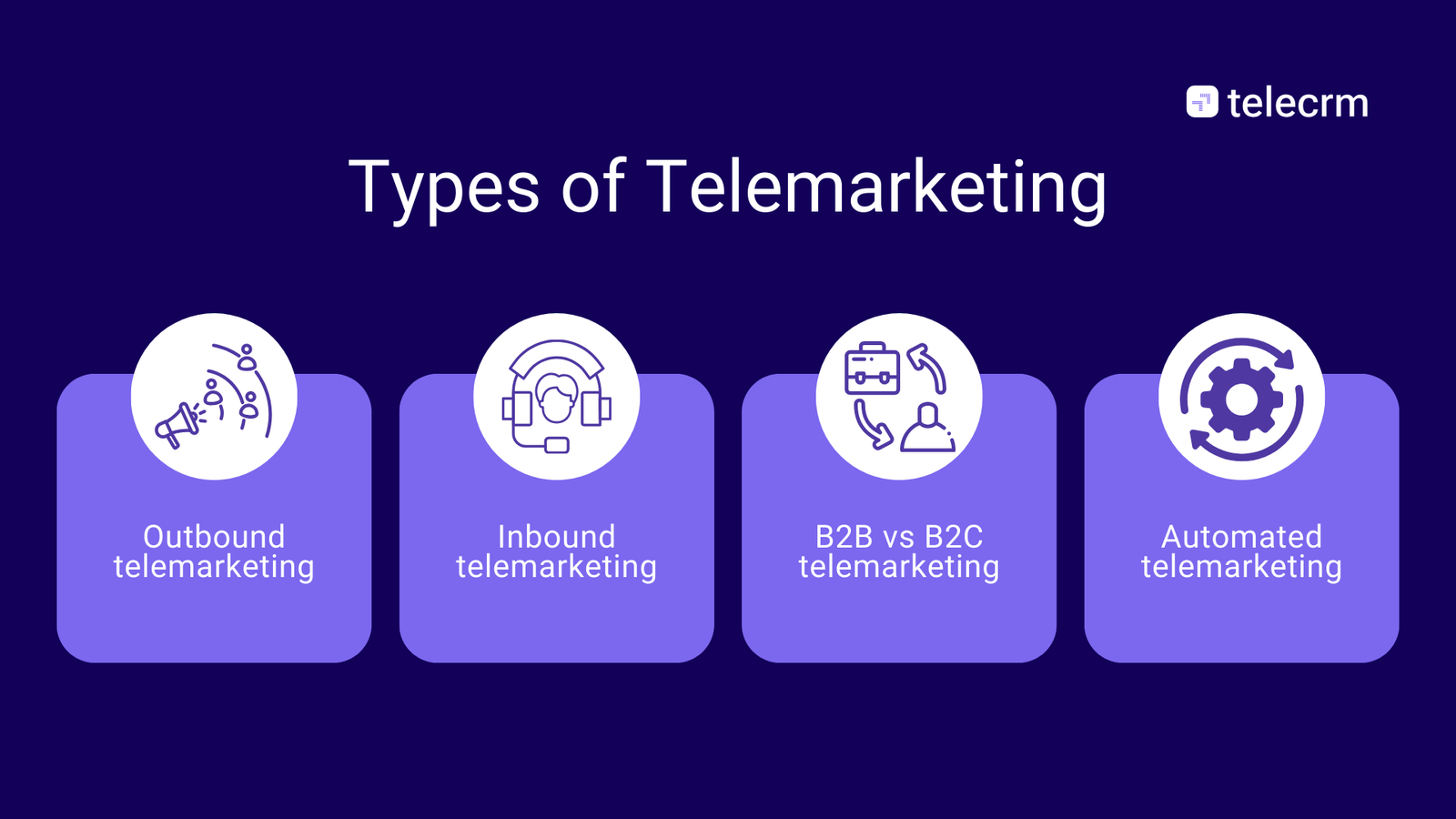
Understanding the types of telemarketing helps you pick the right approach for your business goals.
This is the most common form. A business makes calls to potential customers to talk about its products or services. The aim is usually to generate leads, set appointments or make sales. Outbound calls are proactive — the company reaches out first.
Here, the customer makes the call. It could be to ask a question, get support or learn more about an offer. Inbound telemarketing is more about handling interest that already exists and helping people move closer to a decision.
Telemarketing works in both spaces. B2b telemarketing focuses on reaching other businesses, often with longer sales cycles and multiple decision makers. B2c telemarketing is about calling individual consumers, usually with shorter conversations that aim to close quickly.
Some companies use automated telephone calls to reach many people at once. These calls play a recorded message and can be used for reminders, simple offers or surveys. While cost-effective, they are less personal than speaking to a sales representative.
These three terms often get mixed up, but they are not the same. Each has a different focus and purpose. Here’s a quick breakdown.
Term | What it means | Main goal | Example use |
Telemarketing | Using the phone to connect with potential or existing customers | Generate leads, set appointments and answer questions | A company calls prospects to explain a new service |
Telesales | Selling directly over the phone | Close sales | A sales rep calls and takes payment for a product |
Cold calling | Calling people who have not shown prior interest | Spark interest, introduce an offer | A rep calls a list of prospects to pitch insurance |
This is the broadest of the three. Telemarketing is about starting and building conversations with people over the phone. It covers lead generation, market research, appointment setting and customer support. The goal is not always to sell right away but to move customers closer to a decision.
It covers lead generation, market research, appointment setting and customer support — making it broader in scope than telesales (which only closes) or cold calling (which only targets new prospects).
Telesales is a specific type of phone-based outreach focused entirely on closing a sale in the same call. A telesales agent’s primary goal is to take payment or get a firm commitment — not to set appointments or collect information like a telemarketer does.
Cold calling means contacting people by phone who have had no prior interaction with the business. It has a lower contact rate than warm calling because prospects are not expecting the call — but it remains effective for businesses that need to reach new audiences quickly from a bought or scraped contact list.
Telemarketing’s main advantages are direct customer contact, real-time feedback and lower cost than most paid advertising. Its main disadvantages are high rejection rates, strict compliance requirements in India and the time investment needed to train effective calling agents.
Like any marketing approach, telemarketing comes with strengths and challenges. Knowing both helps you decide if it’s the right fit for your business.
Advantage | Disadvantage |
Direct contact: The caller knows the message has been received because a person picks up the phone | High rejection rates: Most calls end with “no”, which affects team morale over time |
Immediate feedback: Objections and interest signals appear in real time and can be addressed immediately | Compliance requirements: India’s TRAI DND registry and TCCCPR registration are mandatory and carry fines if ignored |
Lower cost than ads: No per-click or impression fees. Cost scales with call time and team size | Training required: Effective calling needs scripted preparation, objection handling practice and ongoing coaching |
Personal touch: Voice conversations build early trust faster than email campaigns or display ads | Negative perception: Unsolicited calls may be viewed as spam, especially automated dialler campaigns |
Flexibility: Works for sales, customer service, surveys, market research and follow-up campaigns | Scaling challenges: Each call takes real agent time and cannot reach thousands at once without automation |
In India, every business that makes outbound promotional calls must register with TRAI under the TCCCPR framework, verify numbers against the Do Not Disturb registry before calling and restrict promotional calls to 9 a.m.–9 p.m. Non-compliance can result in heavy fines and telecom service disconnection.
Telemarketing can be powerful, but it’s also one of the most regulated forms of marketing in India. Strict rules are in place to protect consumers from unwanted or fraudulent calls. As a business owner, knowing these rules isn’t optional — it’s essential.
TRAI maintains a Do Not Disturb (DND) registry through every telecom operator in India. Any business running promotional calls must check the DND list before dialling. Calling a registered DND number is prohibited and can result in fines and telecom service suspension.
The Telecom Regulatory Authority of India (TRAI) has set clear rules to reduce spam calls and messages. Every telecom operator maintains a Do Not Disturb (DND) registry where consumers can block promotional calls and texts.
Every business that makes promotional calls in India must register as a telemarketer with TRAI through its telecom operator. Registration provides a unique Telemarketer ID. Without it, any promotional call or SMS the business sends will be flagged as spam by the network.
Under the Telecom Commercial Communications Customer Preference Regulations (TCCCPR), every telemarketer — whether a large company or a small firm — must register with TRAI through their telecom operator.
Even if a number is not on the DND list, you cannot just start blasting calls at random times. Consent matters.
Businesses that ignore India’s DND registry and TCCCPR rules risk being blacklisted by telecom operators — which means all their outbound calls get blocked network-wide. Compliance protects both the business’s ability to call and its reputation with prospects.
Staying compliant is not just about avoiding fines. It builds trust. Businesses that ignore the rules often get blacklisted, which hurts their brand. On the other hand, following the regulations shows that you respect your customers’ privacy and time, making them more likely to hear you out.
Effective telemarketing depends on four things: a natural calling script, a trained team that handles objections without sounding pushy, tools that reduce manual admin and basic call tracking metrics. Getting all four right consistently determines whether a calling team generates leads or burns through contact lists.
Telemarketing works best when it feels like a proper conversation, not just someone reading a script. If you want your team to get real results, here are a few things to keep in mind.
Don’t hand your team a rigid script that makes them sound like robots. Give them a guide with a few key points:
Think of the script as a map, not a word-for-word speech. These telecalling scripts for different situations can help your team prepare for objections, callbacks and closing conversations.
Most customers won’t say “yes” straight away. Your team needs to know how to listen, stay calm and deal with common replies like “I’m not interested” or “Call me later.”
A rep who listens well will often win trust faster than one who just pushes the pitch.
The four tools that most improve telemarketing team efficiency are: a CRM to store all lead data in one place, an auto-dialler to remove manual dialling, call recording for training and quality review and WhatsApp or SMS for quick post-call follow-ups.
Dialling numbers one by one or keeping notes in Excel will only slow you down. A proper system makes life easier.
The right tools mean fewer mistakes, better tracking and more time spent talking to customers.
A new telemarketing team should track four numbers weekly: total calls made, contact rate (calls where someone picked up), conversion rate (contacts that became meetings or leads) and follow-up completion rate. These four metrics show what is working and where the team needs coaching.
You don’t need fancy reports to start with. Just track a few key numbers:
These numbers show you what’s working and where your team needs a little help.
Without a CRM, a telemarketing team managing more than 20 daily calls will inevitably miss follow-ups, lose lead context between calls and leave managers with no view of team performance. A CRM built for telecalling solves all three gaps in one system.
Telemarketing gets messy fast once you’re handling dozens of calls a day. A CRM keeps things simple and organised. Here’s how it helps:
Not every CRM is built for telemarketing. If you want your calling team to be effective, here are the some features your CRM should have:
For teams looking to improve call quality, tools like Otter AI can automatically transcribe conversations and highlight key moments, making it easier to identify coaching opportunities and track what’s working in your sales calls
telecrm is a CRM built for Indian telecalling teams. It combines lead capture, 1-click calling, call recording, WhatsApp messaging, automated follow-up reminders and TRAI-compliant reporting in a single platform — without requiring separate tools for each function.
telecrm is built specifically for calling and WhatsApp communication. Unlike general-purpose CRMs adapted for telecalling, telecrm is designed from the ground up for teams that make calls and manage follow-ups as their primary daily activity.for general sales or marketing — not for the day-to-day usage of telemarketing teams.
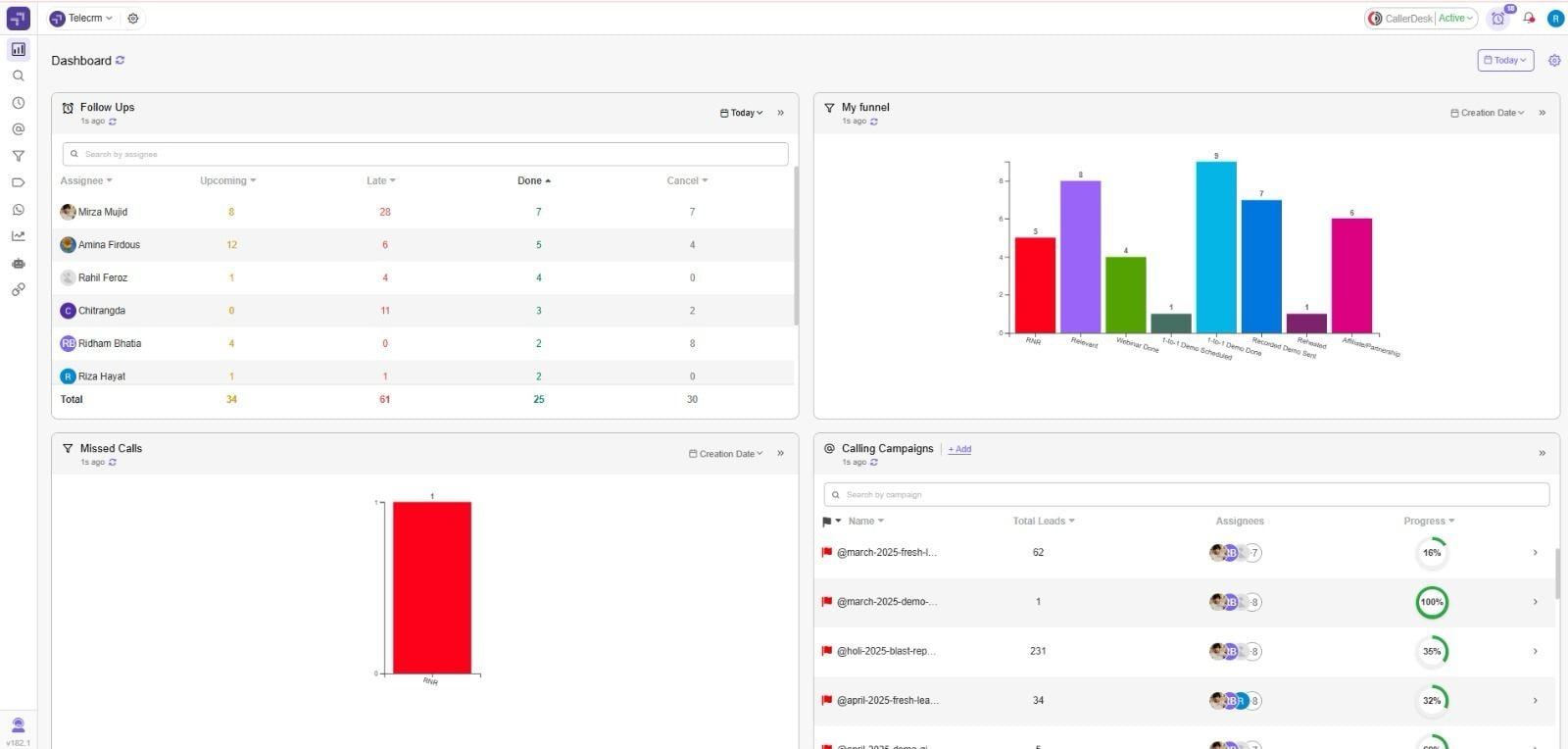
Here’s why:
Explore telecrm’s call management software to see how your team can organise calls, track outcomes and keep follow-ups on schedule.
Book a demo of telecrm to know more about pricing and features
Telemarketing in India is shifting towards AI-assisted dialling, multichannel communication (calls combined with WhatsApp, SMS and email), stricter DND compliance and data-driven targeting. Teams that adapt to these changes will find calling more effective, not less relevant.
Telemarketing is changing, but it’s not going away. Here are a few trends to watch:
Telemarketing remains one of the simplest and most effective ways to connect with customers. Whether you’re just starting out or already running a calling team, the difference between success and frustration often comes down to how organised your process is.
If you’re new to telemarketing, the key is to start small but structured — clear scripts, a bit of training for your team and telecrm to keep everything in one place. This way, you avoid the pain of scattered leads and missed follow-ups.
If you already use telemarketing in your own business, you’ll know how quickly things can get complicated — multiple agents calling, leads slipping through the cracks and no clear view of results. That’s where upgrading to a proper telemarketing CRM like telecrm makes all the difference.
Ready to see how telecrm can help your team connect better and sell more? Book a demo to see how telecrm manages calling, WhatsApp follow-ups and lead tracking for Indian telemarketing teams.
Telemarketing is the use of phone calls to reach potential or existing customers for lead generation, appointment setting, sales or market research. It differs from telesales (which focuses only on closing) and cold calling (which targets people with no prior contact) in that it covers the full range of phone-based customer outreach.
The four main types are: outbound telemarketing (businesses calling prospects), inbound telemarketing (customers calling in), B2B telemarketing (targeting businesses with longer sales cycles) and automated telemarketing (recorded messages sent to large contact lists). Outbound is the most common type for lead generation among Indian sales teams.
Advantages include direct customer contact, real-time feedback on objections and lower cost than most digital advertising. Disadvantages include high rejection rates, India’s strict TRAI compliance requirements and the time investment needed to build and train an effective calling team.
Yes, telemarketing is legal in India but regulated by TRAI under the TCCCPR framework. Every telemarketer must register with TRAI through their telecom operator. Calling numbers on the Do Not Disturb registry is prohibited and carries heavy fines. Promotional calls are restricted to 9 a.m.–9 p.m.
Effective telemarketing relies on: a natural calling script, trained reps who can handle objections, auto-dialling tools to reduce manual effort, call recording for quality review and a CRM to track leads and follow-ups. In India, TRAI-compliant call logging and DND registry checks are also essential features.
A telemarketing CRM keeps all lead data, call history and follow-up tasks in one place. It should include lead management, built-in or integrated calling, call recording, follow-up reminders, WhatsApp or SMS messaging and basic reporting on calls made and deals closed. telecrm includes all of these in one platform.
Realistic starting goals for a telemarketing team include: 40–80 calls per agent per day, a 10–20% contact rate (calls where someone picks up), a 5–10% conversion rate from contact to appointment or lead, and zero missed follow-ups. Track these weekly and adjust scripts or call lists based on what the data shows.
Telemarketing works best for products and services that require explanation before purchase. Common examples in India include: insurance policies, real estate, EdTech subscriptions, B2B SaaS platforms, financial products, healthcare services and banking offers. It is also highly effective for appointment-setting and lead qualification in any industry with a sales cycle longer than a single visit.
Telecalling is the Indian term for telemarketing. Both refer to the practice of using phone calls to generate leads, set appointments or follow up with prospects. In Indian job listings and business contexts, the agent role is typically called a telecaller and the activity is referred to as telecalling rather than telemarketing.



© Copyright 2026 telecrm.in (Flamon Cloudtech Pvt Ltd) - All Rights Reserved • Privacy Policy • T&C



© Copyright 2026 telecrm.in - All Rights Reserved • Privacy Policy • T&C