

Hospitals spend a huge portion of admin time answering routine questions — yet 64% of patients say they’ve experienced delays in communication with their healthcare provider (PwC). WhatsApp chatbots offer an instant solution.
They automate common queries, cut down waiting time and free doctors to focus on treatment. With the global healthcare chatbot market projected to hit $543 million by 2028 (CAGR 19%), now is the right time for providers to adopt them.
In this article, we’ll break down what healthcare chatbots are, why WhatsApp is the go-to channel and the top ways providers can use them.
A healthcare chatbot is an AI-powered virtual assistant that helps patients and healthcare providers manage routine communication tasks such as appointment booking, reminders, FAQs, report updates and follow-ups.
Instead of patients waiting for long phone calls or chasing hospital staff, they get instant responses on a preferred communication tool like WhatsApp, letting them get these updates on a channel they already use every day.
For example:
These medical chatbots improve patient communication and reduce delayed responses by automating follow-ups, prescription refills and even mental health check-ins. For doctors, that means less time on repetitive admin and more on patient care.
Because they run on messaging apps like WhatsApp through the WhatsApp Business API, they fit easily into existing healthcare systems, keep sensitive patient information secure and support regulatory compliance.
Whether it’s telehealth services, virtual consultations or in-person appointments, they deliver seamless communication that boosts patient satisfaction, patient engagement and better patient outcomes.
In the healthcare sector, both doctors and patients want seamless communication. Traditional phone calls or hospital staff follow-ups often lead to delayed responses and missed patient queries. That’s why WhatsApp, the preferred communication tool for billions, has become the first choice for healthcare communication.
Also read: How to Create a WhatsApp Community for Businesses and Teams
Imagine a hospital preparing for a vaccination drive. Instead of staff making thousands of calls, the healthcare chatbot sends out bulk reminders through appointment scheduling on WhatsApp. In one click, the hospital reaches thousands of patients with details about doctor availability, timings, and booking links.
The chatbot then handles patient communication automation, confirming slots, sending health reminders via WhatsApp, sharing test result notifications via WhatsApp if required and following up with a 24/7 patient support WhatsApp message.
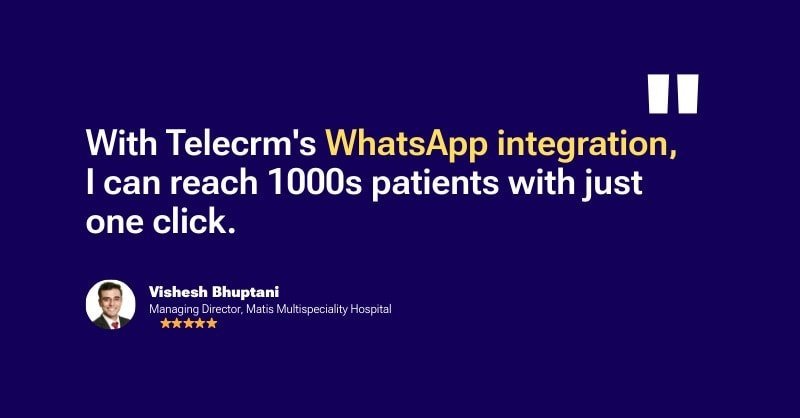
All of this happens instantly and securely through telecrm’s WhatsApp integration, exactly like Vishesh Bhuptani (Managing Director, Matis Multispeciality Hospital) highlighted: “With telecrm’s WhatsApp integration, I can reach thousands of patients with just one click.”
This mix of mass outreach, telemedicine automation, and personalised care shows why healthcare providers and medical professionals see WhatsApp chatbots as the future of the healthcare system, especially in fast-growing regions like healthcare chatbots India.
So how do these chatbots actually help in day-to-day healthcare? Generally, healthcare chatbot use cases are regarding appointment booking, medication reminders, lab report updates, patient support or basic emergency guidance.
Let’s explore the five most common use cases amongst them.
Healthcare chatbots simplify booking appointments by integrating with hospital management systems.
Missed medicines lower patient outcomes. Medical chatbots send medicine reminders and track progress.
Bots provide secure access to patient data, medical history and lab reports.
Chatbots in healthcare handle routine tasks like answering patient queries (“How do I cancel an appointment?”) and collecting patient feedback.
Some healthcare chatbots act as emergency response chatbots or provide mental health assistance.
From reminding patients about medicines to enabling virtual consultations and telehealth services, these chatbots in healthcare ensure patients receive timely care, reduce delayed responses and make healthcare communication more effective.
From patient communication to staff productivity, healthcare chatbots help providers respond faster, reduce staff workload, improve patient engagement, manage routine communication and keep care-related updates available around the clock.
Here’s exactly how healthcare chatbots make a real difference.
Patients no longer wait on hold for simple queries. A chatbot on WhatsApp answers instantly — whether it’s about appointment timings, lab results or follow-up reminders.
Routine tasks like rescheduling appointments, sending medicine reminders or handling cancellations move from hospital staff to the chatbot. This frees doctors and nurses to focus on treatment.
Bots keep patients actively involved in their care. For example, a hypertension patient can get daily reminders for medication along with lifestyle tips, improving adherence and long-term outcomes.
Modern chatbots can integrate with electronic health records while keeping sensitive patient information safe. This ensures compliance and builds trust in the system.
Unlike a call centre, chatbots are available 24/7. Patients can ask about side effects at midnight, check their appointment status or request a prescription refill at any time.
Related read: Guide to The Best WhatsApp Chatbot Tools for Businesses in 2026
Setting up a WhatsApp chatbot for healthcare may sound complex, but with telecrm, a WhatsApp CRM, it becomes straightforward. Here’s how a hospital or clinic can implement it:
telecrm integrates directly with the WhatsApp Business API, ensuring secure and compliant use. This keeps sensitive patient data safe while allowing providers to use WhatsApp as their main communication channel.
Start by mapping out routine interactions. For example:
Instead of hospital staff making endless calls, the chatbot handles:
telecrm allows integration with patient records, so messages can be personalised. Example:
With telecrm dashboards, providers can track:
By combining WhatsApp’s familiarity with telecrm’s automation, healthcare providers can deliver faster communication, reduce workload and build trust through timely, personalised care.
The future of healthcare isn’t just about advanced treatments; it’s also about how well providers communicate with patients. WhatsApp chatbots give healthcare providers the ability to deliver instant responses, manage appointments, send medication reminders and even share lab reports — all through a platform patients already trust and use daily.
For hospitals, clinics and individual practitioners, this means reduced workload, smoother operations and improved patient satisfaction. For patients, it means accessible, reliable and personalised care at their fingertips.
With tools like telecrm, implementing a WhatsApp chatbot for healthcare is no longer a technical challenge. It’s a practical step toward better patient outcomes, stronger engagement and a more efficient healthcare system. Give your patients faster, smarter care. Book a demo today.
A healthcare chatbot is an AI-powered virtual assistant that helps hospitals, clinics and healthcare providers automate routine patient communication. It can answer common queries, book appointments, send reminders, share lab reports, collect feedback and support patients through messaging platforms like WhatsApp.
A WhatsApp chatbot helps healthcare providers by automating repetitive tasks such as appointment booking, follow-up reminders, prescription refill requests, lab report updates and patient FAQs. This reduces the workload on hospital staff, improves response time and allows doctors to focus more on patient care.
WhatsApp is useful for healthcare communication because patients already use it daily and can receive instant updates without downloading another app. Hospitals can use WhatsApp to send appointment confirmations, medication reminders, test result notifications, follow-ups and emergency updates in a familiar and accessible format.
The top use cases of healthcare chatbots include booking appointments, sending medication reminders, sharing lab reports, answering patient queries, collecting feedback, supporting prescription refills and providing basic emergency or mental health assistance. These use cases help improve patient engagement and reduce communication delays.



© Copyright 2026 telecrm.in (Flamon Cloudtech Pvt Ltd) - All Rights Reserved • Privacy Policy • T&C



© Copyright 2026 telecrm.in - All Rights Reserved • Privacy Policy • T&C