
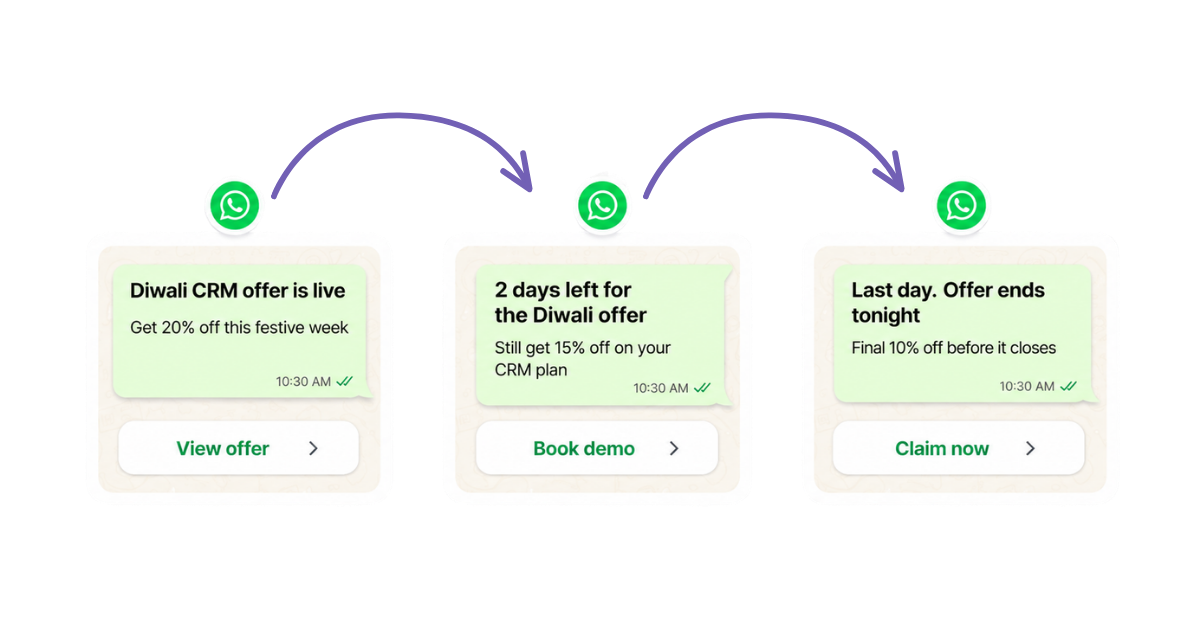
One message is rarely enough to turn a new enquiry into a customer.
A lead may need product information, answers to common questions, a reminder before a call and a follow-up after the conversation. Sending all of this manually becomes difficult once lead volume starts growing.
A WhatsApp drip campaign automates these interactions through pre-scheduled messages and behaviour-based triggers. Each message is sent according to the lead’s actions, interests and stage in the customer journey.
Done well, WhatsApp drip marketing helps businesses nurture leads, retain customers and keep their audience engaged. This guide will show you how to plan message sequences, follow WhatsApp’s policies and track the key metrics that influence campaign performance.
A WhatsApp drip campaign is an automated sequence of WhatsApp messages sent to a contact based on predefined triggers, time delays, customer behaviour and changes in the customer journey.
Instead of sending one message to an entire contact list, a drip campaign determines:
This makes a WhatsApp drip different from a standard broadcast. A broadcast sends one message to a selected audience, while a drip campaign delivers a connected series of messages that change according to user actions and customer data.
For example, a lead who submits an enquiry may enter the following sequence:
Each step is controlled by an automation rule rather than a sales rep manually checking when to send messages.
A successful WhatsApp drip campaign includes triggers, entry conditions, message templates, time delays, decision branches, actions and exit conditions. Here is what each component does:
A trigger is the event that starts the campaign, such as a form submission, Meta ad enquiry, demo booking, missed appointment or completed purchase. For example, a new lead entering the CRM can automatically trigger a lead nurturing sequence.
Entry conditions decide whether a contact qualifies for the campaign. These may check consent, lead source, sales stage, customer interest or whether the contact has opted out.
Message templates are predefined WhatsApp messages arranged in a planned sequence, such as a welcome message, product information or post-demo follow-up. They can be personalised using details such as the customer’s name, interest, appointment time or assigned sales rep.
Time delays control how long the campaign waits before sending the next message. The delay may range from a few minutes after an enquiry to several days after a demo or purchase.
Conditions decide what happens next based on customer behaviour. For example, a reply may pause the campaign, while a link click or demo booking may move the contact to another message sequence.
Actions are tasks the automation performs beyond sending WhatsApp messages. It may assign a sales rep, update a lead field, change the sales stage, create a follow-up task or notify a manager.
Exit conditions define when a contact should leave the campaign. The sequence may stop when the contact replies, books an appointment, completes a purchase, opts out or moves to another sales stage.
WhatsApp drip campaigns can be categorised into three types based on what controls the message sequence: time, customer behaviour or sales stage.
Time-based drip campaigns send pre-scheduled messages after fixed intervals, such as immediately after sign-up, one day later and three days later. They are commonly used for welcome sequences, onboarding, appointment reminders, payment reminders and post-purchase communication.
These campaigns are easy to set up, but the sequence should stop when the recipient replies, converts or completes the intended action.
Behaviour-based campaigns adjust the next message based on user actions, such as replying, clicking a link, booking an appointment, completing a payment or remaining inactive.
For example, a lead who clicks a pricing link may receive a consultation offer, while an inactive lead may receive a follow-up explaining the product’s key benefits. This makes the messages more relevant to the recipient’s past interactions.
Stage-based campaigns send messages according to a contact’s position in the sales funnel. New leads may receive welcome and qualification messages, while leads who complete a demo may receive case studies, pricing information or follow-ups.
When the lead moves to another stage in the CRM, the existing sequence stops and a more relevant campaign can begin. This keeps communication aligned with the customer journey.
A WhatsApp drip campaign works by connecting a trigger, a set of rules and a sequence of automated messages. When a contact performs a defined action, the system checks whether they meet the campaign conditions and then sends the first message.
For example, a person may submit a website form, click a WhatsApp ad or book a demo. This action adds them to a relevant message sequence. The campaign may send a welcome message immediately, wait for a fixed period and then check whether the contact replied, clicked a link or completed the intended action.
What happens next depends on the rules set within the campaign. If the lead responds, the automation may pause and assign the conversation to a sales rep. If there is no response, the system may send another follow-up. If the lead books an appointment, the campaign may move them into an appointment reminder sequence.
The complete flow usually looks like this:
Trigger → entry check → first message → time delay → customer action check → next message, branch or exit
These campaigns are generally run through the WhatsApp Business API connected to a CRM or automation platform. The platform stores customer data, sends approved message templates, records user actions and decides which step should happen next.
A successful WhatsApp drip campaign does not send messages simply because a set amount of time has passed. It uses customer behaviour, previous interactions and sales stages to ensure every follow-up remains relevant to the customer journey.
WhatsApp drip campaigns, broadcasts, chatbots and email drip campaigns can all be used to engage customers, but they serve different purposes.
A WhatsApp broadcast sends one message to a selected group of contacts at the same time. It works well for announcements, offers and general updates, but it does not create an ongoing message sequence based on customer behaviour.
A WhatsApp chatbot handles real-time conversations. It responds when a customer asks a question, clicks an option or provides information. A drip campaign continues communication over time, even when the customer is not actively chatting.
Email drip campaigns also send automated message sequences, but they are better suited for longer content, newsletters, reports and detailed resources. WhatsApp drip campaigns are more suitable for short, timely messages such as lead follow-ups, qualification questions, appointment reminders and payment updates.
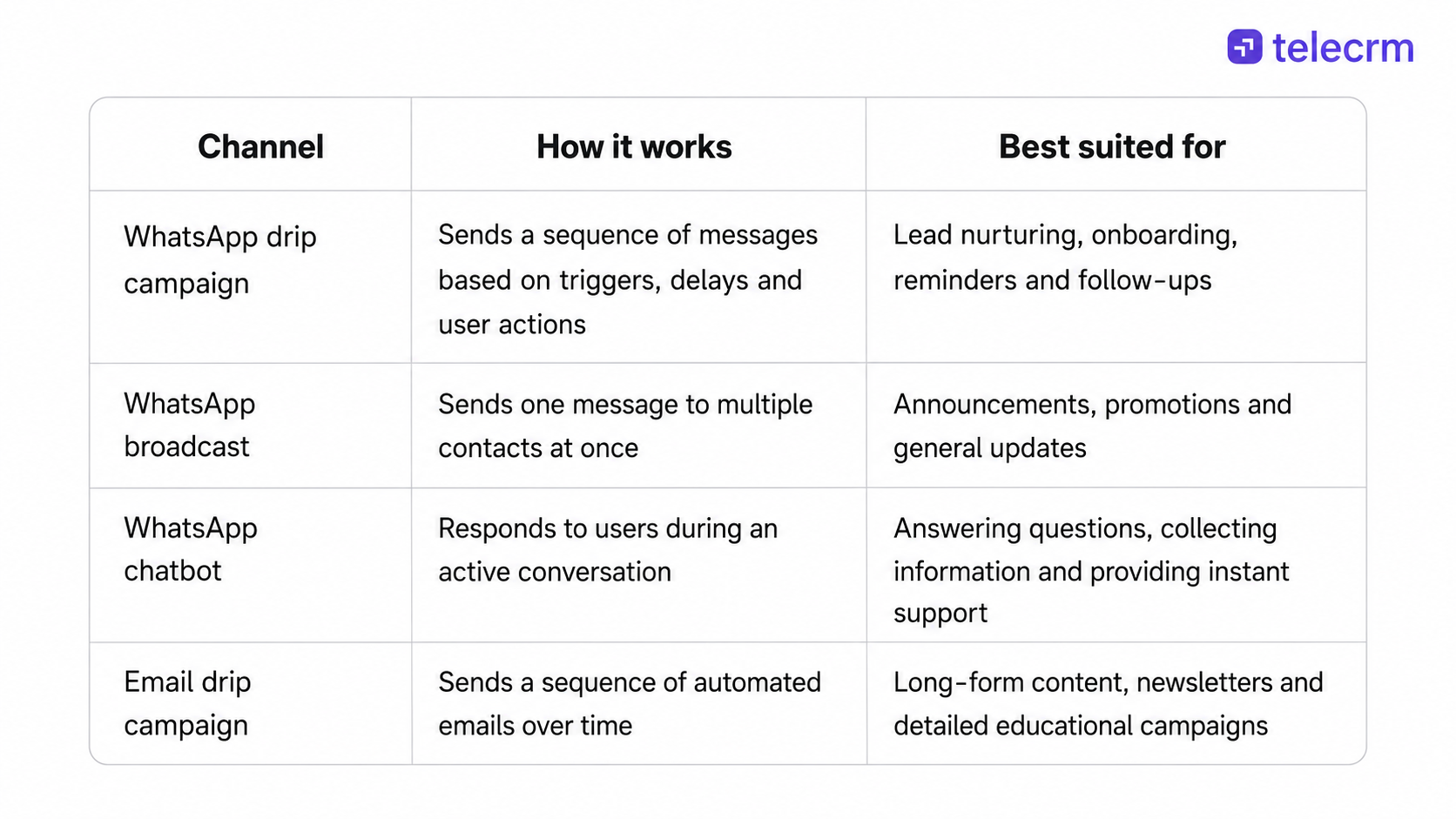
These channels do not have to work separately. A business may use a chatbot to qualify a new lead, a WhatsApp drip campaign to send follow-ups and appointment reminders and email to share detailed product information.
The right option depends on the purpose of the message. Broadcasts are useful for one-time communication, chatbots support real-time conversations, email handles detailed content and WhatsApp drip campaigns maintain engagement across different stages of the customer journey.
A WhatsApp drip campaign helps businesses follow up with leads and customers consistently without relying on manual reminders. Once the sequence is set up, relevant messages can be sent automatically based on time, customer behaviour or changes in the sales funnel.
Sales reps often miss follow-ups when lead volume increases. Drip campaigns ensure every contact receives the planned messages, whether that is a welcome message, appointment reminder, payment update or post-demo follow-up.
A new lead can receive an automated acknowledgement as soon as they submit a form or click a WhatsApp ad. This keeps the lead engaged until a sales rep is available to continue the conversation.
Businesses can tailor messages based on lead source, product interest, previous interactions, purchase history or stage in the customer journey. This makes messages feel more personal than generic bulk communication.
Not every lead is ready to buy after the first interaction. WhatsApp drip marketing allows businesses to share information, answer common questions and follow up over time until the lead is ready to take the next step.
Drip campaigns automate routine communication, allowing sales reps to focus on calls, qualified leads and real-time conversations. The system can handle basic reminders and updates while the team steps in when human interaction is needed.
Timely messages make it easier for customers to respond, click a link, book an appointment or complete a payment. Because WhatsApp supports two-way communication, the recipient can continue the conversation directly from the message.
WhatsApp drip campaigns can connect marketing, sales and customer support activities. A contact can move from a welcome sequence to a demo reminder campaign, then to onboarding or post-purchase communication without losing context.
When connected to a CRM or automation platform, businesses can track message delivery, replies, link clicks, bookings, conversions and other key metrics. These insights help identify which message sequences are working and where improvements are needed.
The mechanics are straightforward: a trigger starts a sequence of automated messages, each separated by a delay, with conditions that decide whether to continue, branch or stop.
Triggers are events that kick off the drip. For telecrm users, common triggers include:
Automated messages can be triggered by user actions – this is what separates a drip from a broadcast. Each message fires only when the condition is met.
Sample customer journey for a coaching institute enquiry:
Day | Message | Goal |
Day 0 | Welcome message: “Hi Ritika, thanks for your interest in our NEET batch…” | Acknowledge, share next step |
Day 1 | Value-add: short video of a classroom session | Build trust |
Day 3 | Social proof: testimonial from a student who cracked NEET | Create urgency |
Day 5 | Demo invite: “Book a free trial class this Saturday” | Drive action |
Day 7 | Limited offer: early-bird discount expiring in 48 hours | Close |
WhatsApp supports images, videos, PDFs and interactive buttons in messages, so each step in the sequence can use rich media to engage customers beyond plain text messages.
Exit rules are critical. If a lead replies at Day 1, the drip should pause and route that lead to a sales rep. If someone books the demo, they should move to an onboarding drip, not keep receiving the nurturing sequence. Automation tools like telecrm handle this with workflow conditions tied to CRM stage changes and call dispositions.
Different industries use WhatsApp drips differently, but the underlying logic is the same: send the right message to the right person at the right time, based on where they are in the customer journey.
Every template should follow these principles:
For ready-to-use examples, check out these WhatsApp promotion message templates and real estate WhatsApp templates.
You need the WhatsApp Business API plus telecrm’s integration to run scalable, compliant drips. The regular WhatsApp app cannot send automated messages at scale, lacks analytics and risks getting your number banned. Here is the full breakdown of WhatsApp Business API pricing for reference.
Obtaining explicit opt-in is essential for compliance with WhatsApp’s policies. You must obtain explicit consent before sending WhatsApp messages – through forms, click-to-WhatsApp ads or QR codes.
Step-by-step flow:
For a deeper walkthrough on combining channels, see telecrm’s marketing automation guide.
Even simple drip campaigns can annoy leads or get your number blocked if done carelessly. Your marketing strategies need to balance automation with empathy.
1. Always get opt-in first. Follow opt-in rules strictly. Invalid sources like purchased lists or scraped numbers will tank your deliverability and violate WhatsApp’s policies.
2. Segment your audience. Segmenting audiences boosts conversion rates significantly. Proper audience segmentation increases message relevance and audience segmentation allows tailored messaging based on behaviour. Effective segmentation considers demographics and purchase history. Segment your audience based on demographics and behaviour to tailor messages based on what each group actually cares about. Segmentation enhances customer engagement and retention rates – it is the foundation of every successful WhatsApp drip campaign.
3. Personalise beyond first names. Personalise messages using customer names and past interactions. Personalised messages increase engagement by 70%. Using customer names in messages boosts relevance and messages tailored to user behavior enhance customer relationships. Personalisation of messages can enhance user engagement in WhatsApp campaigns and personalised content can lead to higher conversion rates. Reference previous interactions, mention the exact course or property and tailor messages based on audience-based criteria and customer behaviour. The goal is to make tailored messages feel personal, not templated.
4. Get timing and frequency right. Space messages 1–3 days apart depending on urgency. Send during reasonable hours. For high-value, long-cycle products, use longer gaps. Maintain message freshness in campaigns by reflecting new products or seasonal changes instead of repeating the same pitch.
5. Keep messages short. WhatsApp messages should be concise and easy to read on mobile devices. One idea per message, one CTA, done. Use engaging content and dynamic content – not walls of text messages.
6. Mix value with offers. Alternate between educational content, social proof and promotional offers. If every message is a discount, you train leads to being ignored. Address pain points with helpful tips before pushing for a sale.
7. Provide a clear stop mechanism. Let leads opt out easily. It protects your sender reputation and keeps your list clean.
8. Measure and iterate. Tracking campaign performance metrics is necessary to improve engagement. Monitor campaign performance using metrics like open rates, response rates and conversions per message. Use telecrm’s detailed analytics to identify which message in your drip causes the biggest drop-off, then A/B test alternatives. Track key metrics like read rate, reply rate and click-through to understand real campaign performance. Avoid sending repetitive messages to maintain engagement – if a message isn’t working, replace it.
India-specific compliance note: WhatsApp Business API is fully legal in India, but India’s DPDP Act 2023 requires purpose clarity, documented consent and the ability for users to withdraw. Always keep opt-in records and include stop/unsubscribe options in promotional sequences.
WhatsApp drip campaigns turn random, manual follow-up into a predictable system that works even when your team is busy, on leave or changes entirely. The drip marketing approach replaces “I forgot to call them back” with a machine that sends personalised messages at every stage of the customer journey, keeping your audience engaged and your pipeline moving.
The real power of WhatsApp drip marketing comes when it is connected to a CRM like telecrm. When calls, SMS and WhatsApp message sequences run together, nothing falls through the cracks and your marketing efforts translate directly into business growth and measurable customer satisfaction.
Start small. Pick one high-impact journey – like new enquiry to booked demo – and build a 5-message drip before trying advanced branching and multiple campaigns. Once you see the impact on customer engagement and conversions, scaling becomes the easy part.
See how telecrm can automate your WhatsApp follow-ups – book a 15-minute demo to design your first WhatsApp drip campaign.
The regular WhatsApp app cannot send automated messages at scale. It lacks approved template support, has no analytics, no CRM integration and carries a high risk of getting your number permanently banned if you send messages in bulk. The WhatsApp business api, connected through a platform like telecrm, gives you compliant template sending, automation tools, delivery tracking and the ability to handle hundreds or thousands of leads without manual effort. For any serious drip marketing effort, API is the only safe and scalable path.
Most effective drips contain 4–10 messages. For shorter sales cycles (coaching enquiries, small-ticket products), 5 messages over 7–10 days works well. For high-value items (real estate, insurance), you may stretch to 8–10 messages over 3–4 weeks with longer gaps. Space messages 1–3 days apart and always adjust based on user behavior and response patterns. If leads are replying early, the drip is working – shorten it. If they are going silent, test different content formats or timing.
Absolutely. This is where telecrm differs from standalone WhatsApp tools. You can build a single workflow where a missed call triggers a WhatsApp message, a non-reply after 2 days triggers an auto-dialer call assigned to the right person and a successful call disposition moves the lead to the next drip stage. Combining channels in one sequence is the most effective way to engage customers across the entire sales funnel without losing context.
The automation should pause or exit the drip for that specific contact and route them to a sales rep for lasting relationships through real conversation. In telecrm, a reply can trigger a stage change or ownership assignment, stopping the automated sequence while the rep picks up the two way communication in the same CRM thread. Continuing generic automated messages after a lead has replied is one of the fastest ways to lose trust and damage customer satisfaction.



© Copyright 2026 telecrm.in (Flamon Cloudtech Pvt Ltd) - All Rights Reserved • Privacy Policy • T&C



© Copyright 2025 telecrm.in - All Rights Reserved • Privacy Policy • T&C