

Most businesses don’t fail at WhatsApp marketing because WhatsApp doesn’t work.
They fail because they treat it like a bulk messaging tool.
One offer. One copied message. One long contact list. And then they wonder why people ignore, block or report them.
But WhatsApp is not email. It is not SMS. And it is definitely not a dumping ground for random promotions.
It is where your customers already ask questions, compare options, confirm appointments, request prices, share documents and make decisions. That is what makes WhatsApp powerful, but also risky. If your message is useful, it feels personal. If it is irrelevant, it feels intrusive.
So the real question is not “Should you use WhatsApp marketing?”
The real question is: how do you use it without annoying the same customers you are trying to convert?
That is exactly what this guide will help you understand: what WhatsApp marketing really means, how it works, where businesses go wrong and how to use it as a proper customer communication channel, not just a bulk messaging shortcut.
WhatsApp marketing is the use of WhatsApp to reach opted-in leads and customers with relevant messages and turn business interest into real customer action. It can include promotional campaigns, lead follow-ups, reminders, product updates and re-engagement messages, while also giving customers a direct way to reply, ask questions and take the next step.
That next step could be anything important to your business.
It could be:
This is what makes WhatsApp marketing useful. It is not just about sending messages. It is about using WhatsApp to keep a lead or customer moving forward instead of letting the conversation stop halfway.
Businesses use WhatsApp marketing because it helps them stay close to the customer at the exact moments when interest is high and action is possible.
A lead may ignore an email. They may not pick up a call. But they will often check WhatsApp, read a short message and reply when free. That is what makes WhatsApp different from many other marketing channels. It fits naturally into the way people already communicate.
For a business, that matters because growth usually depends on small moments:
When these moments are handled well, WhatsApp marketing can improve customer acquisition, boost customer engagement and help move more people through the sales funnel.
Speed matters more than most businesses think.
When someone fills a form, clicks an ad or asks for details, they are interested in that moment. A quick WhatsApp message helps you catch that interest before it fades. Instead of waiting for phone calls to connect, your sales team can reach customers with a simple first message and start the conversation faster.
That is one of the biggest reasons businesses use WhatsApp marketing campaigns. It helps teams act while the lead is still warm, whether the goal is to generate replies, promote an offer or bring an old lead back into the conversation.
A lot of leads are not lost because the product is bad. They are lost because the follow-up is weak.
Someone asked for pricing, but no one replied again. Someone said they would decide next week, but the reminder never went out. Someone showed interest, but the conversation stopped after the first exchange.
WhatsApp marketing helps fix this. It gives businesses a simple way to send follow-ups, reminders and check-ins without making every interaction feel formal or heavy. This is where a clear WhatsApp marketing strategy makes a real difference. It helps your team know what to send, when to send it and why.
Customers like WhatsApp because it feels easy.
They can reply in their own time. They can ask one quick question instead of sitting through a long call. They can send a document, screenshot or location without effort. That makes WhatsApp useful not just for new leads, but also for existing customers who need updates, support or service conversations.
This is why many businesses now treat WhatsApp as a serious business channel, not just a messaging app. It makes everyday customer communication simpler and more natural.
Most teams already use WhatsApp. The real problem is that the work often stays hidden inside personal chats.
One rep says they followed up. Another says the lead is interested. But unless those WhatsApp chats are tracked properly, managers are left guessing. That creates confusion, missed follow-ups and data silos between chats, phone calls and customer data stored elsewhere.
That is why businesses do not just need WhatsApp. They need a way to connect WhatsApp with their wider process. When conversations are organised properly, managers can see what is happening, track key metrics and understand which messages are helping the business move forward.
In simple terms, businesses use WhatsApp marketing because it helps them respond faster, follow up better and keep customer conversations moving in a way that can actually lead to more sales.
Starting WhatsApp marketing is not difficult. The hard part is doing it in a way that actually gets replies, keeps follow-ups organised and helps your business grow.
A lot of teams start by just sending messages. That usually creates confusion very quickly.
A better way is to build the basics first. Once those basics are clear, your WhatsApp marketing becomes much easier to manage.
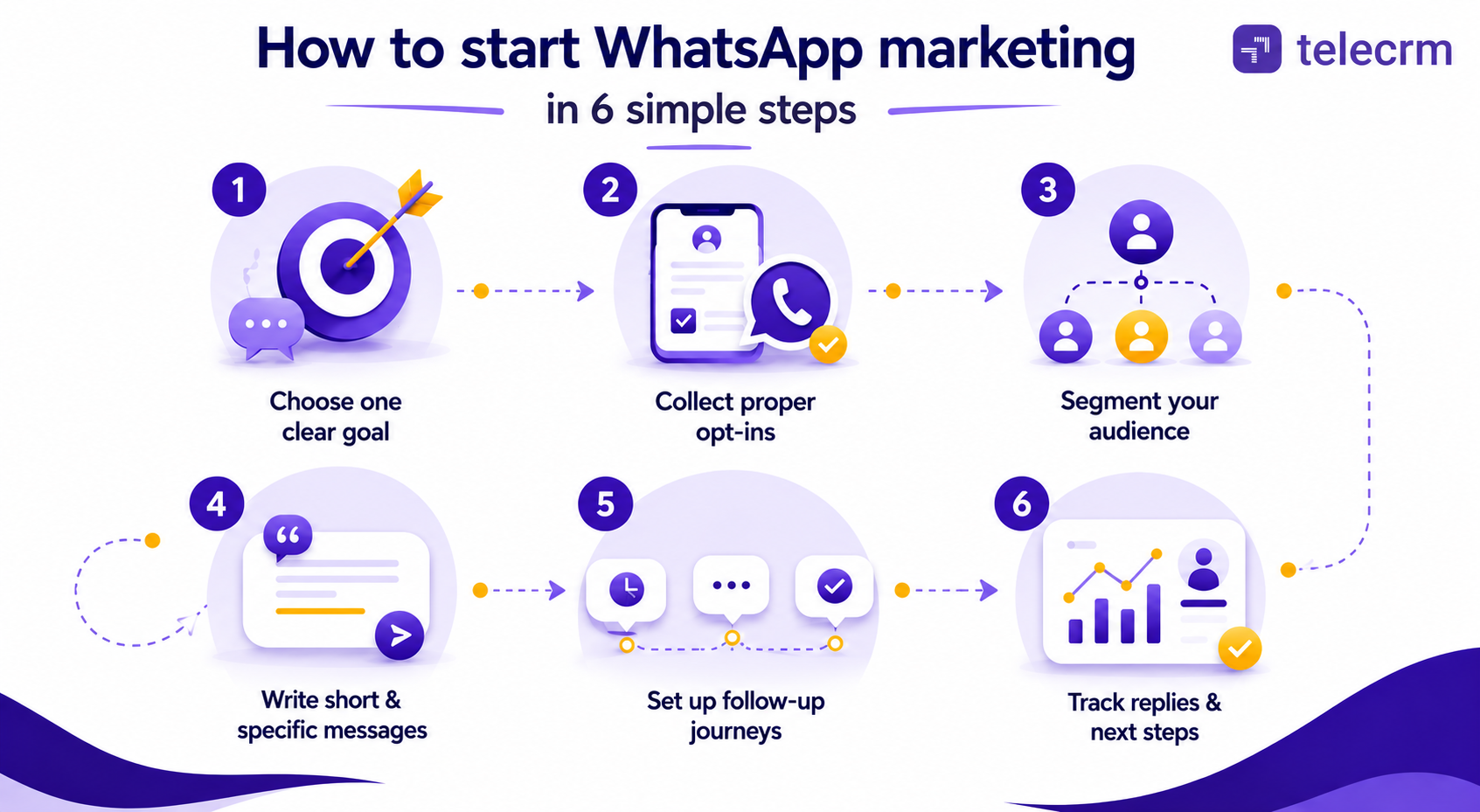
Start with one simple question:
What do you want this WhatsApp effort to do?
Do not try to do everything at once.
One WhatsApp campaign should have one main job. For example:
This matters because the goal decides everything else.
It decides:
For example, if your goal is to book demos, your message should push towards a demo booking.
If your goal is to reactivate cold leads, your message should restart the conversation, not jump straight to a hard sell.
A lot of WhatsApp marketing fails because the message is trying to do too much. It tries to introduce the business, explain every feature, give an offer and ask for a call in one go.
That makes the message weak.
Before sending WhatsApp messages, make sure people have agreed to hear from your business.
This is where many businesses take shortcuts, and that usually creates poor results later. People ignore the message, block the number or simply do not trust it.
A proper opt-in means the person knows they may receive WhatsApp communication from you.
This can happen through:
The important thing is clarity.
The person should understand that by filling the form or taking the action, they may receive WhatsApp messages from your business.
Do not build your WhatsApp marketing on random contacts, scraped numbers or old lists with no context. That usually leads to low replies and a poor customer experience.
Good WhatsApp marketing starts with permission.
Once you have people who opted in, do not treat them all the same.
This is one of the biggest mistakes businesses make. They send the same message to everyone because it feels faster. In reality, it hurts replies.
A fresh lead is not the same as an old lead.
Someone who booked a demo is not the same as someone who just asked for pricing.
An existing customer is not the same as a new enquiry.
That is why segmentation matters.
You can start with simple groups like:
You do not need a very complex setup in the beginning. Even basic segmentation can improve the quality of your WhatsApp messages.
This helps you send the right message to the right people, instead of repeating the same message across your whole contact list.
Most WhatsApp messages fail because they are either too vague or too long.
People do not want to read heavy paragraphs on WhatsApp. They want to quickly understand:
That is it.
A good WhatsApp message usually has three parts:
For example, instead of writing a long sales message, keep it tight:
Hi Rahul, you had asked about our CRM for your sales team. Want me to share pricing or book a quick demo?
This works better because it is easy to understand and easy to reply to.
Keep these points in mind:
The simpler the message, the easier it is for the customer to respond.
One message is rarely enough.
Most people do not reply the first time. Not because they are not interested, but because they are busy, comparing options or simply not ready in that moment.
That is why follow-up journeys matter.
A follow-up journey is just a planned sequence of messages sent over time. It helps you stay in touch without depending fully on memory or manual effort.
A simple journey can look like this:
This makes your WhatsApp marketing more consistent.
It also helps your sales team avoid two common problems:
The key here is not to overdo it.
Do not keep sending messages just because automation makes it easy. Every follow-up should have a reason.
Sending messages is only one part of WhatsApp marketing.
The real value comes from knowing what happened after the message.
These are the things that matter. This is why tracking is so important.
Without tracking, your team ends up with scattered WhatsApp chats, missed follow-ups and no clear view of which WhatsApp marketing campaigns are actually working.
At the very least, you should track:
For marketing campaigns, also track:
As your business grows, this is where WhatsApp marketing software or a CRM-connected setup becomes useful. It helps you connect WhatsApp, follow-ups, customer data and sales progress in one place.
That is what turns WhatsApp from a simple messaging app into a serious business channel.
Once the basics are clear, the next question is simple: what kind of WhatsApp messages should you actually send?
This is where many businesses get stuck.
They know they want to use WhatsApp marketing, but they end up sending the same message again and again. That usually leads to poor replies because not every lead is in the same situation.
A new enquiry needs one kind of message. A demo lead needs another. An old lead who stopped replying needs a very different tone.
That is why your WhatsApp marketing messages should match the stage the customer is in. When the message fits the moment, it feels useful. When it does not, it gets ignored.
This is usually the first message a person gets after showing interest in your business.
It may happen after they fill a form, click an ad, message your WhatsApp account, ask for details on your website or come from another channel. At this stage, speed matters more than polish. The person has just shown interest, so the goal is to acknowledge that interest quickly and open the conversation.
A good new lead follow-up message should do three things:
For example, if someone asks about your service, the message does not need to explain everything. It just needs to start the conversation properly.
This is where many teams make a mistake. They send a long introduction, add too much information or try to sell too early. A first message should feel light and easy to respond to.
The goal here is simple: do not let a fresh lead go cold because nobody responded well or on time.
A lot of leads drop off not because they lost interest, but because they forgot.
That is why reminder messages matter so much.
If someone has already booked a demo, consultation, appointment, site visit or call, they do not need another introduction to your business. They need a clear reminder with the details that matter.
A good reminder message should tell them:
That is it.
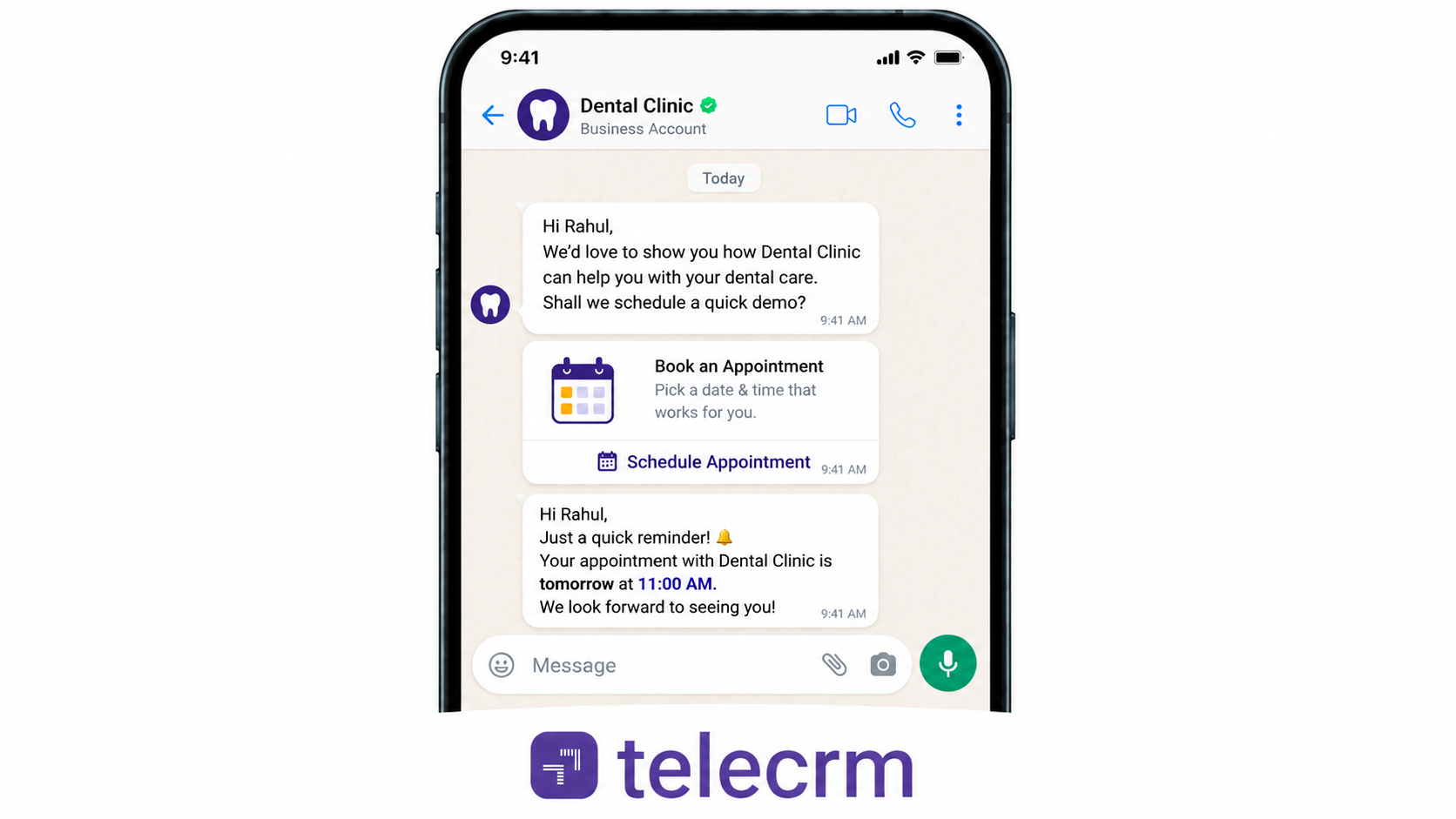
Keep these messages short. Do not turn a reminder into another sales pitch. The job of the message is to reduce no-shows and keep the person prepared.
This kind of WhatsApp campaign works especially well because people are more likely to notice a short reminder on WhatsApp than on email or some other channels.
Not every lead replies after the first message. That does not always mean they are not interested.
Sometimes they are busy. Sometimes they are comparing options. Sometimes they need more time before taking the next step.
That is where drip follow-up messages help.
A drip is simply a planned series of WhatsApp messages sent over a few days. Instead of relying only on manual follow-ups, you create a path that keeps the conversation alive.
For example, a simple drip can look like this:
The point is not to keep sending messages until the customer gives in. The point is to stay present without becoming annoying.
This works best when each message has a reason. If every message says the same thing, people will stop caring. But if each one adds immediate value, the chances of a reply go up.
These messages are for people who started something but did not finish it.
That “something” could be:
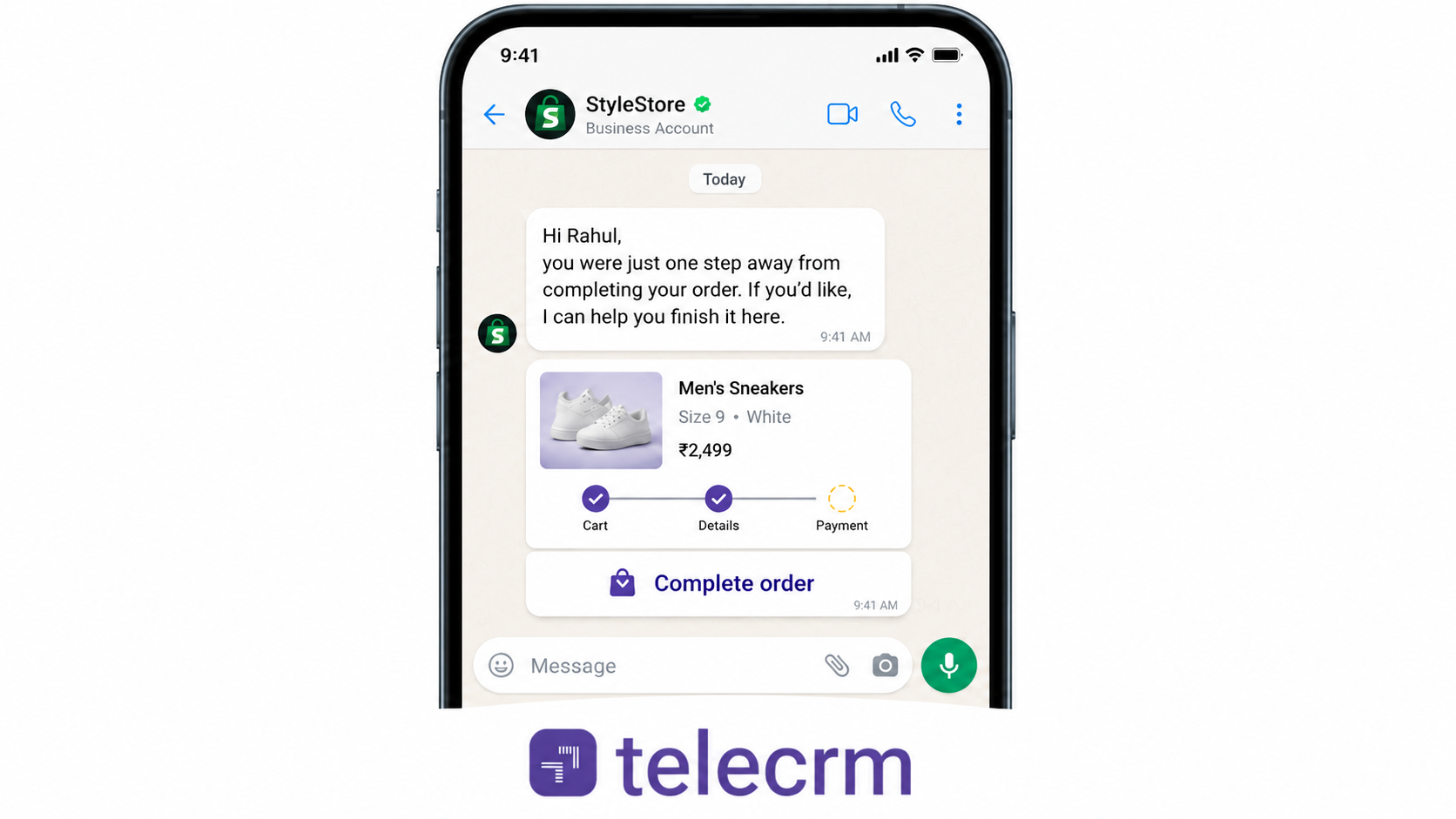
In all these cases, the person already showed intent. They were interested enough to begin. The problem is that they dropped off before finishing.
This is where WhatsApp marketing can work very well.
A short message can remind them where they stopped and make it easier to continue. The tone matters here. Do not make it sound like pressure. Make it sound helpful.
The message should bring them back to the action they already started, not force them into a fresh decision from zero.
For e-commerce brands, this can help recover incomplete purchases. For service businesses, it can help recover unfinished forms, missed bookings or delayed payments.
WhatsApp marketing is not only for new leads.
It is also useful for existing customers.
A lot of businesses focus so much on customer acquisition that they forget how much revenue can come from repeat business, renewals and simple follow-ups after the first sale.
Renewal and repeat purchase messages help you stay in touch after the first transaction. These can be used for:
These messages work because the customer already knows your business. You are not starting from zero. You are continuing a relationship.
That makes the tone different too. These messages should feel useful and timely, not overly promotional.
If done well, they can improve customer loyalty and help you get more value from customers you already have.
Every business has leads that showed interest once and then disappeared.
Maybe they asked for pricing and stopped replying. Maybe they were interested but not ready. Maybe they chose another option and now their situation has changed.
These are cold leads.
A reactivation message gives you a simple way to restart the conversation without sounding pushy. The purpose is not to chase them aggressively. It is to check whether there is still any interest.
This kind of message works best when it is short, direct and respectful. Do not pretend the lead is fresh. They are not. And do not send a heavy promotional message out of nowhere.
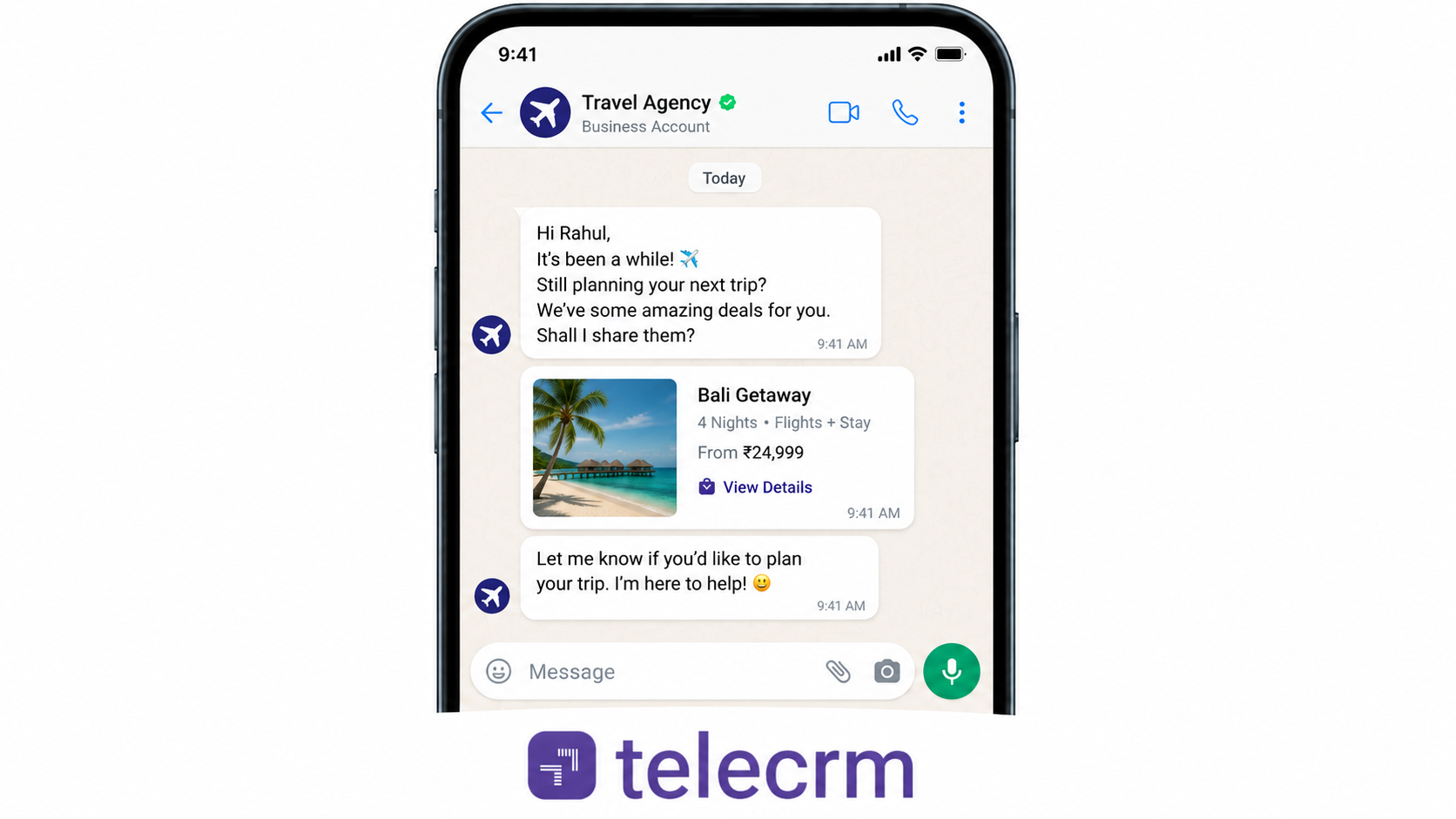
A soft reactivation message can help you:
This makes your WhatsApp marketing campaigns sharper because your sales team spends less time on dead ends and more time on people who may still convert.
One important thing to understand is that WhatsApp also classifies Business Platform messages into different categories:
For marketing teams, this distinction matters because the message category affects how the message can be used and what you pay for it.
This is one of the first decisions businesses need to make.
Do you just need a simple setup to handle chats yourself, or do you need a system that can support a team, automate messages and connect WhatsApp with the rest of your business tools?
That is the difference between the WhatsApp Business app and the WhatsApp Business Platform.
WhatsApp itself positions the Business app for small businesses that personally manage conversations, while the Business Platform is meant for medium to large businesses that need to communicate with customers at scale through programmatic access.
The WhatsApp Business app is the simpler option.
It is a free-to-download app built for small business owners. WhatsApp says it includes built-in tools to help businesses manage conversations, showcase products and work more efficiently.
This is usually the right choice when:
If you are just starting out, this app is often enough.
It helps you create a proper business presence on WhatsApp instead of using a personal account for everything. That alone can make your business look more organised and easier to trust.
The WhatsApp Business Platform is for businesses that need more control.
It is the official WhatsApp API-based setup used when a business wants to handle customer conversations at scale, connect multiple agents, use bots or automation and integrate WhatsApp with its existing tools. WhatsApp says businesses can use the Platform to connect thousands of agents and bots, use rich messaging features and integrate WhatsApp with the rest of their tech stack.
This is usually the right choice when:
This is where WhatsApp stops being just a chat app and becomes part of your business process.
Instead of one person handling everything from one phone, your team can work from a shared system. That makes it easier to manage customer data, avoid missed replies and keep conversations moving.
Here is the easiest way to look at it:
Factor | WhatsApp Business app | WhatsApp Business Platform |
Best for | Small businesses | Growing teams |
Team access | One person or a small team | Multiple agents or large teams |
Automation | Basic | Advanced |
CRM integration | No or limited | Yes |
WhatsApp Flows | No | Yes |
Best when | You handle chats manually | You want structure and scale |
The easiest rule is this:
The app helps you get started. The Platform helps you grow without losing control.
That matters because once leads start coming from different channels and multiple agents are involved, WhatsApp chats can quickly become messy. Messages get missed, follow-ups depend on memory and managers lose visibility. A better setup helps prevent that.
One more practical point: WhatsApp Business Platform pricing is charged on a per-message basis, and the charges depend on the message category and recipient market. WhatsApp says businesses are charged when a message is delivered, not just sent.
If you want WhatsApp marketing to work for the long run, get the basics right.
Most problems start when businesses message people without clear permission, send promotional messages at the wrong time or keep following up after the customer has lost interest.
The WhatsApp Business Messaging Policy says businesses can contact people only if they have the person’s mobile number and opt-in permission. It also says businesses must respect opt-out requests.
On the WhatsApp Business Platform, businesses can start conversations only with approved message templates. If a user messages you first, you can reply freely for 24 hours from their last message.
Do not message people who have not agreed to hear from you.
Your opt-in should be clear and tied to a real action, such as:
The person should understand that they may receive WhatsApp messages from your business. That is the baseline rule in the WhatsApp Business Messaging Policy.
This rule matters only if you are using the WhatsApp Business Platform, not just the WhatsApp Business app.
On the Platform:
That is the simplest way to think about it.
If someone does not want to hear from you, make it easy for them to stop.
The WhatsApp Business Messaging Policy requires businesses to respect requests to block, discontinue or opt out of communication.
A simple line is enough:
This keeps your list cleaner and protects trust.
WhatsApp marketing starts to fail when businesses:
The WhatsApp Business Messaging Policy says businesses must not spam or surprise people with their communication.
A message works better when:
In simple terms:
WhatsApp marketing works better with a CRM like telecrm because your team does not have to manage chats, follow-ups and lead updates in different places.
That is where most teams lose control.
A lead replies on WhatsApp. Someone calls later. A follow-up is promised. Then the chat stays on one phone, the call is logged somewhere else and the next step gets missed. telecrm brings these parts together, so WhatsApp marketing becomes easier to run and easier to track.
For example, if someone replies to a campaign asking for pricing, the conversation can stay linked to that lead. Your sales rep can call them, update the lead stage, schedule the next follow-up and continue the WhatsApp conversation without losing the context of what happened earlier.
With WhatsApp Chat Sync, telecrm keeps WhatsApp chats connected to the lead.
So when someone opens the lead, they can see the conversation in context. They do not have to ask the rep what the customer said or search through screenshots to understand what happened.
That makes the whole process cleaner for the team and smoother for the customer.
A lot of leads are not lost in the first message. They are lost after that.
Someone asks for pricing. Someone wants a callback tomorrow. Someone says they will decide next week. These are simple follow-ups, but they get missed all the time when the team is working across separate tools.
telecrm helps keep those next steps clear by tying WhatsApp activity to lead stages, reminders and calling. So the team knows what needs to happen next.
Most sales conversations do not happen in one format.
A lead may first reply on WhatsApp, then ask for a call, then come back with more questions on chat. If these interactions stay disconnected, the team keeps losing context.
telecrm makes this easier because calling and WhatsApp sit in the same flow. The conversation feels connected, and the sales process becomes much easier to manage.
Manual WhatsApp follow-ups can work in the beginning. But once lead volume grows, things start getting messy very quickly.
telecrm gives you a more structured setup with WhatsApp Chat Sync and WhatsApp API support, so your team can handle WhatsApp marketing in a more organised way. And for API usage, businesses pay Meta directly for message charges. We do not add any markup on that.
That is why telecrm fits naturally with WhatsApp marketing. It helps your team respond faster, follow up better and keep every conversation moving in one clear system.
WhatsApp marketing works when it is simple, timely and relevant.
You do not need to start with a complex setup. Start with one goal, send useful messages, follow up properly and make sure every conversation has a clear next step.
The real difference comes when your team can track those conversations, not just send them.
If your business already uses WhatsApp to handle leads, follow-ups and customer conversations, book a telecrm demo to see how you can manage chats, calls and lead progress in one place
Start simple. First, get a clear opt-in from people who want to hear from your business. Then decide one goal, such as replying to new leads, sending reminders or bringing back old enquiries. After that, send short, relevant messages and track replies. If your volume grows, move from the WhatsApp Business app to the WhatsApp Business Platform or API.
For that kind of volume, do not rely on manual sending from the app. Use the WhatsApp Business Platform or API, send only to people who have opted in and use approved message templates for business-initiated messages. That is the safe and proper setup for large-scale WhatsApp marketing.
Yes, if you do it properly. In practice, that means people should have agreed to receive your messages, you should respect opt-outs, and you should follow both WhatsApp’s business policy and India’s digital personal data law. If you message random people without consent, you are asking for trouble.
If you are using the WhatsApp Business app, you can use business broadcasts or broadcast lists for simple bulk sends. But if you need more control, better tracking or regular large-volume sending, the better route is the WhatsApp Business Platform. That is the more scalable option.
You use the WhatsApp API through the WhatsApp Business Platform. In simple terms, you set up your business account, connect your number, create approved templates, then connect the API to your CRM, chatbot or other system so messages, replies and workflows can be managed properly.
MSMEs can use WhatsApp for lead follow-ups, product updates, limited-time offers, customer support, abandoned enquiry recovery, event reminders and personalised sales conversations.
No, not for ongoing business messaging. Meta charges businesses on a per-message basis for messages delivered through the WhatsApp Business Platform, and pricing depends on the message category and recipient market. Some providers may also add their own platform fees or message markup. With telecrm, businesses pay Meta’s applicable WhatsApp API message charges without an additional markup on those charges.



© Copyright 2026 telecrm.in (Flamon Cloudtech Pvt Ltd) - All Rights Reserved • Privacy Policy • T&C



© Copyright 2026 telecrm.in - All Rights Reserved • Privacy Policy • T&C