

Running an IVF clinic is not the hard part. Managing the chaos behind patient enquiries is.
Because the real problem is not a lack of demand. It is what happens after the enquiry comes in.
Patients reach out from multiple places, such as ads, calls, WhatsApp, website forms and referrals. But in many clinics, these conversations do not live in one system. They stay scattered across tabs, tools and sometimes just memory.
And that is where things start slipping.
IVF enquiries are not one-step interactions. They involve repeated follow-ups, consultations, questions, hesitation and a lot of decision-making before a patient moves forward. Without a proper system in place, that journey becomes difficult to manage very quickly.
If you think about your current process, how many enquiries are you truly tracking right now without missing even a single follow-up?
If the answer is “not all of them”, you are not alone. Read this blog to see how a healthcare CRM helps you bring structure to patient enquiries, improve follow-ups and manage every lead journey with more clarity.
IVF lead management software is a healthcare CRM system for fertility clinics that captures, organises and tracks patient enquiries from calls, WhatsApp, ads, website forms and referrals in one healthcare dashboard.
It helps clinics manage follow-ups, consultations, patient context and conversion stages without relying on memory or scattered tools.

More importantly, it removes the need to rely on memory or scattered tools. And the result? A process that feels controlled, visible and far more predictable.
To make things easier for you and in your workflow, here are some of the top IVF lead management software you can explore to find what fits your work process best.
For IVF clinics, telecrm is most useful when enquiries are coming from multiple channels and counsellors need a single place to track calls, WhatsApp chats, follow-ups, lead stages and patient history.
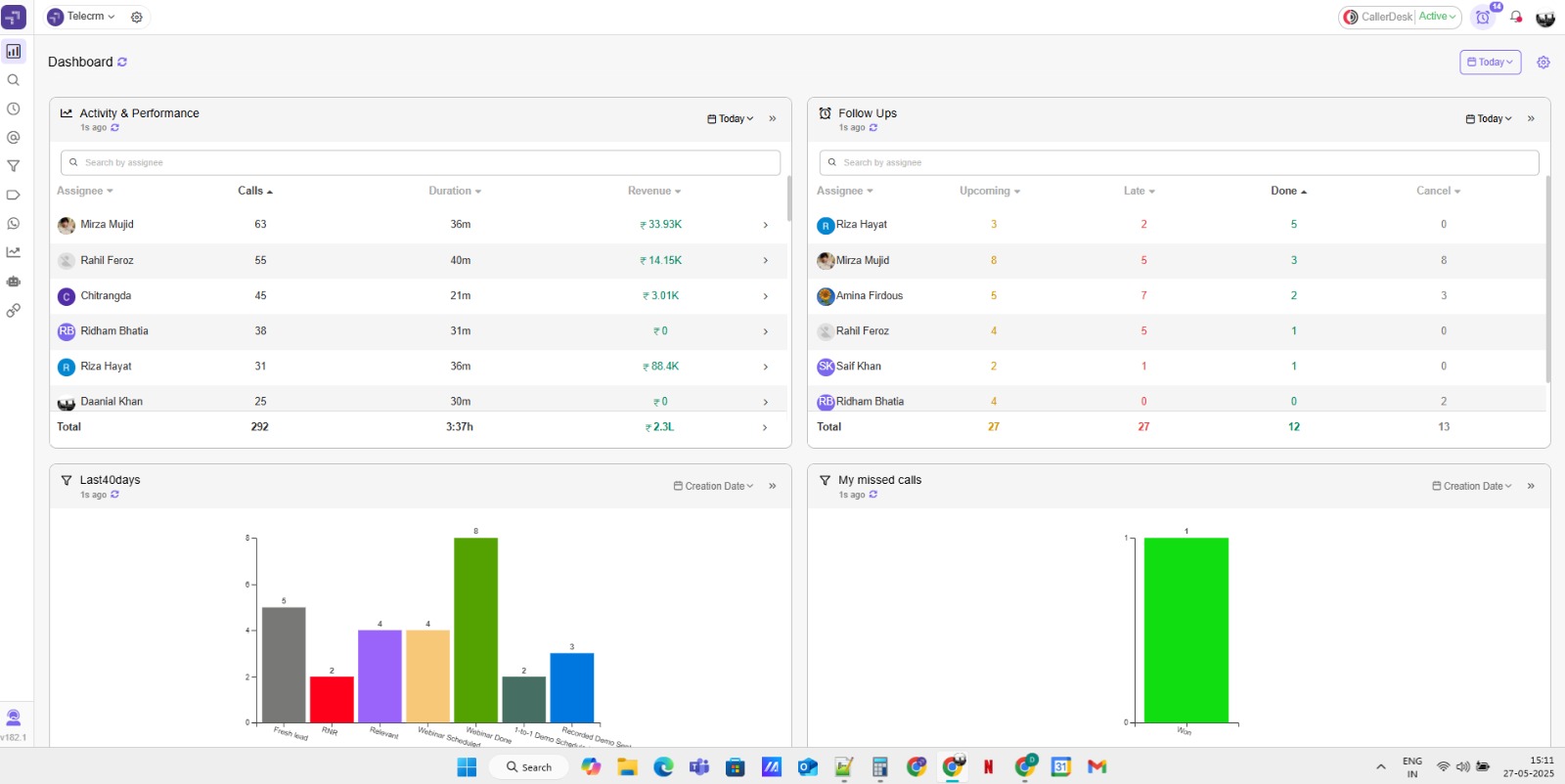
Top Features:
Core plan: ₹1099 per user/month (quarterly), ₹799 per user/month (annually)
Add-ons: WhatsApp chat sync: 200 per user/month
LeadSquared is a well-known CRM that helps clinics manage lead capture, tracking and automation at scale. It’s particularly useful for clinics handling a high volume of enquiries and looking to track conversions more closely.
Top Features:
Lite plan: ₹2500 per user/month (annually billed)
Pro plan: ₹5000 per user/month (annually billed)
Super plan: Custom pricing
(Annual billing; pricing varies by features, automation level and enterprise requirements)
Vitrify is an IVF-focused management software that supports patient management with clinical and lab-related workflows. It’s suited for clinics looking for a more comprehensive system beyond just lead management.
Top Features:
Starter tier: $23 per user/month (20–50 users)
Enterprise tier: $19 per user/month (higher user volume)
(Monthly billing; pricing varies based on the number of users and clinic scale)
ARTis is designed specifically as a fertility software, focusing on managing both administrative and clinical processes. It helps maintain detailed patient history while also supporting clinic workflows.
Top Features:
Basic plan: Custom pricing
Premium plan: Custom pricing
(Pricing not publicly disclosed; varies based on modules, clinic size and customisation needs)
ConceiveX focuses on improving patient engagement and communication for fertility clinics. It’s useful for clinics that want to enhance follow-ups and overall patient experience.
Top Features:
20-50 licenses: ₹1300 per user/month
50-100 licenses: ₹1200 per user/month
100+ licenses: ₹1100 per user/month
(Pricing varies based on features, integrations and clinic requirements)
Drlogy is a cloud-based IVF clinic management software designed to handle everything from patient registration to treatment tracking and follow-ups in one system. It’s a good fit for clinics looking for a balance between lead management and complete clinic operations.
Top Features:
Starter plan: Custom pricing
Advanced plan: Custom pricing
(Pricing varies based on modules like patient management, lab integration and clinic size)
Suggested read: Healthcare Management System — Definition, Features and More
Not every software that claims to manage leads will actually work for an IVF clinic. The real difference lies in how well it supports the patient journey, how your team works and the level of consistency it brings to follow-ups.
An IVF lead management software should fit into your team’s current way of working. If it does not, resistance is inevitable.
And that resistance rarely shows up as direct complaints. It shows up in smaller but more damaging ways. Counsellors delay updates, front desk teams forget to log enquiries, follow-ups happen outside the system and management ends up looking at incomplete data.
Over time, the software starts looking like the problem, when in reality it was never simple enough to adopt in the first place. That is why usability is not a bonus feature here. It is foundational.
Patients may call, send a WhatsApp message, fill out a website form, respond to an ad or come through a referral and still expect one smooth response from your clinic.
That is why your software should be able to capture enquiries from multiple sources in one place. If your team is still checking each platform separately, delays, missed enquiries and duplicate efforts begin right from the start.
A good IVF lead management software should bring all incoming enquiries into one structured system so your team can respond faster and with better context.
In IVF, most patient communication does not happen in one formal thread. It happens across calls and WhatsApp, often over days or weeks.
That makes integration essential. Your team should be able to see calls, messages and follow-up history in one place instead of switching between devices, personal chats or disconnected tools.
This helps your clinic maintain continuity in communication and reduces the risk of patients being followed up without proper context.
A lead is not just a name and number in IVF. It is the beginning of a longer, more sensitive decision journey.
Your team should always be able to see where the patient stands, what conversations have already happened, what concerns were raised and what needs to happen next.
When patient data is centralised with proper context, communication becomes more informed and far less repetitive. Without it, patients often end up repeating themselves and your team ends up working with incomplete information.
Timing plays a major role in IVF decision-making. A missed callback or delayed response can be enough for a patient to lose trust or start exploring other options.
That is why follow-ups should not depend on memory. They should be system-driven.
Look for features such as:
This keeps your team consistent and makes sure no enquiry quietly slips through the cracks.
IVF journeys do not follow a generic sales pipeline. Your software should allow you to create stages that match the actual process followed by your clinic.
For example:
You may also want to include treatment-specific stages depending on how your clinic manages internal workflows.
Clear stages help your team stay aligned, make prioritisation easier and give management far better visibility into pipeline movement and conversions.
Not every enquiry is at the same stage of readiness. Some patients are still exploring. Some are comparing clinics. Others may be ready to book a consultation or begin the next step.
Your software should help your team identify and prioritise leads based on intent, urgency or stage. Without that visibility, every enquiry starts looking equally urgent and your team ends up spreading attention too thinly.
Better prioritisation leads to better response quality, stronger follow-ups and more efficient use of your team’s time.
IVF clinics handle highly sensitive personal and medical information. So data security is not optional.
Your software should support strong access controls, role-based permissions and reliable data protection standards. Depending on your clinic’s requirements and geography, compliance support may also matter.
This is not only about protecting data. It is also about maintaining patient trust at every stage of the journey.
A system should simplify your workflow, not create more friction during implementation.
If setup is too complicated or the software needs constant hand-holding to work properly, your team is less likely to use it consistently. The transition should feel smooth, with minimal disruption to ongoing patient communication and follow-ups.
That matters even more in IVF clinics, where day-to-day coordination cannot afford too much operational disturbance.
When these features come together, you do not just get a tool. You get a system your team can actually rely on.
Suggested read: A-Z Guide on Automation in Healthcare
Before talking about solutions, it helps to look at what is really breaking beneath the surface. Most IVF clinics do not struggle because enquiries are not coming in. They struggle because those enquiries are not being managed with enough structure, speed and context.
Patients reach out through calls, WhatsApp, website forms, referrals and sometimes even walk-ins. But without a proper system, these touchpoints stay scattered instead of building into one clear journey.
What starts as a simple tracking issue slowly becomes a visibility problem. Your team no longer knows who needs urgent attention, who is still deciding and who needs nurturing. And when that clarity is missing, some leads do not get managed properly; they get forgotten altogether.
Not every IVF enquiry is at the same stage of intent. One patient may just be exploring options. Another may be comparing clinics. A third may be ready to book a consultation.
But without defined stages and proper lead tracking, they all sit in one pool and look identical. That makes prioritisation difficult. And when everything appears urgent, your team ends up reacting instead of working with a clear process.
IVF is rarely an instant decision. Patients need time, reassurance, conversations and clarity before taking the next step.
That is normal. What causes damage is not the time they take, but the silence they experience during that time. When follow-ups are delayed, inconsistent or completely missed, trust starts weakening. Patients may not always say it, but they notice when communication feels patchy or disconnected.
Spreadsheets, notebooks, WhatsApp chats and memory may seem manageable in the beginning. But IVF lead management involves multiple conversations, updates, reminders and handoffs.
That makes manual tracking risky. Duplicate entries, missed updates, incomplete notes, wrong statuses, inaccurate MIS reports and fragmented reporting become common. The problem is that many of these errors stay invisible until they affect follow-ups, reporting or conversions.
In IVF, trust starts building long before treatment begins. It starts with the first enquiry, the first response, the first follow-up and the first consultation conversation.
So when a patient has to repeat details, waits too long for a reply, or speaks to someone who has no context, it creates doubt early. These may seem like small operational gaps internally, but from the patient’s side, they signal disorganisation at a very sensitive stage of the journey.
Manual systems can appear manageable when lead volume is low. But as enquiries increase, those same systems begin to break under pressure.

The issue is not that your team suddenly becomes inefficient. It is that the process stops scaling with demand. More leads start coming in, but follow-ups become harder to manage, visibility drops and workload starts piling up unevenly across the team.
That is usually the point where clinics realise the issue is not lead generation alone. It is the absence of a proper system to manage growth.
For IVF clinics, the right lead management software is not just a sales tool. It is a system for protecting patient context, improving follow-up consistency and helping teams convert enquiries with more care and visibility.
IVF enquiries aren’t just leads, they’re high-intent, high-emotion and time-sensitive conversations that need the right amount of attention at the right time.
If you’re managing your IVF leads across spreadsheets, WhatsApp chats and memory, you’re not just working harder. You’re quietly losing patients who were already considering you.
And that is what makes this difficult to notice. The loss does not always look big at the time but it shows up in missed follow-ups, delayed responses, repeated questions, broken context and patients who slowly stop engaging.
If you want a clearer, secure and more structured way to progress your entire lead journey without adding complexity, telecrm is worth exploring. Not as another tool, but as the system that finally brings everything together.
Book a demo now and start treating every patient journey with the clarity and attention it truly deserves.
IVF lead management software is a healthcare CRM system that helps fertility clinics capture, organise and follow up with patient enquiries from calls, WhatsApp, ads, website forms and referrals.
IVF clinics need lead management software because patient enquiries involve multiple conversations, follow-ups, consultations and decision stages. A structured system helps teams avoid missed follow-ups and maintain patient context.
The best IVF lead management software depends on the clinic’s workflow. telecrm is suitable for clinics that need call, WhatsApp and follow-up tracking, while tools like LeadSquared, Vitrify, ARTis, ConceiveX and Drlogy support different levels of automation, clinical workflow and patient management.



© Copyright 2026 telecrm.in (Flamon Cloudtech Pvt Ltd) - All Rights Reserved • Privacy Policy • T&C



© Copyright 2026 telecrm.in - All Rights Reserved • Privacy Policy • T&C