
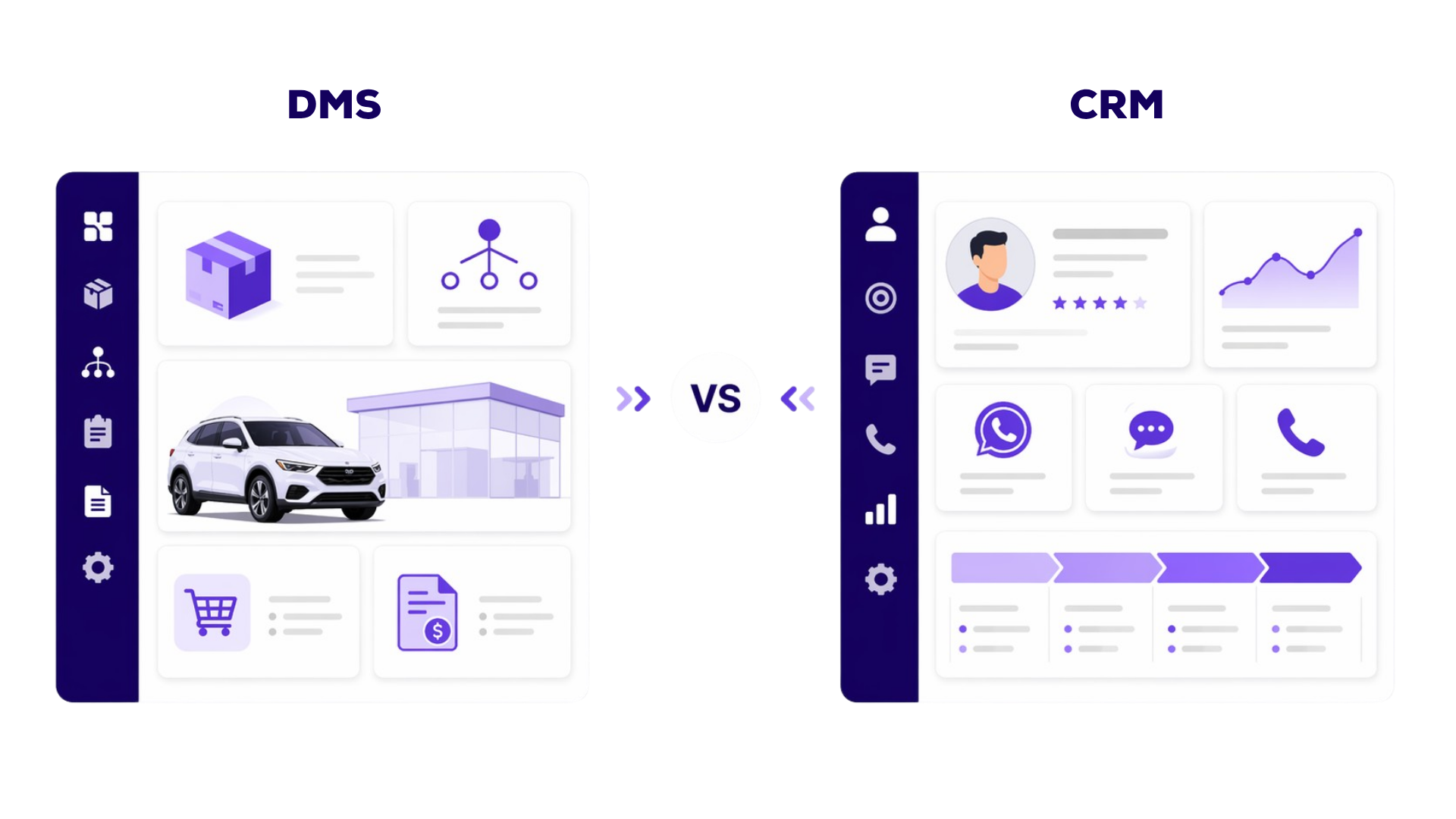
You know your dealership needs a software upgrade and every time you research, you come across two names, DMS and CRM. Both promise to fix how your business runs. Both seem to do similar things. But the more you read about them, the more confused you get about choosing the right one.
Which one manages your leads? Which one handles your inventory? Do you need both? Or will one do the job?
If you also face this problem, then you are at the right place. In this blog, we will end the DMS vs CRM debate and break down exactly what each of them does, how they’re different and which one your dealership should prioritise first.
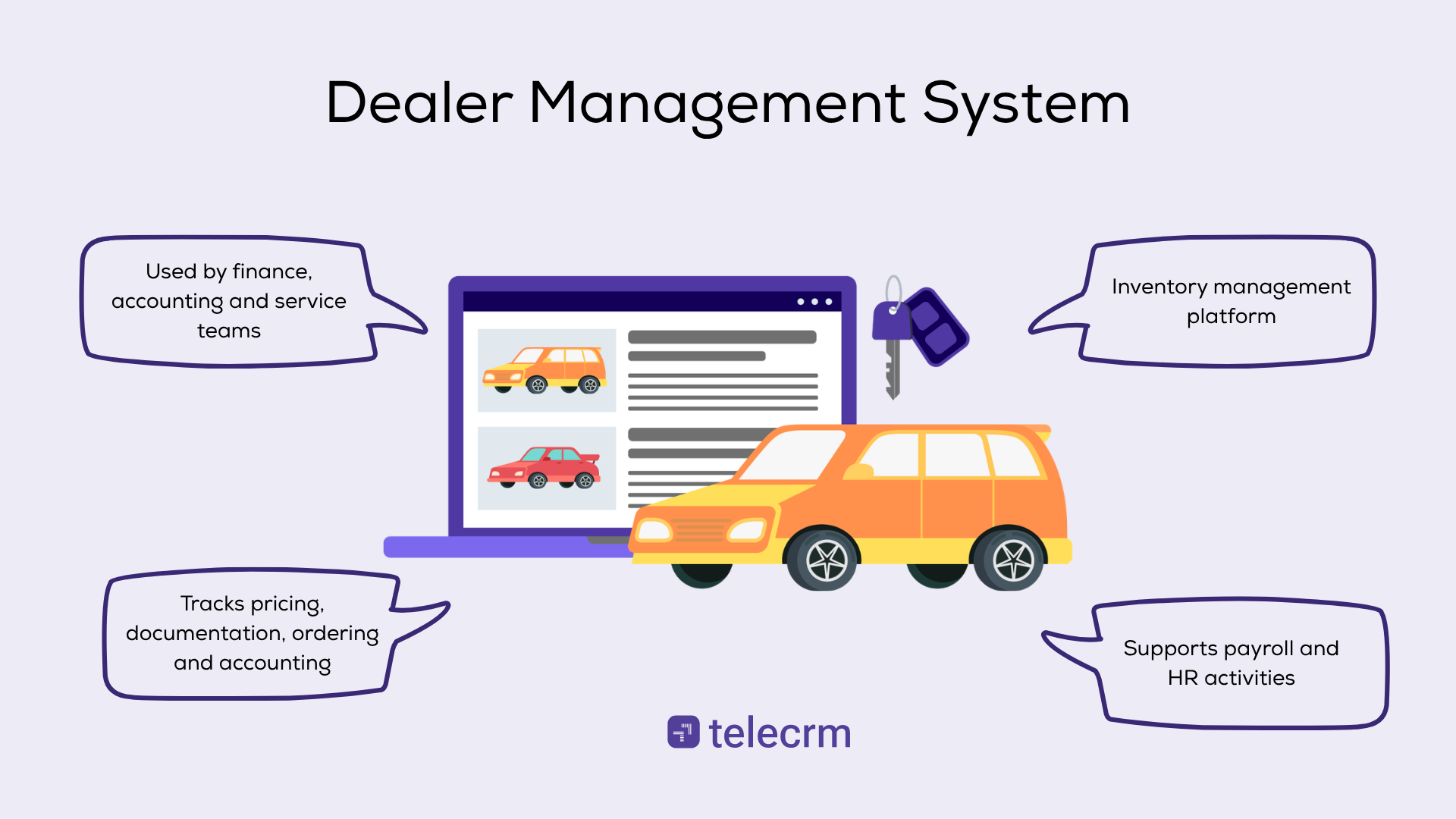
A dealer management system (DMS) is software that manages the operational side of a dealership, including vehicle inventory, pricing, invoicing, finance, service jobs, parts and compliance. It tracks what has been sold, serviced and recorded in the business.
It is the operational backbone of a dealership. It handles everything that keeps the business running day to day. From the moment a car arrives in your lot to the moment it’s sold, registered and invoiced.
The dealer management system is designed specifically for the automotive industry. It manages the transactions, paperwork and numbers. Your finance team lives in it. Your service managers use it.
The core functions that a DMS serves are:
It answers this question: “What did we sell, and how did we manage it?”
It is built for structured, rigid business operations, not for chasing leads or nurturing customer relationships. Most DMS platforms restrict access to a few departments: finance, accounting and service. It’s not a tool your sales reps will use to follow up with a prospect.
Popular DMS platforms in the automotive space include CDK Global, Reynolds & Reynolds and Dealertrack.
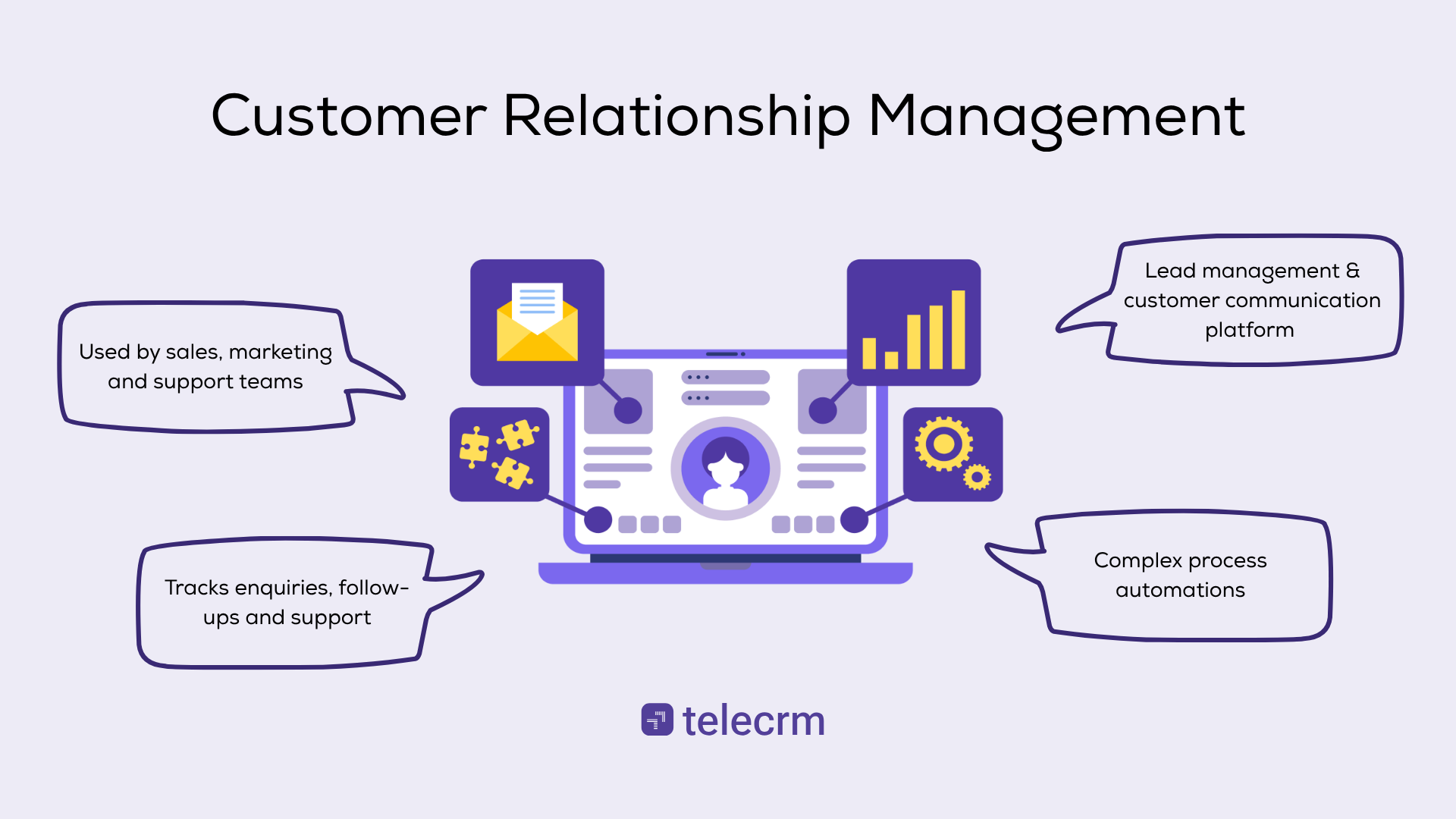
Customer relationship management (CRM) software is a dealership system for managing leads, customer conversations, follow-ups, marketing campaigns and post-sale engagement. Unlike a DMS, it focuses on people and relationships rather than completed transactions.
Automotive CRM software helps dealerships capture leads from multiple sources, track every customer interaction, plan follow-ups, run marketing campaigns and manage post-sales processes all from one place. A good CRM system collects customer data, including call records, emails, chat history and more. Over time, this builds a clear picture of each customer’s preferences and journey.
The core functions of a CRM are:
The CRM is where customer engagement is built. It is the tool that prevents leads from falling through the cracks, keeps your reps accountable and gives your managers a live view of their pipeline.
Both CRM and DMS are systems used at dealerships; both store customer data, and both sound similar on paper. But they solve very different problems.
The main difference between a DMS and a CRM is this: a DMS manages back-office dealership operations, while a CRM manages front-office lead, sales and customer engagement workflows.
Here’s a detailed breakdown of these differences:
A DMS exists to keep your dealership operationally sound. Pricing, documentation, parts ordering and daily accounting all live here. Whereas a CRM exists to keep your revenue pipeline moving. Capturing enquiries, managing follow-ups and taking care of post-purchase enquiries.
The DMS holds transactional records like deal sheets, warranty information, workshop job cards and financial statements. It is a system of record. The CRM holds relationship data like who called, what they asked, which model they’re interested in and when to reach out next. It is a system of action.
The DMS is primarily used by department heads, service advisors and accounts staff. It is not a front-line sales tool. The CRM sits in the hands of your sales teams and marketing personnel who are actively working to convert interest into a closed deal.
For a DMS, a customer is a completed transaction; an invoice, a registered vehicle or a service history entry. But, for a CRM, a customer is a relationship in progress; someone whose preferences, past interactions and future potential are all tracked across their customer journey.
Feature | DMS | CRM |
Primary focus | Operations and transactions | Customer relationships, sales & support |
Primary users | Finance, accounting, service teams | Sales, marketing and customer support teams |
Data type | Rigid, structured financial data | Flexible behavioural and relationship data |
Lead tracking | Minimal or none | Core capability |
Marketing campaigns | Requires third-party integration | Built-in |
Inventory management | Core capability | Provided in some CRM systems |
Customer communication | Limited | Extensive |
Workflow automation | Operational workflows | Sales, marketing & support process workflow |
Both systems have their pros and cons. But they serve a somewhat different purpose, too. So, in the end, this depends entirely on where your biggest pain point is right now.
Your dealership has no structured way to manage inventory, raise invoices, process deals or track service jobs. If your business processes are still running on spreadsheets and paper, a dealer management system is the foundation you need to build on.
You have leads coming in from your website, walk-ins or social channels, but no reliable process for following up with them. If customer interactions are happening in scattered WhatsApp groups and personal phones and your sales reps have no shared visibility on who followed up with whom, a CRM is what you need immediately.
Lead management gaps are expensive. Every lead that doesn’t get followed up on is a lost sale. A CRM fixes this before it gets worse.
Read more: CRM for Automobile Industry in India: A Complete Guide
You’re running a mid-to-large dealership, or a multi-location group and you need your client engagement teams and your back office to stop operating in isolation. At this scale, DMS and CRM together are not a luxury, they’re a necessity.
Most established dealerships already have a DMS. The more common problem is that their DMS has a basic built-in CRM module, one that isn’t even close to good enough for a dedicated sales process. If that sounds like you, adding a proper automotive CRM on top is the move.
Many modern DMS platforms have added basic CRM features like contact management, simple follow-up reminders and even some customer information storage. Similarly, some CRM software tools have started adding inventory views and service data access.
This overlap is exactly why dealership teams use the terms interchangeably and end up confused about which system holds the “real” customer data.
The confusion often leads to real problems:
The overlap doesn’t mean these tools are the same. It means they were designed to work together rather than replace each other.
Myth: If a DMS has CRM features, your dealership does not need a CRM.
Reality: Basic CRM modules inside a DMS may handle contacts or reminders, but dedicated CRM software is stronger for lead tracking, follow-up automation, campaign management and pipeline visibility.
No. A DMS cannot fully replace a CRM for dealerships that rely on active lead management, sales follow-ups, marketing campaigns or customer engagement.
A dealership software platform built primarily for back-office operations will always fall short as a sales and customer engagement tool. Here’s why.
DMS platforms handle structured data — invoices, parts orders and contracts. The data is rigid because it needs to be. Compliance and accounting require consistency.
CRM systems are built for messy, human data — a prospect who called three times, asked about one model, test-drove another and still hasn’t decided. Tracking that customer journey requires flexibility and speed that a DMS simply isn’t architected to provide.
The DMS doesn’t know who your best prospects are. It doesn’t send follow-up reminders to your reps. It doesn’t help you build marketing campaigns for customers whose service contracts are about to expire. It doesn’t track which leads came from Facebook and which came from your showroom floor.
A CRM software enables sales, service and marketing to share a single view of every customer — something a DMS cannot replicate. Collaborative CRM systems are particularly powerful in dealerships where sales teams and service advisors both interact with the same customer, but currently have no way to see each other’s notes.
Expecting your DMS to replace a CRM is like asking your accountant to manage your sales pipeline. Technically, they work in the same company, but that’s not their job.
Read more: 10 Automobile Upselling Strategies to Boost Sales & Retain Customers
The most effective modern dealership runs both, with the two systems integrated. Let’s have a glimpse of what that looks like in practice.
A new lead comes in through your website enquiry form. The automotive CRM captures it automatically, assigns it to a sales rep and sends a follow-up reminder within minutes. The rep calls, qualifies the lead and books a test drive. All of this is tracked in the CRM.
The customer buys. Now the deal moves to the DMS, where the invoice is raised, the vehicle is allocated from inventory, the finance is processed and the registration paperwork is completed. The transaction is owned entirely by the DMS.
A few months later, the customer comes in for a service. The service advisor checks the DMS for the service history. Simultaneously, the CRM flags that this customer’s warranty is expiring soon, triggering an automated follow-up about a renewal offer. The automotive CRM owns the relationship; the DMS owns the record.
When DMS and CRM systems are properly integrated, the magic happens: no duplicate data entry, no conflicting records and no gaps in the customer lifecycle. The customer gets a hassle-free customer experience and doesn’t need to repeat their details every time. Your teams don’t need to switch between systems to get a full picture.
DMS-CRM integration is the gold standard for any dealership serious about both operational efficiency and customer retention.
The key benefits of running DMS and CRM software together:
For multiple locations or distributed businesses, this integration becomes even more critical. A single centralised view across branches means your dealership leaders can actually manage performance and not just guess at it.
The DMS vs CRM question has a clear answer once you understand what each tool is actually for.
A dealer management system runs your dealership’s operations, including inventory, finance, service and compliance. On the other hand, a customer relationship management system grows your dealership’s revenue by managing leads, nurturing customer relationships and keeping your sales teams on track.
In short, dealerships usually need both systems: a DMS to run operations and a CRM to grow revenue. If your current problem is inventory, invoicing or service tracking, start with a DMS. If your current problem is missed leads, scattered follow-ups or poor sales visibility, start with a CRM.
If you’re already running a CRM but it’s not built for the way Indian car dealerships actually sell, it might be worth a look at telecrm.
telecrm is a CRM built specifically for Indian sales teams. It combines calling, WhatsApp and lead management in one place, so your reps have everything they need without switching between apps. Leads come in automatically from 20+ platforms. Every call is recorded and summarised. Follow-ups are automated. And your managers get a real-time view of pipeline performance.
To begin your journey, book a free demo today.



© Copyright 2026 telecrm.in (Flamon Cloudtech Pvt Ltd) - All Rights Reserved • Privacy Policy • T&C



© Copyright 2026 telecrm.in - All Rights Reserved • Privacy Policy • T&C