
If you’re an insurance professional, this might sound familiar:
These are just a few struggles; you probably know a dozen more. Every insurance team goes through this. Not because you’re not putting in enough effort, but because you’re juggling too many tools and never have enough time.
That’s where a customer relationship management system (CRM) helps. And even better, an insurance CRM, solves all of this by putting leads, policies, communication and renewals in one place — visible to every agent, updated in real time, accessible from any device.
This guide covers the 10 key insurance CRM features that actually matter for Indian agencies, plus tips to help you choose the right system for your team.
Most agencies start with a generic CRM or tool to store leads and client details. But all that generic CRMs store are contacts. A dedicated insurance CRM tracks policies, triggers renewal reminders, logs claims, records every agent call and routes new leads from IndiaMart and Meta Ads automatically — all in one place, purpose-built for the insurance sales cycle.
For agencies, the client relationship doesn’t end with a policy sale. It continues through ongoing communication and service delivery, all of which need to be tracked. But when these touchpoints are scattered across spreadsheets, WhatsApp and calls, important updates are easy to miss.
That’s where generic tools start to fall short. Here are some of the common challenges insurance teams face when using them:
A dedicated insurance CRM is built for how the industry actually works. It helps you manage daily communication, automate processes to take care of policy renewals and keep your team aligned across every stage of the customer journey. It also solves the challenges that generic CRMs simply aren’t built for.
So now that we’ve seen why generic tools don’t quite fit the insurance workflow, let’s look at the key CRM features that actually make a difference. These are the ones designed to simplify your daily work and help you serve clients better.
Without a proper system, it’s hard to capture leads coming in from different platforms and track who to follow up with and when. A CRM makes this easier by integrating all your lead sources and giving you a clear sales pipeline view.
You can use lead scoring in CRM to rate and segment your leads based on their interest. Also, the custom field insurance feature lets you store important client details like lead source, insurance type or premium amount. Together, these features help you collect relevant lead information quickly, track the entire customer journey and manage your sales process more efficiently.
Benefits of this feature:
With insurance workflow automation, you can automate daily tasks by setting triggers for specific actions. Be it assigning leads to team members, sending reminders to leads on WhatsApp or managing client interactions through customer service automation.
Benefits of this feature:
Struggling to manage hundreds of policies and update records on Excel sheets? Need a better way to handle it all? The policy management software feature allows you to keep track of all client policies in one place.
It gives your team a single platform. where you can check policy status, update records and set automated alerts for upcoming renewals.
Benefits of this feature:
Related Read: Top Ways to Boost Insurance Policy Renewal with Automation in 2026
Managing claims means handling multiple steps, which include collecting documents, updating claim progress and keeping clients informed throughout the process. The claims management CRM feature makes the process faster and more organised. Different teams involved can view real-time progress and act accordingly. No need to manually share updates internally.
Benefits of this feature:
Every client interaction generates data, including personal details, policy numbers, documents, ID proofs and claim records. A good CRM helps simplify document management for insurance teams by keeping all customer data and related documents in one place, so you don’t lose them or have to ask clients to send them again.
Benefits of this feature:
This feature brings all your client interactions under one roof. You can call, message or email directly from the CRM. See every interaction in one thread, whether it’s from you or someone else on the team.
For Indian insurance agencies, WhatsApp is the primary channel for client conversations — most clients will not respond to calls but will reply to a WhatsApp message within minutes. A CRM with native WhatsApp integration keeps every message thread visible to the full team, not locked in one agent’s personal phone.
Benefits of this feature:
Know what’s really working- across your team and with your clients. The reporting and analytics feature turns data into insights you can actually act on. From lead conversions and policy renewals to follow-up activity and agent performance, you get a clear view of what’s driving results and where improvements are needed.
Benefits of this feature:
Related Read: How Insurance KPI Metrics Help Track Performance & Growth
You won’t find this feature in every CRM, but it’s an important one. As an insurance professional, you’re always on calls, in meetings or visiting clients. Not having access to client data when you need it can slow everything down.
With a mobile CRM for insurance, you get the same powerful features on your phone so you can manage leads, policies and renewals no matter where you are.
Benefits of this feature:
In the insurance industry, client data is extremely sensitive and highly regulated. The data security and compliance tracking CRM features ensure that every piece of information, from ID proofs to policy documents, is stored and managed safely.
With encrypted databases, role-based access and secure backups, your customer data stays protected while your business remains compliant with data-protection standards.
Benefits of this feature:
An insurance CRM should connect with every tool your team already uses: IndiaMart and Justdial for lead capture, Meta Ads for campaign leads, WhatsApp for communication and accounting software for commission tracking. Data flows automatically between systems — no manual export, no copy-paste, no missed leads between tools. This single integration layer is what allows a 10-agent agency to operate with the efficiency of a team three times its size.
Benefits of this feature:
Investing in a CRM is a big decision. You don’t want to spend money on something your team won’t actually use. This is a very common mistake: many businesses end up buying software packed with features and modules that look great in demos but in practice, they’re not useful for teams and get ignored completely.
In this section, we’ve shared a few simple tips to help you choose a CRM that truly fits your business requirements.
The CRM software should fit how your team already works and not force you to change your process entirely.
For example, if your agency handles a high volume of renewals, look for features like auto-reminders, call scheduling and bulk WhatsApp messaging. For longer sales cycles, choose one that offers detailed tracking and multi-stage pipelines.
Automation isn’t about replacing your team; it’s about freeing them to focus on building client relationships.
So while deciding, ask yourself: Does this CRM have the capability to handle routine tasks automatically or will your team still chase reminders manually?
Go with CRM software that your team can actually use comfortably. Take free trials if available. See how your team adapts to it. If it seems complicated to your team, try reaching out to support for help or check out some other options.
A CRM that connects with WhatsApp or has built-in calling can save you hours every week.
Question to ask yourself: can anyone on your team pick up a client conversation mid-way and still know the full story?
If not, you’ll keep losing time switching between chats, emails and call logs.
telecrm for instance, comes with these built-in features to help you manage client communication more easily.
Choose a CRM that turns data into clear insights.
For example, imagine a growing insurance business with 15 agents. The manager wants to know which channels bring the best leads or which agents close faster. That’s where insight on renewal rate, ROI tracking and agent performance analytics becomes essential.
If insights like these are available in CRM, you can act faster and improve where it matters.
Don’t skip this factor. Good onboarding and migration support can save you a lot of frustration later. Check if you can easily import existing insurance data and ask how the provider handles data migration if you ever switch CRMs.
If you’re looking for a CRM to automate business processes, manage client data and improve customer relationships, telecrm could be the perfect pick. It’s designed specifically to suit insurance workflows and includes all the key features we discussed in this blog.
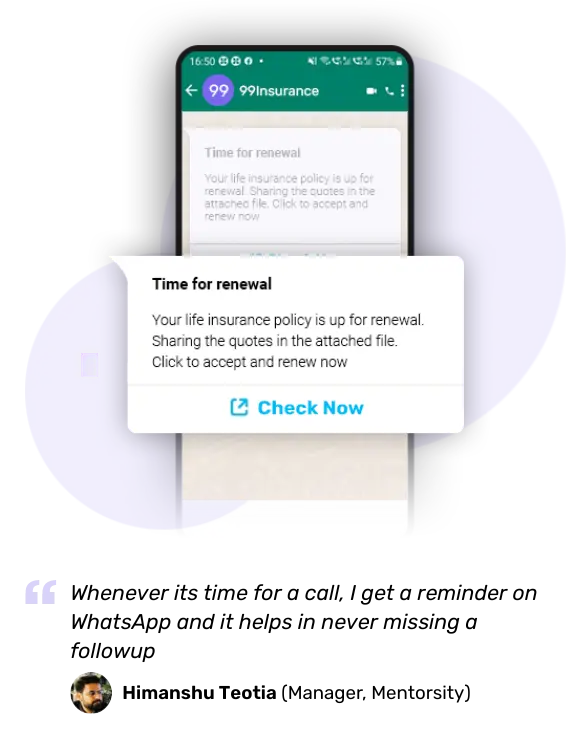
Here’s what makes it a top choice for insurance agencies across India:
Choosing the right CRM isn’t about adding another tool; it’s about making your business run smoothly and retaining clients. That’s why we created this blog to help you in three simple ways:
Now that you know what to look for, take the next step:
And if you want to get started quickly, check out telecrm. You can schedule a free demo and see how it works for your insurance business.
A CRM in the insurance industry is a platform that centralises client data, policy records and communication in one place. It helps agencies capture leads from IndiaMart or Meta Ads, automate renewals and follow-ups, track claims and give agents one dashboard instead of five tools. The result is faster response times, fewer missed renewals and stronger client retention.
The role of a CRM in the insurance sector is to help agencies, brokers and providers manage customer relationships more efficiently while improving everyday operations. It acts as a single system to handle leads, policies, renewals and claims without juggling multiple tools.
Here’s what it mainly does:
The key features of an insurance CRM are lead tracking with multi-source capture, workflow automation for follow-ups and renewals, policy management, claim tracking, document storage, WhatsApp and calling integration, real-time analytics, mobile access, data security and integration with IndiaMart, Meta Ads and other Indian lead platforms.
Indian insurance agencies need a CRM with WhatsApp integration (since most client communication happens on WhatsApp), automated renewal reminders, native lead capture from IndiaMart and Justdial, a built-in dialer with call recording and mobile access for field agents. Generic global CRMs often lack these capabilities.
A CRM centralises all claim-related documents, communication and status updates under one client profile. Different teams can view real-time claim progress without sending status update emails, and clients can be kept informed automatically at each stage through WhatsApp or SMS messages
Yes. A good insurance CRM connects with your existing policy management tools, lead platforms like IndiaMart and Justdial, and communication channels like WhatsApp. This means data moves automatically between systems without manual entry, reducing errors and saving agent time.
Check six things: whether the CRM supports your specific insurance products (life, health, motor), whether it integrates with your lead sources, whether it has built-in WhatsApp and calling, whether it works on mobile, whether it automates renewals and whether support and data migration are included. Run a free trial with your actual team before committing.
Not exactly. Insurance management software is a broad term for any system that runs an insurance business, including policy administration, claims, commissions and accounting. An insurance CRM is the part that handles customers and sales: leads, calls, WhatsApp follow-ups, renewal reminders and team performance. Many agencies and brokers use a CRM for sales and connect it to the policy or accounting tools they already have.



© Copyright 2026 telecrm.in (Flamon Cloudtech Pvt Ltd) - All Rights Reserved • Privacy Policy • T&C



© Copyright 2026 telecrm.in - All Rights Reserved • Privacy Policy • T&C