
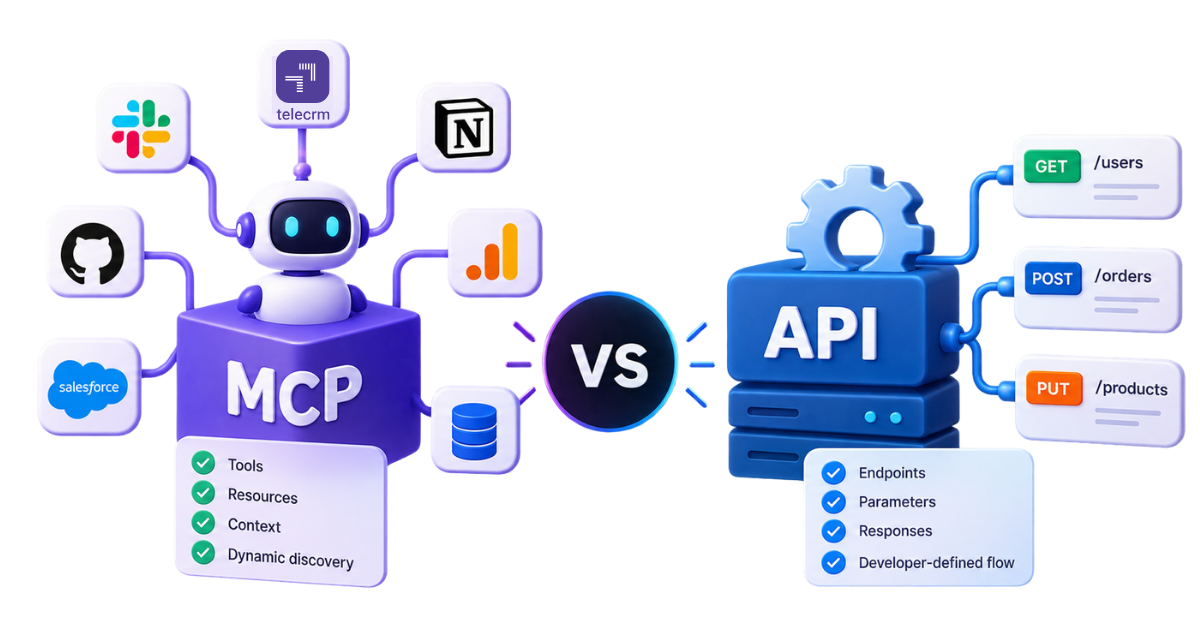
In simple terms, MCP vs API comes down to this: an API lets one software system talk to another through fixed endpoints, while MCP helps AI discover and use the right software tools—often by working through those APIs underneath.
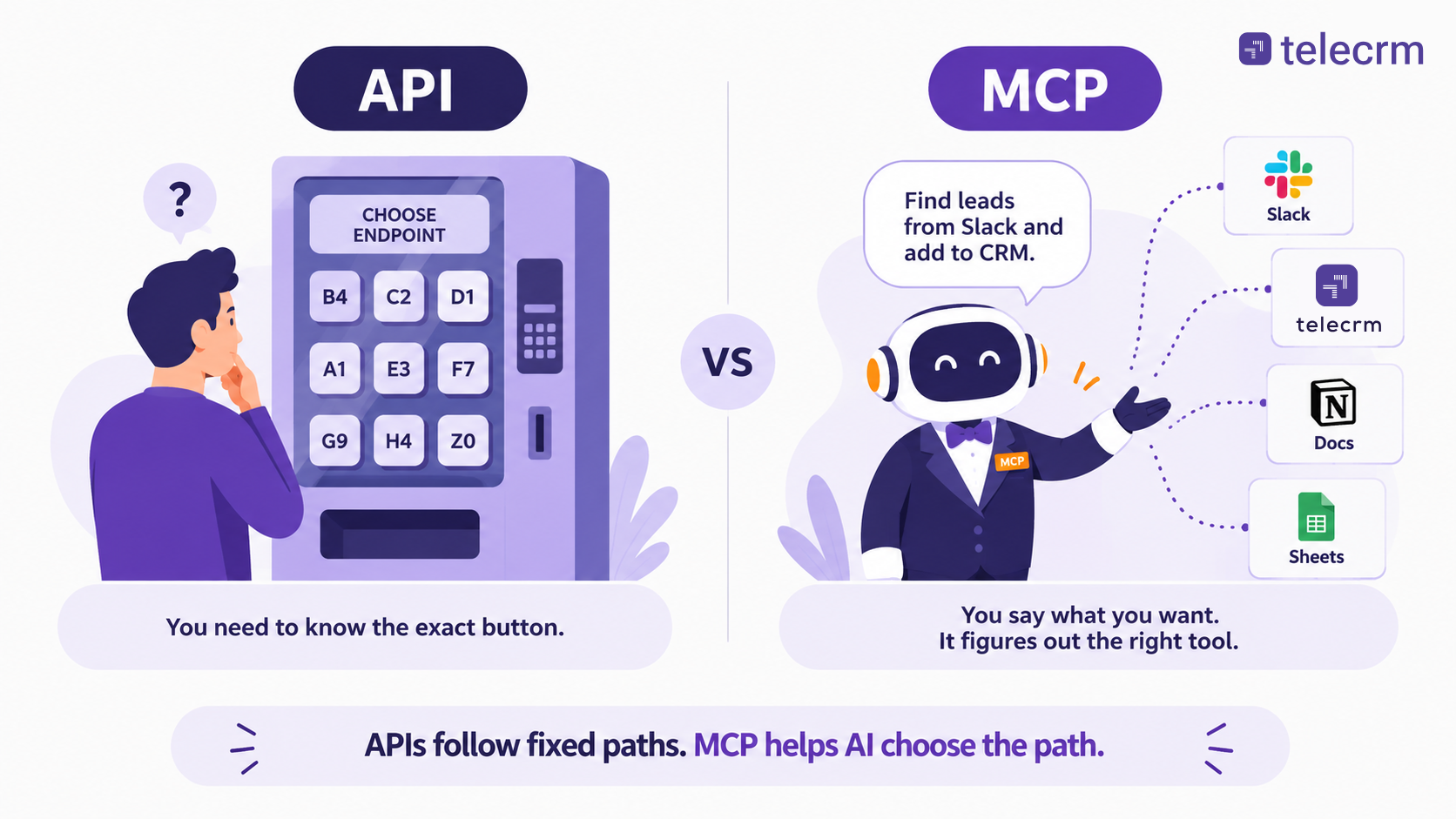
Think of an API like ordering from a vending machine.
You need to know the exact button to press. Press B4, and you get a Coke. Press C2, and you get chips. Every action is predefined.
MCP is more like having a smart concierge standing in front of many vending machines. You simply say, “I want something cold and sugar-free,” and the concierge figures out which machine to use, which button to press, and what to bring you.
That difference matters most for developers, AI teams, business managers, and companies connecting AI to business systems such as CRMs, where models need to work across multiple tools and data sources without custom wiring for every task.
In technical terms:
API: Software calls fixed endpoints to get data or perform actions.
MCP: AI uses a standard protocol to discover and use the right tools.
So, MCP does not replace APIs. It often works with existing APIs and makes them easier for AI models and AI agents to use. Below, we’ll break down what APIs and MCP are, their key differences, how they complement each other, why MCP is becoming more important.
An API (application programming interface) is a defined way for one software application to request data or trigger an action in another. For example, a CRM API can let another app fetch a lead, create a contact, update a deal or trigger a workflow.
Most traditional REST APIs work through fixed endpoints. They are usually stateless, so the caller has to manage context between requests. A developer needs to know which endpoint to call, what data to pass, how authentication works through API keys or auth tokens and what response to expect.
For example, a request like GET /leads/123 asks the system for the details of lead 123. The API checks the request, verifies access, processes it and returns the relevant data.
So, an API is essentially a structured doorway between two software systems. It is reliable and precise, but the integration usually needs to be defined in advance. APIs provide robust and predictable software integration for stable use cases.
APIs started as a simple idea: one program should be able to use another system without needing to understand how it works internally. The term application program interface appeared in computing literature by 1968, although the underlying concept goes back even earlier.
The web made APIs far more important. In 2000, Salesforce launched one of the early modern web APIs, SOAP 1.1 was published and Roy Fielding formally described REST — the architecture behind many of today’s web APIs.
From there, APIs became the standard way to connect websites, apps and SaaS platforms. A website could send a lead to a CRM, a CRM could trigger another tool, or an app could pull data from an external service.
That is why APIs became so dominant: they gave software a predictable, agreed way to talk to other software.
MCP (Model Context Protocol) is a standard way for AI applications to discover and use external tools, data sources and software capabilities. MCP was originally introduced by Anthropic as an open standard. Instead of building a completely custom integration for every AI tool, the mcp protocol gives them a consistent way to connect.
An MCP server exposes what a system can do, such as fetching records, searching data or triggering an action. An MCP client inside an AI application can query MCP servers to discover available tools and capabilities, then helps the AI model decide which tool to use.
For example, if a user asks, “Show me the leads that need attention today,” the AI can identify the relevant MCP tool, send the request through the MCP server and return the result without the user knowing which endpoint or API call was used underneath.
MCP introduces a consistent protocol for these connections and can simplify authentication with standardised OAuth 2.1 support. So, MCP acts like an MCP layer between AI applications and external tools and data sources. It does not replace existing APIs; it standardises how AI models and AI agents understand and use them.
At first glance, MCP and APIs can look similar: both help one system access something another system can do. The difference becomes clearer when you look at how that access is organised, how much the connecting application needs to know beforehand, and what happens when the number of tools grows, with one practical distinction being that APIs are usually stateless while MCP can support stateful sessions for ongoing AI interactions.
Basis | Traditional API | MCP |
What the caller needs to know | The application is usually built around specific endpoints, parameters and response formats | An MCP client can learn what tools and capabilities an MCP server makes available |
How new capabilities are added | Adding a new API endpoint does not automatically make existing applications use it; developers usually need to update the integration | New tools can be exposed through the MCP server with descriptions and schemas that compatible clients can discover through dynamic tool discovery |
Who decides the next step | The developer normally writes the workflow in advance | The AI model can choose between available tools based on the user’s request |
Handling multiple tools | Developers build the logic for deciding which API to call and in what order | MCP gives AI applications a common way to access multiple tools, making agentic and multi-step workflows easier to build |
What can be exposed | Usually data or actions through API endpoints | MCP servers can expose tools, resources and other context in a standard format |
How tightly the integration is connected | The application is often written specifically for that API’s structure | MCP creates a common interface between the AI application and different MCP servers |
Maintenance | If an API changes, the custom integration using it may also need to change | MCP standardizes the layer the AI client interacts with, although the MCP server still needs to handle changes in the systems underneath |
Authentication and security | Every API defines its own authentication and permission setup | MCP can simplify this with standardized OAuth 2.1 support, but it still requires proper authorization and permissions; it does not bypass the security of the underlying system |
Best suited for | Predictable software integration through traditional REST APIs where you already know exactly what should happen | Scalable AI applications where the required tool or sequence of actions can change depending on what the user asks |
The easiest way to see the practical difference is through a task.
Suppose a form submission should always create a lead. An API is ideal: the workflow can simply say, “When this happens, call this endpoint.”
Now suppose a sales manager asks an AI assistant: “Check this lead, tell me what happened in the last conversation and update the status if they already booked a demo.” The AI may need to search for the lead, fetch activity history, inspect another piece of data and then decide whether an update is required. That is the kind of situation where MCP becomes more useful because the path is not completely decided before the request arrives.
This is also why MCP matters more as AI applications become more capable. It is not simply another way to send an API call. It provides a standard layer for exposing capabilities to AI, while the APIs underneath can continue doing the actual work. It enables AI models to interact with external systems more adaptively than fixed endpoint integrations.
No. MCP is not replacing APIs. In many cases, it actually depends on them.
APIs remain the core way software systems exchange data and trigger actions, doing the reliable underlying work and helping AI systems use APIs effectively. MCP adds an AI-friendly layer on top, so AI models can understand what tools are available and how to use them.
For example, an MCP server may expose a tool called “Get customer details”, while the actual data is still fetched through an existing API in the background.
So, APIs provide the connection, while MCP makes that connection easier for AI to understand and use. They are complementary technologies, not competing technologies. In many cases, framing this as MCP versus APIs is the wrong comparison, because MCP often sits on top of APIs rather than replacing them.
Yes, in many cases you can build an MCP server on top of your existing APIs. But think of it less like “converting” an API and more like how teams build MCP servers as a layer in front of existing systems, like putting a receptionist in front of a complicated office.
Your APIs are the individual departments. One handles customer data, another updates records, another checks payments. They all work, but an AI model would need to know exactly which department to contact and what instructions to give.
The MCP server becomes the receptionist. It tells the AI what services are available, what each one does and what information is needed, which reduces the need to write custom code for every endpoint-level interaction. So instead of dealing with several raw API endpoints, the AI might simply see a tool called “Find leads that need follow-up”, while the MCP server handles the required API calls behind the scenes.
So yes, existing APIs can power an MCP server. The real work is not just exposing the endpoints, but turning them into clear, useful AI capabilities. In practice, one MCP server can present several underlying API-powered functions through one consistent interface.
Technically, AI can use APIs. But the difficult part is that every API has its own way of working. One might need an API key, another might use a different authentication method, and each can have its own endpoints, parameters and response formats.
So before an AI model can use an API properly, developers usually have to write custom integration code that explains things like: which API to call, what data to send, what the response means and what to do if something fails — and often write code to handle endpoint logic, errors, and context between calls, since APIs are typically stateless and require context management.
Now imagine an AI assistant that needs to work with 20 different tools. Without a common standard, this gets even harder when you need to connect AI or connect AI agents to many external tools through separate integrations.
That is where MCP helps. MCP standardises how tools are described and made available to AI systems, so the model can understand what tools exist, what they do and when to use them. It does not remove APIs. It simply makes them much easier for AI applications and AI agents to work with, and, unlike traditional APIs, it supports capability discovery and more context-aware interactions for AI systems.
MCP and APIs usually work together, not against each other, as different layers in the same architecture.
Think of an API as the engine inside a car. It does the actual work: fetching data, updating records, sending information or triggering actions. MCP is more like the steering wheel and dashboard that make those capabilities easier for an AI system to understand and control. In practice, it acts like an mcp adapter between AI models and the underlying APIs or tools.
A simple flow looks like this:
User asks a question → AI understands the intent → MCP enables AI models to choose or invoke the right tool → the tool calls the API → the API fetches or updates data → MCP passes the result back to the AI → AI gives the user an answer
For example, you ask: “Which leads need a follow-up today?” The AI picks the relevant MCP tool, that tool uses the CRM API to fetch the data, and the AI turns the result into a useful answer.
So, APIs remain the foundation, while MCP adds a standard AI-friendly layer on top. APIs do the work; MCP helps AI know what work is possible and how to use it. Put simply, MCP enables AI agents to work across multiple tools without changing the role of the APIs underneath.
For years, software mostly needed to talk to other software, which is why APIs were enough for most integrations.
Now, AI models and AI agents are expected to do much more: search data, use business tools, take actions and move across multiple systems. That creates a new problem, how does AI understand what tools exist and how to use them safely and consistently?
MCP addresses that through dynamic tool discovery, which is a big reason it is becoming important for scalable AI applications. Instead of building custom integration code for every new AI model and every new system, developers can expose capabilities through a consistent protocol. MCP solves the fragmentation caused by separate custom connectors and manual updates.
You can think of it as the USB-C moment for AI integrations: different devices can still work differently underneath, but they now have a common way to connect. MCP flips the integration model from hardcoded endpoints toward runtime discovery for AI-driven use cases.
A CRM has to do two very different jobs today. It needs to connect with other business systems, and it also needs to become easier for AI tools to understand and work with, combining software integration for business systems with AI-facing access patterns.
That is where APIs and MCP play different roles.
telecrm is a powerful CRM built around lead management, calling, WhatsApp, automation and sales reporting. It uses APIs to connect with external systems and move data between them. For example, a business can use telecrm APIs to push leads into the CRM, update records, trigger workflows or connect telecrm with another application.
MCP adds another layer. With telecrm MCP, compatible AI assistants can interact with CRM capabilities more naturally in a way that is easier for AI models to understand. Instead of building a separate fixed integration for every question, a manager can ask things like “Which leads need attention today?”, “Why did we lose deals last month?” or “What is my churn rate?” The AI can also query MCP servers for available CRM tools instead of relying only on fixed endpoint knowledge.
The flow is simple:
API: Website or app → telecrm API → Create, fetch or update data MCP: Manager → AI assistant → telecrm MCP → CRM tools and data → Answer
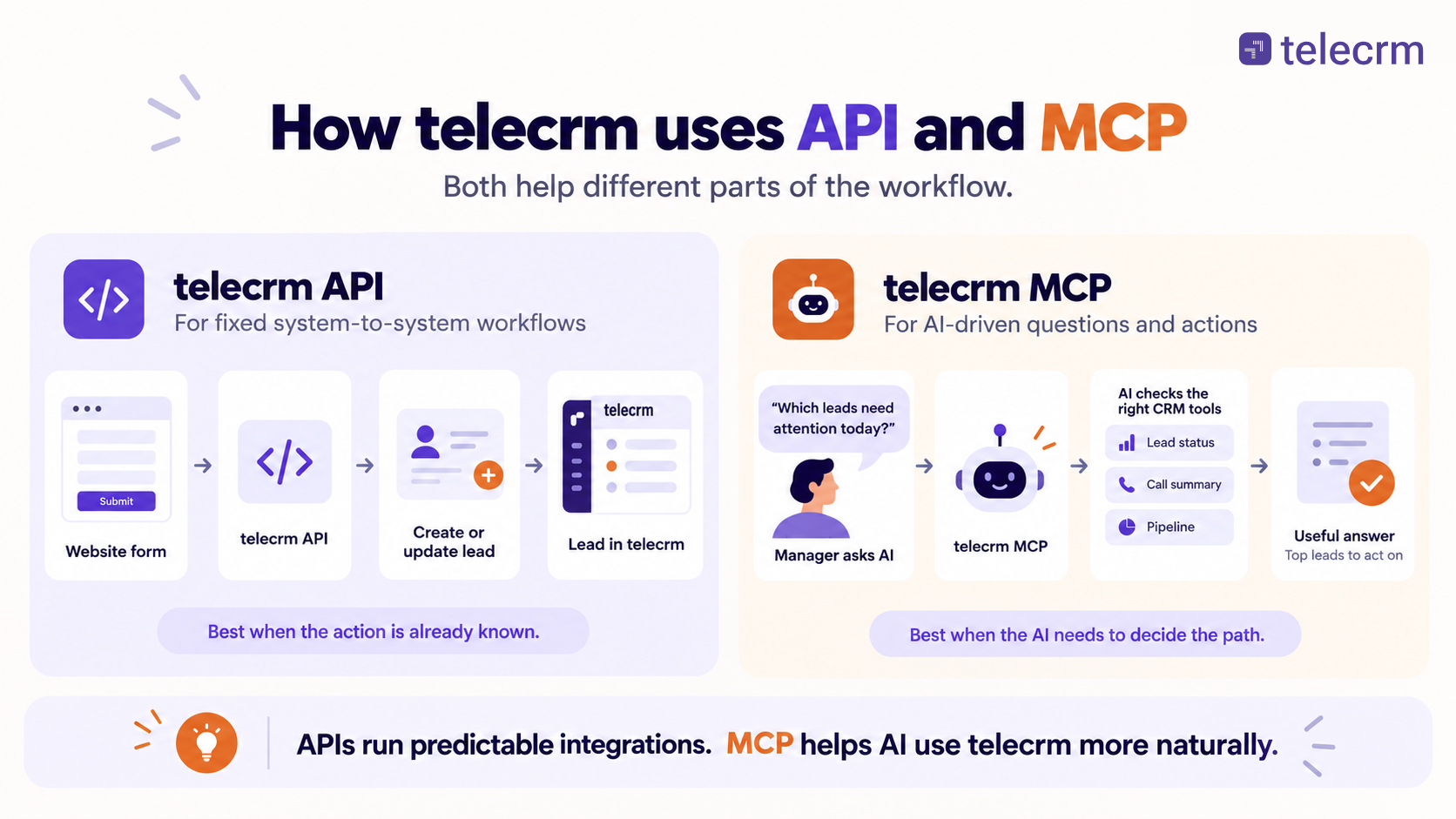
So telecrm uses APIs for system-to-system integration and MCP for AI-to-CRM interaction. One helps software work with telecrm, while the other helps AI understand and use telecrm more naturally.
Now that you know how MCP and APIs differ, the more useful question is: what kind of system does your business need?
If you have predictable workflows, capturing leads from a website, syncing customer data, updating records or connecting two applications, APIs are usually the right foundation. The action is known in advance, so a fixed integration works well, and APIs provide robust support for predictable business processes, while MCP fits better when interactions need more flexibility.
But if you want employees to interact with business systems through AI, asking questions, analysing data, finding information or triggering different actions depending on the situation, MCP becomes much more useful. It gives AI a structured way to work with those systems without creating a separate workflow for every possible question, including context-aware access to multiple tools that supports scalable AI applications.
For many businesses, the answer will therefore be both: APIs running reliable processes in the background and MCP making those systems easier to access through AI. For most teams, the best choice is using them together rather than treating them as competing technologies.
The real opportunity is not choosing the newer technology. It is building a system where routine work happens automatically and people can get answers or take action without digging through multiple tools themselves. Book a demo with telecrm and get an all-in-one CRM with MCP and API integrations.
An API lets one software system request data or actions from another. MCP gives AI a standard way to discover and use tools, APIs and data sources.
Yes. Existing APIs can often be exposed through an MCP server, and developers may also build MCP servers on top of those APIs, but they still need to define useful tools, permissions, inputs and outputs for the AI to understand.
An MCP server exposes tools, resources or data that an AI application can use. It acts as the bridge between the AI and the underlying business systems.
An MCP client is the part of an AI application that connects to MCP servers, discovers available tools, and can query MCP servers at runtime to find available capabilities, helping the AI model use them.
Not necessarily. Traditional REST APIs are often better for stable, fixed integrations, while MCP is more useful when an AI needs context-aware tool choice or needs to handle different requests dynamically.
Yes. MCP is particularly useful for AI agents that need access to several tools or data sources and may need to combine them in a multi-step workflow, because MCP enables AI agents to discover and coordinate multiple tools dynamically across steps.



© Copyright 2026 telecrm.in (Flamon Cloudtech Pvt Ltd) - All Rights Reserved • Privacy Policy • T&C



© Copyright 2026 telecrm.in - All Rights Reserved • Privacy Policy • T&C