
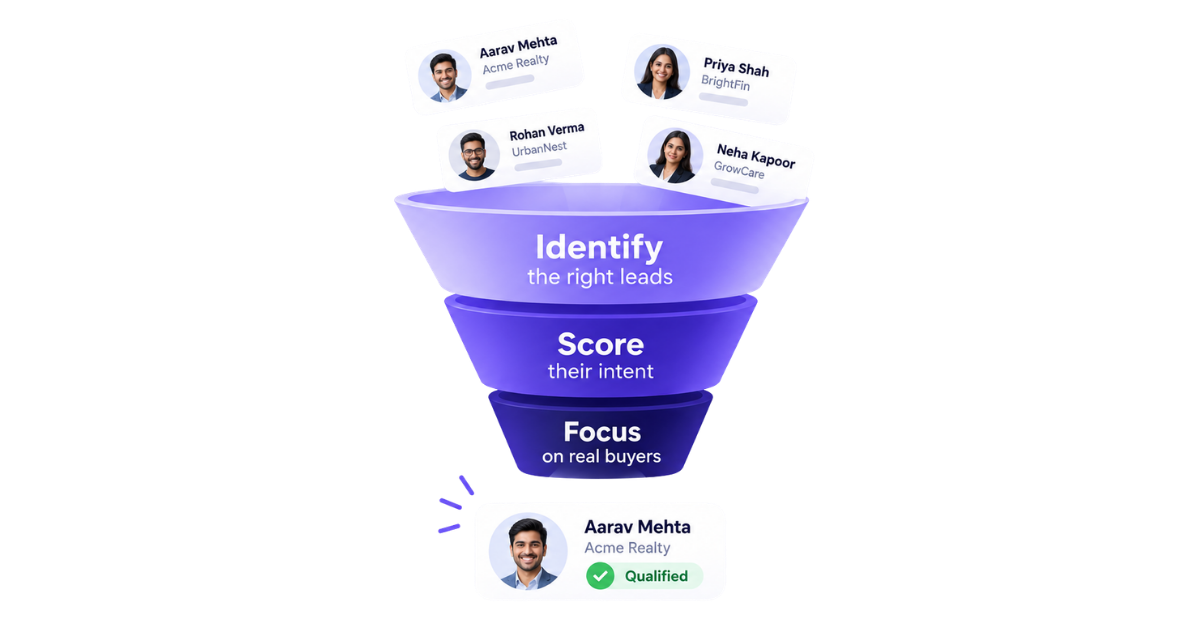
Lead qualification is the process of checking whether a potential buyer has a real problem you can solve, the ability to pay for it and the authority to make or influence the buying decision — before you spend hours trying to sell to them.
As Peter Drucker famously put it:
“There is nothing so useless as doing efficiently that which should not be done at all.”
The same applies to sales. You should not be spending hours pitching to someone who was never going to buy in the first place. That is one of the biggest traps in sales.
It does not matter how strong your pitch is or how good your presentation looks. If the person on the other end has no budget, no genuine need or no way to make or influence the buying decision, you are putting effort into an opportunity that was unlikely to go anywhere.
Lead qualification helps you avoid that trap before you fall into it. It filters your leads early, separates serious buyers from window shoppers and helps your sales team spend more time on opportunities that actually have a chance of closing. So, how do you qualify a lead properly? Let’s break it down.
Lead qualification is essentially a decision-making process that helps sales and marketing teams determine whether a potential customer has enough fit, need and buying potential to justify further sales efforts.
A lead does not become qualified simply because they filled out a form, downloaded a resource or responded to a campaign. Those actions may indicate interest, but qualification looks deeper at whether that interest can realistically turn into a sales opportunity.
A qualified lead usually meets a combination of criteria such as:
For example, two people may submit the same demo form. One may fit your target audience, have clearly defined pain points and be actively evaluating solutions. The other may only be researching for a future requirement.
Both are leads, but they do not have the same lead quality or deserve the same level of sales attention. This is why the lead qualification process helps sales teams separate the most promising leads from those that need more nurturing or are unlikely to become paying customers.
To build a solid foundation before you even start qualifying, check out this ultimate guide on what lead management is.
You sit down at your desk each morning with a list of 20 prospective buyers. Your entire job — and your commission — depends on spending your energy only on the people who can and will buy, while politely stepping away from the ones who won’t.
Here is how you actually qualify a lead step by step, from the second a notification hits your inbox to the moment you decide whether to accept, nurture or reject them.
Before you dial a number or book a meeting, look at the information already available about the lead. Where did they come from? Which keyword, ad or landing page brought them in? What did they enquire about? What information did they submit in the form?
At this stage, you are looking for contextual fit.
By now, you may be able to remove a few obvious unqualified leads. For everyone else, you have only formed an initial view. The discovery call is where you test whether that view is actually correct.
Once you get the lead on a call, lead qualification should not feel like an interrogation where you fire one question after another. It is a guided diagnostic conversation.
You are trying to verify the information you already have and understand four things that are much harder to capture through a form.
Understand what is actually going wrong today and why the lead is looking for a solution. Do not stop at broad requirements such as “better lead management” or “better reporting”. Dig until you understand the actual problem behind the requirement.
Find out how much that problem matters. Is it costing the business leads, revenue, time, productivity or creating another measurable impact? A problem they can comfortably live with is very different from one they actively need to solve.
Find out who is involved and how the decision will be made. Understand who is evaluating the solution, who influences the decision, who controls the budget and whether any other approvals are required.
Understand why they are looking now and when they expect to act. This helps separate an immediate sales opportunity from someone who has genuine interest but may not buy for several months.
By the end of the discovery call, you should know what they are trying to solve, how important it is, who will decide and when they are likely to act.
Speed is everything; learn why reaching out instantly matters in this guide to lead response time.
At the end of the discovery call, you should have enough information to make a clear decision. Do not leave every interested lead sitting in the same sales pipeline stage.
This is a Sales Qualified Lead (SQL) with good fit + real pain + buying intent + a realistic path to purchase.
Move sales qualified leads further into the sales process — whether that means a detailed demo, a discussion with another stakeholder or a proposal.
The lead may be suitable and genuinely interested, but there is no immediate buying window, which often means they are among marketing qualified leads ( MQLs ): a good fit for marketing communications but not yet ready for sales. Record why they are not ready, continue relevant marketing and sales efforts, with marketing efforts tailored to move them toward becoming more qualified leads over time, and re-engage when the timing becomes more realistic.
The lead may fall outside your target audience, have no genuine requirement, need something you cannot provide or have no realistic path to purchase. Disqualifying these leads early saves your sales team’s time for stronger opportunities.That is what the entire lead qualification process is designed to answer:
Who should I pursue now, who should I come back to later and who should I stop chasing altogether?
Lead qualification frameworks did not all appear at the same time or solve the same problem. They evolved as sales became more complex. They also give sales professionals a more consistent way to qualify sales leads, which reduces gut-feel decisions.
BANT came first, commonly traced back to IBM’s sales organisation. It gave reps four simple checks — Budget, Authority, Need and Timeline — to quickly decide whether an opportunity deserved attention. As consultative selling became more common, CHAMP flipped that logic by putting the buyer’s challenge before their budget. Later, complex enterprise sales created another problem altogether: even an interested buyer with money could still get stuck between multiple stakeholders, approvals and procurement. That is what MEDDIC was built to address, and it also shows why the depth of any framework should match deal complexity to help minimise subjective assessments.
BANT is the lightest of the three frameworks. You establish four things: Budget, Authority, Need and Timeline. The objective is to quickly find gaps in an opportunity before investing too much sales time.
Use it when your sales process is relatively short, the buying decision involves few people and you need to qualify a high volume of leads. You do not have to ask the four questions in order; by the end of qualification, you simply need enough evidence to know whether all four exist.
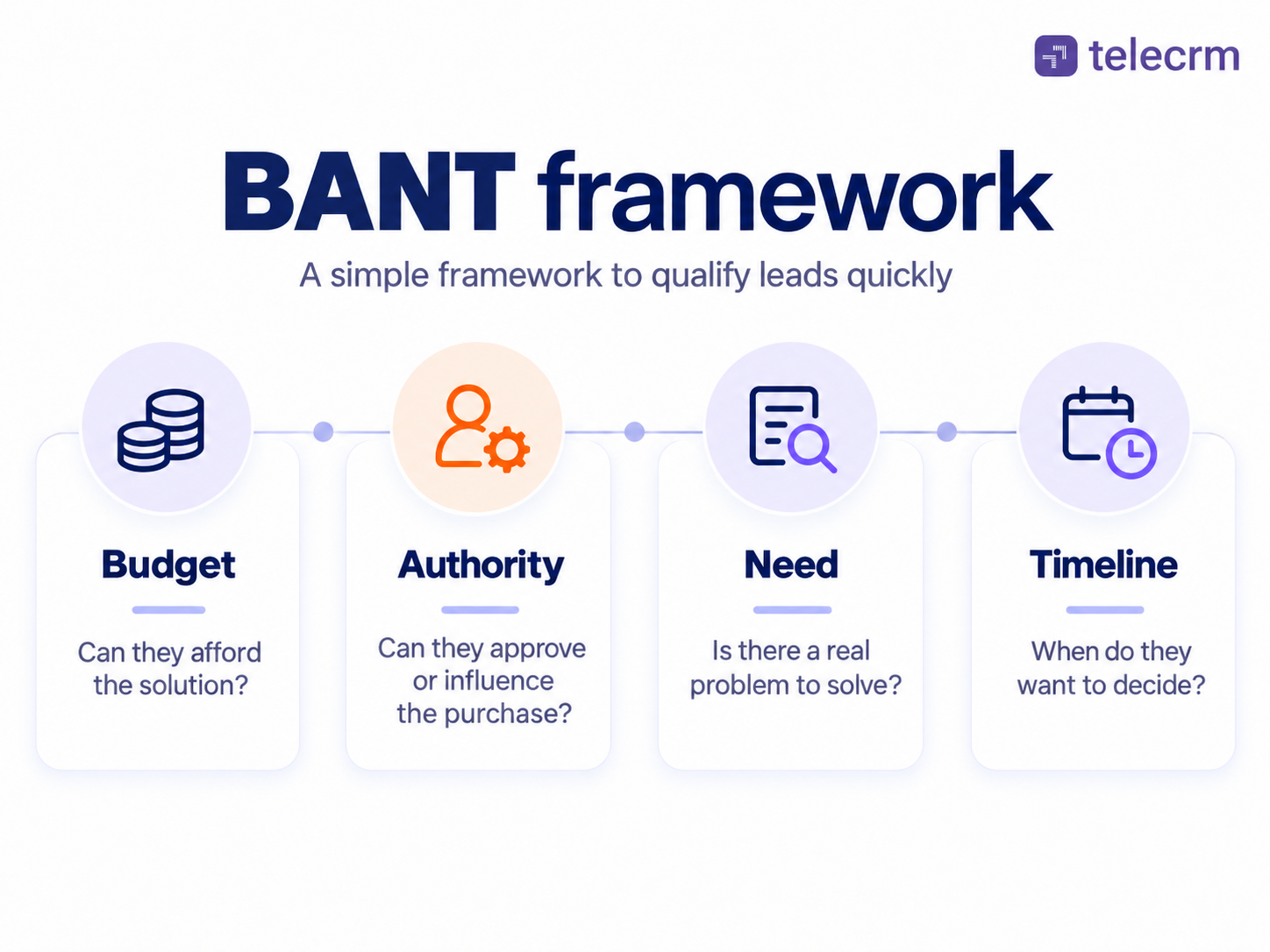
Its weakness is that it assumes things such as budget and authority are already defined. In many modern B2B purchases, the buyer may first recognise the value of solving a problem and only then secure budget or bring the final decision-maker into the conversation.
CHAMP — Challenges, Authority, Money and Prioritisation — developed as a more buyer-led alternative to BANT. Instead of opening with “Do you have the budget?”, you start by understanding what the buyer is trying to fix and how important that problem is.
That small change matters. If there is no meaningful challenge, authority and budget become irrelevant. If the problem is serious enough, money may be found and other stakeholders may be brought into the process.
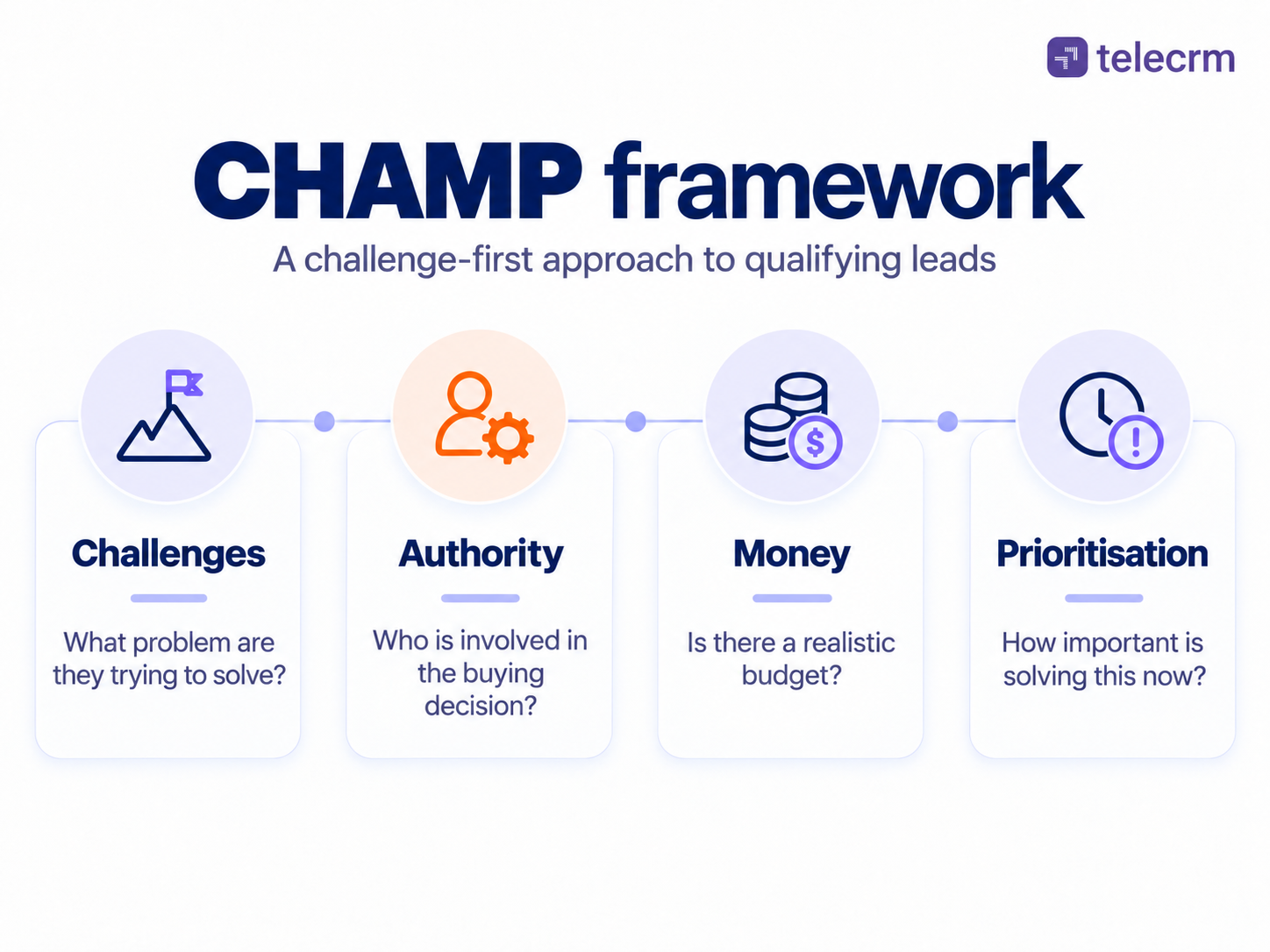
This makes CHAMP particularly useful for consultative sales, where the prospect may know they have a problem but has not yet built a complete business case around solving it. Zorian Rotenberg’s CHAMP methodology explicitly puts the buyer’s challenges at the centre of qualification.
MEDDIC was created inside PTC in 1996 as the company was dealing with a much harder qualification problem: large enterprise opportunities involving multiple people and long decision processes. According to MEDDICC’s account of its history, PTC’s sales organisation had reached roughly 300 reps, and the team studied why deals were won, lost or delayed. That work produced six checks: Metrics, Economic Buyer, Decision Criteria, Decision Process, Identify Pain and Champion.
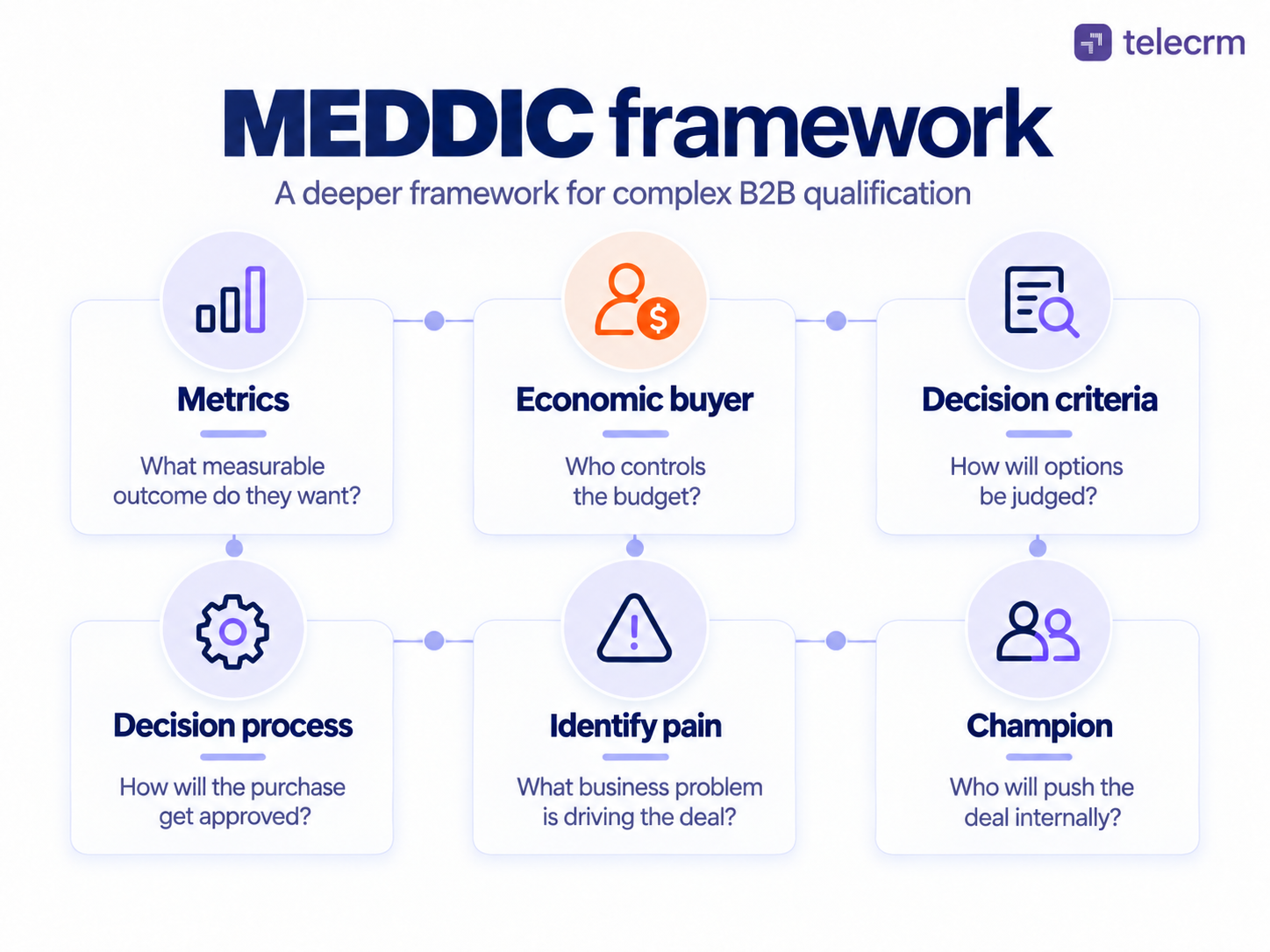
This means MEDDIC goes beyond asking whether the prospect wants to buy. You map the value they expect, who controls the money, how the solution will be judged, what approvals the deal must pass through and whether someone inside the company is actively helping you move it forward.
Use it when the deal is large enough that simply knowing budget, need and timeline is not enough. If five or six stakeholders can influence the purchase, understanding the buying process becomes as important as understanding the buyer.
Feature | BANT | MEDDIC | CHAMP |
Primary Focus | Financial ability & timeline | Risk reduction & process tracking | Customer pain points |
Complexity | Low | High | Medium |
Best Deal Size | Small to Medium | Large Enterprise | Medium to Large |
Lead Orientation | Seller-focused | Process-focused | Buyer-focused |
You do not necessarily have to choose one framework and use it forever. A sales team may use BANT for quick initial qualification, move towards CHAMP during discovery or apply MEDDIC to larger opportunities where the decision process becomes more complicated, as long as the choice supports the wider sales strategy rather than just rep preference.
The point of a qualification framework is not to make reps memorise an acronym. It is to make sure the depth of qualification matches the complexity of the deal.
Lead qualification keeps your sales pipeline focused on opportunities that actually have a chance of closing. Without it, sales reps can end up spending time on prospects who do not match your Ideal Customer Profile (ICP), have no clear buying intent or are nowhere close to becoming a Sales Qualified Lead (SQL). Here is why lead qualification matters:
1. It helps sales reps focus on the right opportunities
A sales rep has limited time, so every hour spent on a weak lead is an hour not spent on a stronger one. Qualification helps reps focus on prospects who match the ICP, have a genuine need, show buying intent and have a realistic path to purchase.
2. It shortens the sales cycle
When poor-fit or low-intent leads are identified early, they do not sit in the pipeline for weeks pretending to be real opportunities. Qualified leads already have clearer pain points, stronger urgency and better buying potential, allowing reps to move faster towards demos, stakeholder discussions and proposals.
3. It improves win rates and deal quality
Leads that closely match your ICP are generally easier to sell to because the product already fits their needs. That means reps spend less time forcing the fit, deals face fewer unnecessary objections and there is often less pressure to rely on discounts just to get them closed.
4. It makes your pipeline and forecasting more accurate
An unqualified deal should not carry the same weight as a serious opportunity, yet many pipelines treat them that way. This creates what sales leaders often call a phantom pipeline — deals that look good in reports but have very little chance of closing.
A stronger qualification process keeps those deals out, making pipeline coverage, expected revenue and quarterly forecasting far more realistic.
5. It reduces the risk of bad-fit customers and churn
Qualification should not stop at asking, “Can we close this customer?” It should also ask, “Should we?”
A customer who does not truly fit the product may buy today but struggle to get value later. That often leads to more support requests, lower adoption, poor Customer Lifetime Value (CLV) and eventually churn. Strong qualification helps protect retention by making sure the fit exists before the deal is closed.
6. It aligns marketing and sales around the same definition of a good lead
One of the biggest benefits of a structured qualification process is that it creates a clear progression from Marketing Qualified Lead (MQL) to Sales Qualified Lead (SQL).
Marketing can define which behaviours or characteristics make someone an MQL, while sales can decide what additional criteria must be met before that lead becomes an SQL.
This shared definition helps marketing improve targeting and lead generation, while sales receives opportunities that are more relevant, better qualified and more likely to convert.
A framework keeps qualification consistent. But when hundreds of leads come in every day, your reps should not have to manually inspect each one.
With telecrm, you can automate much of the qualification process:
Use forms and custom fields to collect details such as company size, requirement, location, role, budget and timeline. telecrm, as a lead management system, can automatically capture leads from your website, Excel and multiple lead sources.
Turn your qualification criteria into a lead scoring model. Give more weight to leads that match your ICP, come from high-intent sources or show stronger buying intent. This helps sales reps focus on the most promising leads first.
Form data and lead scores only tell part of the story. telecrm keeps calls, WhatsApp conversations, follow-ups and activities against the lead, while Lead IQ can surface intent, pain points, important context and suggested next steps.
So qualification becomes:
Fit → Intent → Conversation context → Sales judgement
Once a lead is ready for sales, telecrm can distribute it automatically based on location, availability, workload, performance or round-robin rules.
After qualification, reps can manage calls, WhatsApp conversations, follow-ups, reminders and pipeline stages from the same lead record. Sales managers can then track where every opportunity stands using better sales pipeline visibility in your CRM.
The result is a more structured qualification process where telecrm handles much of the capture, scoring, prioritisation and distribution, while reps focus on the final human judgement.
At the end of the day, making more sales isn’t about talking to hundreds of people, it’s about spending your time on the right people.
Good lead qualification is all about changing your mindset. You stop chasing every single person who fills out a form on your website. Instead, you act like an expert who knows exactly who they can help. Walking away from a bad prospect isn’t a loss, it’s a win because it saves you hours of work that you can spend on a customer who is ready to buy right now.
When you ask the right questions early on and politely walk away from bad fits, everything gets easier. Your sales happen faster, your income becomes more reliable and your customers end up much happier.
So, before your next sales call, remember: your job isn’t to fill your calendar with calls — it’s to spend your time where it actually pays off. Book a demo with us to automate this process and start closing deals that actually pay off.
Inbound leads have already shown some level of interest, so qualification usually focuses on whether that interest can become a real opportunity. With outbound leads, sales reps first need to establish both relevance and interest before going deeper into budget, authority, need and timing.
A lead should usually be disqualified when there is a fundamental mismatch that is unlikely to change — such as the wrong use case, no realistic budget, no relevant need or a requirement your product cannot solve. Disqualification should be based on clear criteria rather than a rep simply feeling that the lead is “not good”.
Yes. Some unqualified leads are simply not ready yet. A lead may lack budget today, be tied to another vendor or have no immediate urgency but become a strong sales opportunity later, which is why it is important to distinguish between disqualified leads and nurture leads.
Automated lead qualification uses CRM rules, forms, lead scoring, behavioural data or AI to evaluate and prioritise leads before a sales rep manually reviews them. It can help identify high-fit or high-intent leads faster and route them to the appropriate sales team. Current content around automated qualification increasingly distinguishes rule-based scoring, predictive scoring and conversational qualification.
Review your qualification criteria whenever your ideal customer profile, pricing, product, target market or sales strategy changes. You should also compare qualification decisions with closed-won and closed-lost deals periodically to see whether the signals you consider important are actually predicting sales success.
Lead qualification rate is the percentage of generated leads that meet your criteria and become qualified opportunities. It is useful for comparing lead quality across campaigns, channels and lead generation strategies, but there is no universal “good” rate because qualification standards vary significantly between businesses.



© Copyright 2026 telecrm.in (Flamon Cloudtech Pvt Ltd) - All Rights Reserved • Privacy Policy • T&C



© Copyright 2025 telecrm.in - All Rights Reserved • Privacy Policy • T&C