
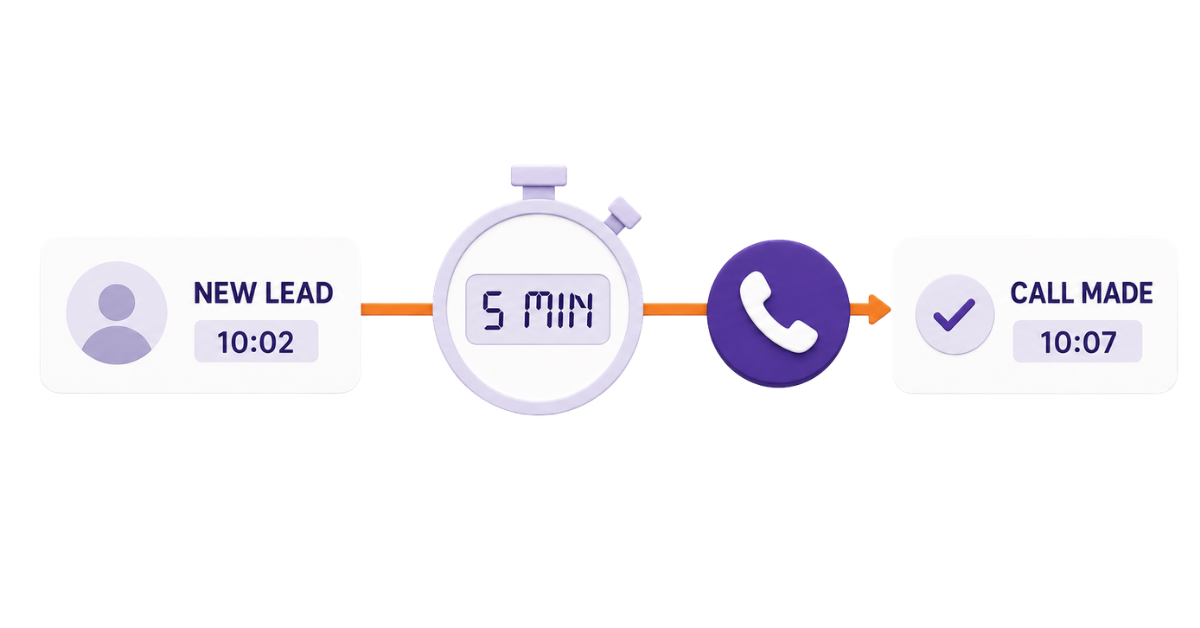

A new lead has just filled out your form, requested pricing or asked for a callback. At that moment, the requirement is fresh in their mind and they are prepared to talk. The longer the enquiry waits in an inbox, spreadsheet or unassigned CRM list, the harder it becomes for a salesperson to start a useful conversation.
That is why lead response time matters. It measures how quickly your business acts after someone shows interest. For sales teams that depend on calls and WhatsApp, improving it can create more conversations from the leads they already generate.
Lead response time is also surrounded by exaggerated statistics. This guide uses only traceable research, explains its limitations and shows how an Indian sales team can build a faster response process without sacrificing the quality of the conversation.
• The strongest available research consistently shows that the chance of contacting and qualifying an inbound lead falls as response time increases.
• In a widely cited lead response study, calling within five minutes rather than 30 minutes was associated with 100 times higher odds of making contact and 21 times higher odds of qualification.
• A separate Harvard Business Review analysis found that companies contacting leads within an hour were nearly seven times more likely to qualify them than companies waiting just one additional hour.
• Five minutes is a sensible internal target for high-intent enquiries, but it is not a universal rule for every lead, channel or industry.
• Sales teams should measure automated acknowledgement, first human attempt and first meaningful contact separately.
• Faster response depends on automatic capture, clear ownership, prioritised queues, escalation rules and complete context for the rep making the call.
Lead response time refers to the time between the creation of an inbound lead and the first action taken by the sales team.
Suppose a prospect submits a Facebook Lead Ad at 11:12 am, which is when a lead shows interest and the timer starts as soon as that new lead enters the system, and the assigned salesperson calls at 11:19 am. The lead response time for that first call is seven minutes.
The calculation is simple:
Lead response time = Time of first sales response − Time the lead entered your system, which reflects the team’s initial contact speed, not the same as meaningful contact.
The definition becomes less useful, however, if every type of response is treated as the same. An automatic acknowledgement is not equivalent to a human conversation. A call attempt that rings without an answer is not the same as speaking to the decision-maker.
A reliable reporting system should therefore record at least three timestamps:
Timestamp | What it records | Why it matters |
Lead creation | When the enquiry entered the CRM | Establishes when the response clock started |
First response | The first call, WhatsApp message, SMS or email | Shows how quickly the business acted |
First meaningful contact | The first two-way conversation with the prospect | Shows how quickly the team actually connected |
This distinction prevents an instant automated message from making the response report look excellent while leads are still waiting hours for a salesperson.
Lead response time measures the beginning of the sales process. Follow-up time measures whether the team continues after the first attempt. They solve different problems:
• First response time tells you how quickly new demand is being handled.
• Follow-up adherence tells you whether interested prospects are being worked consistently.
• Time to meaningful contact tells you how long it takes to reach a real person.
• Time to qualification tells you how quickly the team establishes intent, fit and the next step.
Combining them into one number hides where leads are getting delayed.
There is no single universal conversion multiplier for fast follow-up. Different studies measured different outcomes, including contact, qualification and eventual conversion. Their samples and time periods also differ. In practice, lead response time matters because delays reduce the odds of contact, qualification, and downstream sales outcomes.
Even with those differences, the direction of the evidence is consistent: inbound leads become harder to contact and qualify as the delay increases, which shows why lead response time important decisions should be based on comparable outcomes, not one headline statistic.
The Lead Response Management Study, conducted by Dr James Oldroyd with InsideSales.com, analysed three years of data from six companies, covering more than 15,000 web-generated leads and over 100,000 call attempts.
It reported that:
• The odds of contacting a lead within five minutes rather than 30 minutes were 100 times higher.
• The odds of qualifying a lead within five minutes rather than 30 minutes were 21 times higher.
• Even the difference between five and 10 minutes was material. Contact odds fell fivefold and qualification odds fell fourfold in the study data.
These findings are often misstated as “21 times more likely to convert”. The study measured qualification, not a completed sale. That distinction matters because qualification is only one stage in the sales funnel.
A more recent InsideSales lead response analysis published in 2021 reviewed more than 55 million sales activities involving 5.7 million inbound leads at over 400 companies. It reported conversion rates more than eight times higher when the first attempt happened within five minutes compared with attempts made between five minutes and 24 hours.
This was platform research from a sales technology provider rather than an independent academic trial, so it should be presented with that context.
The Harvard Business Review article The Short Life of Online Sales Leads reported two related pieces of research.
First, the researchers audited 2,241 US companies by submitting a web-generated test lead and measuring the response. They found that:
• 37% responded within an hour.
• 16% responded between one and 24 hours.
• 24% took longer than 24 hours.
• 23% never responded.
• Among companies that responded within 30 days, the average response time was 42 hours.
The 42-hour figure is frequently described online as the current “average B2B lead response time”. That is misleading. It came from a 2011 audit of US companies across several sectors and only included companies that replied within 30 days. It is evidence of how slowly the audited companies responded at that time, not a universal benchmark for every B2B company today.
The same HBR article described a separate analysis of 1.25 million sales leads received by 29 B2C and 13 B2B companies. Businesses that attempted contact within an hour were nearly seven times more likely to qualify the lead than those that waited even one additional hour. They were more than 60 times as likely to qualify the lead as businesses that waited 24 hours or longer.
Again, the outcome was qualification rather than a guaranteed sale. The practical lesson is not that every lead must close quickly. It is that the opportunity to begin a meaningful sales conversation is strongest soon after the enquiry.
The research is useful, but only when its limitations are clear.
The practical conclusion is simple: respond while interest is fresh, measure the result in your own funnel and improve from there.
There is no single ideal response time for every lead. A demo request from someone comparing vendors deserves more urgency than a guide download from a person doing early research, and while there is no single target for every enquiry, many teams still treat a one-minute response for explicit buying signals as ideal because some research says it can boost conversions by 391%.
A better system assigns response targets according to intent and channel.
The following targets are practical operating recommendations, not externally established industry averages; think of them as a flexible view of the ideal lead response time by intent and channel, with industry benchmarks used only as directional context:
Priority | Example | Suggested first human attempt | Appropriate first action |
P1: Explicit buying intent | Demo, quote, pricing or callback request | Within 5 minutes during working hours | Call immediately, then send a contextual WhatsApp message if unanswered |
P2: Active enquiry | WhatsApp question, missed call or high-intent ad lead | Within 10 minutes | Reply on the originating channel and assign a rep |
P3: General inbound lead | Website contact form or marketplace enquiry | Within 30 minutes | Call or message based on the contact preference |
P4: Early research | Guide, webinar or newsletter registration | Same working day | Send the requested resource, then enter an appropriate nurture process |
Adjust these targets for your sales capacity and customer expectations. A five-minute SLA that is usually missed is less useful than a 15-minute SLA the team can meet and improve over time.
If leads currently wait several hours, moving directly to a five-minute SLA may create shortcuts, poor conversations and distorted reporting.
Use a staged target:
The objective is more timely, useful conversations that help convert more leads, not an attractive dashboard number.
To calculate lead response time, measure the average time between lead creation and the first action for one lead by subtracting the creation timestamp from the first response timestamp.
Example
The first-attempt response time is seven minutes. The time to meaningful contact is 34 minutes. Many teams also track average lead response time across all leads, not just one enquiry. Both numbers are useful and they answer different questions.
Averages can hide a small group of severely delayed leads. Consider five response times: 2, 3, 4, 5 and 180 minutes. Teams should also track speed by source, rep, and response band instead of relying on one summary metric.
The average is 38.8 minutes, which makes the whole process look slow. The median is four minutes, which makes it look excellent. Neither figure alone shows that one lead waited three hours.
Use a small set of connected metrics instead to reveal the broader lead response speed pattern:
Segment them by source, campaign, rep, time and priority to locate the actual delay.
Calculating response time only for contacted leads hides the most serious failures. Report untouched leads separately and include every valid enquiry in SLA attainment. Exclude spam, duplicates and tests through documented rules.
Most teams do not intentionally ignore new enquiries. Time disappears between systems and hand-offs, and slow response times do not just create internal bottlenecks; some research suggests 30% of leads go to competitors because of them.
Telling reps to “call faster” rarely solves the underlying problem. A reliable process has five connected layers.
Connect forms, ad platforms, WhatsApp, inbound calls and relevant marketplaces directly to the CRM so your capture system supports lead generation and fast handoff by getting every enquiry into the CRM in real time. Preserve the original creation timestamp, including for web leads, so the response clock does not restart when the lead moves between systems.
Compare valid enquiries at each source with the leads created in the CRM every week. This catches broken integrations early.
Use lead distribution rules based on product, language, location, campaign, availability, or workload. To avoid manual delays, automate lead distribution with automated lead routing so reps do not wait, and assign leads to the best owner as soon as they come in. Add a fallback so an unworked lead returns to a shared pool or another eligible rep, instead of overloading one person when the system can distribute leads equally across eligible owners.
Put P1 and overdue leads at the top so reps focus on the most promising leads first, followed by scheduled callbacks and lower-intent work.
Simple lead scoring can support this prioritisation when intent signals vary.
A useful queue answers three questions at a glance, helping teams handle work faster and turn high quality leads into qualified leads:
Must Read: Automated Lead Scoring Blueprint: Sort Leads Like a Pro
An immediate WhatsApp or SMS acknowledgement can confirm receipt, set expectations and collect an initial detail. SMS follow-ups can engage 90% of leads within three minutes, which is why acknowledgements work well when a rep cannot speak immediately. It should support the human follow-up and help engage leads instantly rather than replace it.
For example:
Hi {{name}}, thanks for enquiring about {{service}}. A member of our team will call you shortly. If another time works better, reply here and let us know.
It confirms the next step without pretending that a salesperson has already handled the enquiry.
When a lead crosses its target, make the delay visible and trigger a defined escalation, because repeated misses often point to broken lead response processes, not isolated rep failure:
Escalation should fix exceptions, not punish reps for impossible workloads. If the whole team misses the SLA at the same time, investigate capacity or process design.
Fast does not always mean calling; a quick response still works best when the first action fits the behaviour that created the enquiry.
Teams should respond to potential customers on the channel they used whenever possible.
Lead source | Strong first response | Common mistake |
Callback, demo or quote form | Call with the submitted context ready | Asking the prospect to repeat every form answer |
WhatsApp enquiry | Reply on WhatsApp, then offer a call when useful | Calling without acknowledging the message |
Missed inbound call | Return the call and send a short message if unanswered | Treating it like a low-intent database lead |
Facebook or Google lead form | Call promptly and mention the exact campaign or offer | Opening with “You filled some form” |
Marketplace enquiry | Confirm the stated requirement before pitching | Giving a generic script unrelated to the listing |
Content download | Deliver the content first, then nurture according to behaviour | Treating an early researcher like a demo request |
A callback form clearly permits a call. A newsletter registration does not signal the same urgency or expectation.
A fast call without context can do more harm than a slightly slower, relevant one. Show the rep the source, campaign, submitted answers and prior interactions before dialling so they can do more than just make contact and improve their chances of converting leads.
A simple opening structure works better than a long script:
For example:
Hi Riya, this is Aman from Northstar Academy. You asked about the weekend data analytics batch a few minutes ago. Is now a good time for a quick call? I can help you compare the August and September start dates.
Use call recordings and outcomes to coach the first 60 seconds. Speed creates the opportunity, but relevant openings are what help meaningful conversations start and keep prospects engaged.
Also Read: Sales Pipeline Visibility CRM: A Complete Guide for 2026
There is no credible universal rule that every team must make exactly six or eight attempts. Cadence depends on intent, consent, buying cycle and channel.
Multiple follow up attempts are often necessary before a prospect replies, especially for high-intent enquiries.
Use a testable starting point. For a high-intent lead, that might look like this:
Time | Action | Purpose |
First 5–10 minutes | Call once | Reach the prospect while the enquiry is fresh |
Immediately after an unanswered call | Send a contextual WhatsApp message | Explain who called and allow an easy reply |
Later the same working day | Second call at a different time | Avoid assuming one missed call means no interest |
Next working day | Call or WhatsApp based on prior engagement | Continue without repeating the same message |
Following days | Fewer, purposeful attempts | Share relevant information or confirm whether to close the enquiry |
Review connection and opt-out rates. Stop when the person declines, withdraws consent, or appears to lose interest after purposeful outreach.
Digital enquiries can arrive when the sales team is unavailable, often outside normal business hours. Measure the scale of this problem from your own data instead of relying on a generic industry percentage.
Separate after-hours performance into two targets:
An after-hours workflow should capture and assign the lead, send a transparent acknowledgement to engage leads until a rep can respond in the next staffed period, and place it in the correct queue for follow-up. An on-call rota should be based on actual lead volume and customer expectations.
Do not make an automated message sound like a human is available when nobody is. A clear promise such as “Our team will call after 9:30 am tomorrow” creates a better experience than an instant generic greeting followed by silence, while still setting a timely response expectation honestly.
telecrm , a lead management system, brings calling, WhatsApp communication, lead management and follow-ups into one sales system. Its role in lead response is not to manufacture urgency. It is to remove the manual gaps in inbound lead response time, as well as general follow-up delays, between an enquiry and the next appropriate action.
According to the official telecrm features page, teams can use it to:
Put together, these capabilities support a cleaner response flow:
Enquiry captured → owner assigned → priority applied → rep notified → call or message completed → next action scheduled → delay visible to the manager
The most important implementation decision is what happens when the normal flow fails. Define who receives an unworked lead, when it is reassigned and how the manager sees the exception. Automation should make ownership clearer, not simply generate more notifications. Prompt notifications and clearer workflows can help sales reps handle new enquiries faster without adding confusion.
Also Read: Lead Management Best Practices for Better ROI and Conversions
Change one part of the system at a time:
Week | Focus | Actions | Output |
1 | Establish the baseline | List every source, preserve creation timestamps and measure median, 90th percentile and untouched lead rate by source and rep | The largest delay is identified |
2 | Repair capture and ownership | Connect manual sources, define owner and fallback rules and test controlled leads from capture to rep notification | Every valid lead arrives with the right timestamp, owner and context |
3 | Introduce priority-based SLAs | Classify intent, set achievable targets, configure escalation and train reps on source-specific openings | New, overdue and scheduled work is clearly separated |
4 | Compare speed with outcomes | Compare contact and qualification by response band, review missed SLAs and adjust routing or staffing, including more sales reps if gaps are due to capacity | The team knows where faster response improves outcomes |
By day 30, the team should have a repeatable process and clear accountability, not merely a lower average.
These are operating examples, not industry conversion benchmarks:
Scenario | Context the rep needs | Appropriate response flow |
Property portal enquiry | Project, budget and preferred location | Route to the relevant rep, call with the requirement visible and send a property-specific WhatsApp message if unanswered |
Course counselling request | Course, intake and preferred schedule | Prioritise the enquiry, acknowledge it honestly if counsellors are busy and use a fallback owner when the assigned person is unavailable |
B2B demo request | Use case, company fit and evaluation stage | Confirm the requirement promptly, then schedule a full discovery or demo and share a relevant case study |
A long buying cycle does not make the first response irrelevant. Its job is to begin the relationship and agree on the next step, not force the entire sale into one call.
Use this checklist to assess the current process:
If several boxes remain unchecked, the response problem is probably structural. Asking reps to work faster will not fix it.
Lead response time is not just a measure of how quickly a salesperson picks up the phone. It reveals whether marketing sources, lead assignment, rep capacity and follow-up processes work together.
The credible research does not promise that every five-minute call will convert. It shows that long delays make contact and qualification substantially harder. That is enough reason to measure the gap and fix it.
Start with the leads showing the clearest buying intent. Capture them without manual hand-offs, assign them immediately, give the rep the context required for a useful conversation and make missed SLAs visible. Then compare response bands with your own contact, qualification and conversion rates.
telecrm brings lead capture, distribution, calling, WhatsApp, reminders and reporting into one system so Indian sales teams can build that process without stitching together separate tools.
Book a telecrm demo to see how your team can respond to new enquiries with more speed, context and control.
For high-intent enquiries such as demo, quote, pricing and callback requests, five minutes is a strong working-hours target for fast lead response time, supported by research showing a sharp fall in contact and qualification odds as delays increase. The aim is to reach leads quickly enough to protect early buying intent, not to force the same rule on every enquiry. Other inbound leads can have longer targets based on intent and channel. Treat these as internal operating goals and validate them against your own qualification and conversion data.
A CRM can remove delays by capturing leads automatically, assigning owners, prioritising urgent enquiries, notifying reps, supporting quick calls or messages and escalating unworked leads. It must be configured around a clear process. Simply storing the lead in a CRM does not make the response faster.
The terms are often used interchangeably. Both describe the time between an inbound enquiry and the business’s first response. A mature measurement system goes further by separating automated acknowledgement, first human attempt and first meaningful contact.
It counts as an automated acknowledgement. It should not be reported as the first human response or a meaningful contact. Track all three separately so the dashboard reflects what the customer actually experienced.
Yes, because the first response is about starting the relationship while the requirement is active, not completing the entire sale. The salesperson can respond promptly, confirm the context and schedule a deeper conversation at an appropriate time.
There is no credible universal number that applies to every business. Start with a modest, multi-channel cadence, vary the timing and measure connection, qualification and opt-out rates. The right number depends on buying intent, deal value, consent and sales cycle.
No. Calling every content download or low-intent registration within five minutes can waste capacity and create a poor experience. Reserve the shortest SLA for explicit buying signals and create different targets for active enquiries and early-stage leads.



© Copyright 2026 telecrm.in (Flamon Cloudtech Pvt Ltd) - All Rights Reserved • Privacy Policy • T&C



© Copyright 2026 telecrm.in - All Rights Reserved • Privacy Policy • T&C