
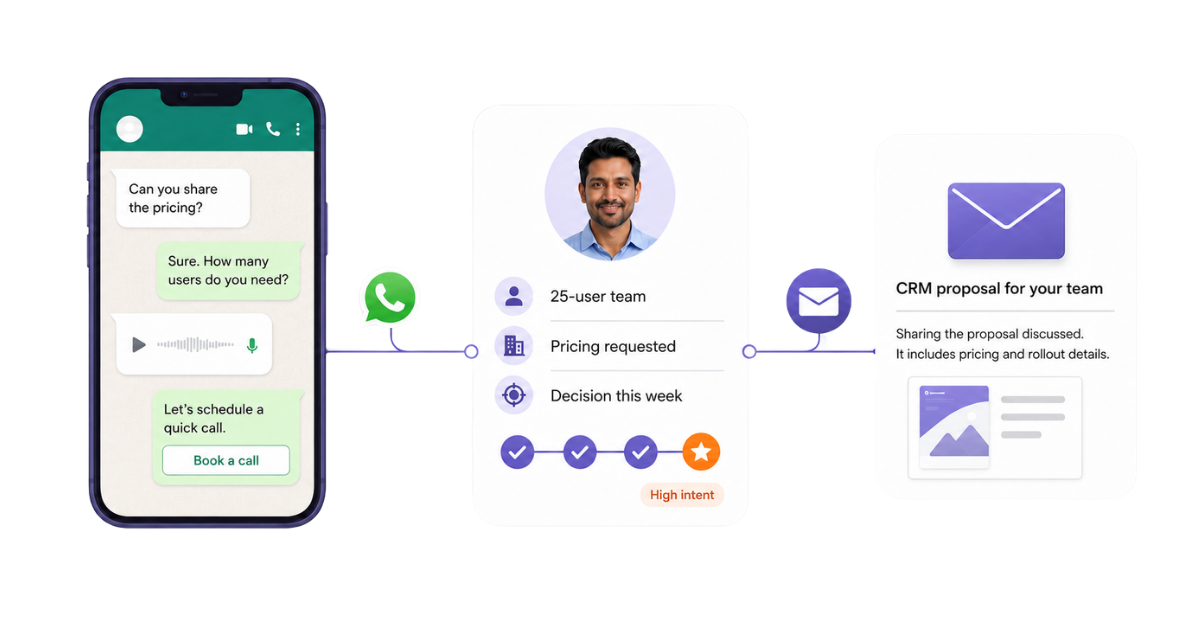
If you’re deciding between WhatsApp and email to nurture leads, the answer hinges on one question: how close is your prospect to buying? WhatsApp dominates when speed, conversation and conversion matter. Email wins when you need to educate at scale, deliver long form content or maintain formal business communication. Most sales teams in 2026 need both – but knowing which marketing channel to lean on and when, makes all the difference.
WhatsApp lead nurturing is the process of engaging prospects through real-time, conversational WhatsApp messages – a mix of automated template messages and personal replies – to move them through your sales pipeline. Unlike static broadcasts, WhatsApp conversations carry context forward: every message, attachment, and voice note stays in a continuous thread, making it easy for sales reps to pick up where the last interaction left off.
The WhatsApp Business API makes this scalable. It enables businesses to send targeted messages, set up automated follow ups triggered by pipeline stages, route incoming chats to the right agent via a shared team inbox, and log every interaction in your CRM. WhatsApp supports rich media interaction, including images and videos, PDFs, and voice messages – all within the same chat window.
WhatsApp lead nurturing is ideal for high-intent leads and immediate follow-ups. When a prospect fills a web form, clicks a click to WhatsApp ad, or requests a demo, WhatsApp captures their attention at the moment of peak interest. The channel excels at direct customer communication – real-time objection handling, appointment confirmations, quote sharing, and closing conversations that would take days over email.
Email lead nurturing uses automated, sequence-based communication to educate and guide prospects over longer periods. Think drip campaigns that deliver case studies, product comparisons, whitepapers, and proposals on a set cadence – each email designed to build trust and move the prospect one step closer to a buying decision.
Email is superior for structured, long-form content delivery. A well-crafted email sequence can walk a prospect through your product’s value proposition across multiple touchpoints, attach detailed proposals, and provide formal documentation trails. Email remains the expected channel for formal business communications – contracts, invoices, compliance records, and detailed feature breakdowns belong here.
Modern email marketing platforms integrate deeply with CRM systems for lead scoring, behavioral triggers, and advanced segmentation. You can segment leads by industry, engagement level, or funnel stage, then deliver personalized messages at scale. Email is effective for nurturing leads over a longer period, particularly in enterprise B2B environments where decision cycles stretch weeks or months and multiple stakeholders need information.
Here’s a quick comparison of how WhatsApp and email perform across the factors that matter most in lead nurturing.
Factor | ||
|---|---|---|
Best for | High-intent leads, conversational selling, instant communication | Large lead volumes, education, formal business communication |
Open Rates | 95–98% | 20–25% after adjustments |
Response Time | Read within 3 minutes on average | Hours to days |
Response/Engagement Rate | 45–60% engagement rates | 2–5% click-through rates |
Cost Model | Per-message pricing (higher per message, lower per conversion) | Volume-based pricing (lower per message, higher per conversion) |
CRM Integration | Real-time sync, shared inbox, pipeline triggers | Mature automation workflows, lead scoring, A/B testing |
Content Strength | Multimedia, voice notes, quick replies | Long form content, proposals, structured campaigns |
One-sentence takeaway: WhatsApp delivers unmatched customer engagement and conversion speed; email offers unbeatable scalability and content depth for the nurturing process.
Choosing between WhatsApp and email is not about which channel has the most impressive headline metrics. It depends on what your lead needs next. Here is how the two channels differ across the seven factors that shape lead nurturing.
WhatsApp is better suited to conversations that require an immediate response. Leads can reply in the same chat and sales reps can continue the discussion without restarting the context.
Email is generally better for communication that does not require an immediate reply. Prospects can read the message, review the information and respond when they are ready.
Verdict: WhatsApp for immediate engagement. Email for slower, long-term nurturing.
WhatsApp personalisation develops through the conversation. A sales rep can ask questions, understand requirements and adapt each response based on what the lead says.
Email personalisation happens mainly through segmentation, behavioural triggers and tailored sequences. It can deliver relevant information at scale, but it is less suited to natural back-and-forth conversations.
Verdict: WhatsApp for one-to-one conversations. Email for personalised communication at scale.
WhatsApp works best for concise, action-oriented communication, especially for flash sales where the message is seen quickly and can drive immediate action. Sales teams can share short messages, images, PDFs, voice notes and buttons without asking the lead to switch channels.
Email provides more room for detailed content such as case studies, product comparisons, newsletters and formal proposals. Its structured format also makes information easier to save, forward and review later.
Verdict: WhatsApp for quick actions and conversations. Email for detailed content and documentation.
Email costs are usually tied to contact volume or subscription tiers, which makes email suitable for nurturing large databases over longer periods.
WhatsApp Business Platform costs depend on the type and number of template messages delivered. The whatsapp marketing cost is also usually shaped by template-message charges plus any automation or integration layer added by the provider. Additional platform charges may also apply depending on the provider. Meta publishes its current pricing rules here.
Instead of comparing only the cost of sending a message, measure the cost of generating a qualified response, appointment or sale.
Verdict: Email for lower-cost nurturing at scale. WhatsApp for focused outreach to leads who are more likely to respond.
A WhatsApp CRM integration can capture incoming enquiries, assign leads to sales reps, store conversation history and trigger follow-ups based on lead activity. This makes WhatsApp closely connected to the daily work of a sales team.
Email CRM integrations are particularly strong for lead scoring, automated sequences, behavioural segmentation and campaign testing. They are useful when leads need multiple educational touchpoints before speaking with sales.
Verdict: WhatsApp for active sales conversations. Email for structured, long-term nurturing programmes.
WhatsApp requires businesses to obtain permission before initiating messages. Outside the 24-hour customer service window, businesses generally need approved templates to restart a conversation. In practice, that whatsapp opt in is what allows compliant marketing messages to be sent on the platform. Meta explains its opt-in requirements and customer service window in its official documentation.
Email also requires responsible consent and unsubscribe management. Delivery depends on factors such as sender reputation, authentication and spam complaints. Roughly 1 in 6 emails never reaches the inbox, which is why sender reputation and authentication matter and why increasingly aggressive spam filters can hurt reach. Messages that fail sender requirements may be rejected or sent to the spam folder, according to Google’s email sender guidelines.
Verdict: WhatsApp offers direct visibility after opt-in, and unlike email it has no spam folder, so opted-in messages appear directly in the chat thread. Email offers more sending flexibility but requires stronger deliverability management.
Email is well suited to complex nurturing programmes and basic automation. Businesses can create multi-step sequences, branch campaigns based on lead behaviour and continue nurturing prospects over several weeks or months. It also works well for routine nurture tasks like welcome emails.
WhatsApp automation is more action-focused. Businesses can send enquiry acknowledgements, appointment reminders and follow-ups based on CRM triggers. Many teams also use automation tools for chatbots or scheduled messaging. WhatsApp Flows can also collect information before handing the conversation to a sales rep.
Verdict: Email for complex, long-term automation. WhatsApp for automating immediate next steps.
Also read: 7 Best CRM with WhatsApp Integration for Sales Teams in 2026
Open rates alone do not tell you which channel is generating better sales results.
In the broader email marketing debate, open rates are often overweighted even though they are now less reliable. Email open rates have become less dependable because features such as Apple’s Mail Privacy Protection prevent senders from accurately determining whether someone opened an email, and it inflates opens for Apple Mail users. Apple confirms this limitation. WhatsApp delivery and read receipts provide faster feedback, but a read message does not necessarily indicate purchase intent.
This email marketing comparison should rely more on clicks, replies, and revenue than on opens. Measure both channels using sales outcomes such as:
These metrics show whether nurturing is helping leads progress, not merely whether messages are being seen.
Winner: Neither channel should be judged by open rates alone. The better channel is the one creating more qualified movement through your sales pipeline.
The strongest strategy assigns each channel a different job instead of sending the same message through both, a stage-by-stage approach that works better than treating email marketing whatsapp as interchangeable.
Lead stage | Primary channel | What to send |
|---|---|---|
Early awareness | Guides, newsletters, case studies and educational content | |
New enquiry | Immediate acknowledgement, qualification questions and appointment options | |
Consideration | Both | Detailed information over email followed by a contextual WhatsApp conversation |
Decision | WhatsApp and calls | Objection handling, demo reminders, quotations and next-step confirmation |
Documentation | Proposals, contracts, invoices and formal summaries | |
Long-term nurture | Periodic educational content until the lead shows fresh intent | |
Re-engagement | A relevant, permission-based message when a strong buying signal appears, including abandoned cart recovery for high-intent leads |
For example, a prospect who downloads a guide can enter an email sequence. If that prospect later visits the pricing page or requests a demo, the CRM can assign the lead to a sales rep and trigger a WhatsApp follow-up. AI demo agents can handle part of that pre-sales window by answering product questions, surfacing relevant demo content, and qualifying buyers before a sales rep takes over. After the discussion, the detailed proposal can be sent through email while WhatsApp is used to confirm the next meeting.
This keeps email from becoming too transactional and WhatsApp from becoming too promotional.
For Indian SMBs and sales teams, WhatsApp is the dominant lead generation and conversion channel. WhatsApp’s conversational nature, combined with telecalling workflows, creates a nurturing process that mirrors how Indian buyers actually prefer to communicate. But don’t abandon email – it still earns its place for brand positioning, content delivery, and formal touchpoints.
WhatsApp delivers better sales results when a lead has already shown intent and the next step depends on a quick conversation; WhatsApp wins decisively when immediate visibility and response are what move the deal forward. Email performs better when prospects need detailed information, repeated education or formal documentation before making a decision.
For Indian sales teams, WhatsApp will often be the primary channel for qualification, follow-ups and conversion. Email still plays an important supporting role throughout longer and more complex buying journeys.
The real advantage comes from connecting the channels to the lead’s stage. When intent rises, the conversation should move quickly to WhatsApp or a call. When the prospect needs more time, email should continue building familiarity without crowding their personal chat.
telecrm helps sales teams capture enquiries, assign them instantly and bring WhatsApp conversations, calls, follow-ups and complete lead history into one place. This gives every rep the context to follow up at the right time and gives managers complete visibility into what is moving each lead towards a sale, because effective nurturing strategies depend on moving the lead to the channel that matches their current intent. Book a demo now to see telecrm in action!
Yes – a hybrid approach is often optimal and increasingly common in 2026. Use email marketing for early-stage nurturing: educational content, newsletters, case studies, and structured drip sequences that build awareness over multiple touchpoints. When lead data shows a prospect is warming up – clicking emails repeatedly, visiting pricing pages, or requesting information – transition them to WhatsApp for conversational, high-touch engagement. A CRM with WhatsApp integration can orchestrate this automatically based on lead scoring and behavior triggers. The key is channel strategy: don’t duplicate the same promotional messages across both, and ensure you obtain explicit opt in for WhatsApp before messaging.
Keep WhatsApp touches to 2–3 per week maximum for active leads. WhatsApp is a personal space – the popular messaging app people use with family and friends – so conflicting messaging frequency on WhatsApp can lead to blockages and opt-outs that damage your sender quality rating. For very engaged leads in active deal stages, slightly higher frequency is acceptable. For colder prospects, space messages further apart. Email tolerates higher frequency (daily or every few days) when content is substantive, but watch unsubscribe rates closely. Monitor blocks and delivery rates on WhatsApp continuously; once your quality rating drops, Meta throttles your ability to send messages at scale.
Start by sending an email asking existing subscribers to opt in to receive scheduled messages via WhatsApp – include a clear value proposition for why they should. Collect and standardize WhatsApp numbers with country codes. Ensure compliance with Meta’s policies and local privacy regulations like India’s DPDP Act. Build WhatsApp templates, get required approvals through your BSP, and integrate with your CRM so that once a lead opts in, their WhatsApp conversations sync to the same lead record. Use whatsapp flows to create a smooth onboarding experience. Monitor delivery and response rates after migration, and adjust your messaging cadence based on engagement.
WhatsApp is the dominant channel for Indian sales teams by a significant margin. India has over 500 million WhatsApp users, and the platform is deeply embedded in how consumers and businesses communicate. Indian SMBs integrating WhatsApp Business API with their CRM consistently report dramatic reductions in lead response time – from hours to minutes – and measurably higher conversion rates. Telecalling CRMs that combine calling, WhatsApp, and lead distribution in one dashboard see the strongest results. WhatsApp is particularly effective for non-urgent communications too – payment reminders, appointment confirmations, and transactional messages. That said, email still matters for segments expecting formal communication (finance, corporate B2B, government) and for delivering detailed proposals or compliance documentation. The winning approach for Indian teams: WhatsApp-first for speed and conversion, email for depth and documentation.
Yes – a hybrid approach is often optimal and increasingly common in 2026. Use email marketing for early-stage nurturing: educational content, newsletters, case studies, and structured drip sequences that build awareness over multiple touchpoints. When lead data shows a prospect is warming up – clicking emails repeatedly, visiting pricing pages, or requesting information – transition them to WhatsApp for conversational, high-touch engagement. A CRM with WhatsApp integration can orchestrate this automatically based on lead scoring and behavior triggers. The key is channel strategy: don’t duplicate the same promotional messages across both, and ensure you obtain explicit opt in for WhatsApp before messaging.
Keep WhatsApp touches to 2–3 per week maximum for active leads. WhatsApp is a personal space – the popular messaging app people use with family and friends – so conflicting messaging frequency on WhatsApp can lead to blockages and opt-outs that damage your sender quality rating. For very engaged leads in active deal stages, slightly higher frequency is acceptable. For colder prospects, space messages further apart. Email tolerates higher frequency (daily or every few days) when content is substantive, but watch unsubscribe rates closely. Monitor blocks and delivery rates on WhatsApp continuously; once your quality rating drops, Meta throttles your ability to send messages at scale.
Start by sending an email asking existing subscribers to opt in to receive scheduled messages via WhatsApp – include a clear value proposition for why they should. Collect and standardize WhatsApp numbers with country codes. Ensure compliance with Meta’s policies and local privacy regulations like India’s DPDP Act. Build WhatsApp templates, get required approvals through your BSP, and integrate with your CRM so that once a lead opts in, their WhatsApp conversations sync to the same lead record. Use whatsapp flows to create a smooth onboarding experience. Monitor delivery and response rates after migration, and adjust your messaging cadence based on engagement.



© Copyright 2026 telecrm.in (Flamon Cloudtech Pvt Ltd) - All Rights Reserved • Privacy Policy • T&C



© Copyright 2026 telecrm.in - All Rights Reserved • Privacy Policy • T&C