


Running an affiliate program without proper tracking is like managing a sales team without a CRM. You have no idea who is performing, what is converting or where your money is going. This guide covers everything you need to know about affiliate tracking software: how it works, what features matter, which platforms lead the market and how to avoid costly mistakes.
Affiliate tracking software is technology that monitors traffic and conversions generated by your affiliate partners. It records every click, attributes each sale or lead to the correct affiliate, calculates commissions and handles payouts.
Unlike general analytics tools such as Google Analytics, affiliate tracking software focuses specifically on partner attribution. It answers questions your standard dashboard cannot: which affiliate drove this sale, what commission do they earn and how does their referred customer behave over time?
Businesses need dedicated tracking for affiliate programs because manual methods break down quickly. Spreadsheets cannot handle complex commission structures, multi-touch attribution or fraud prevention at scale.
At the core, tracking software captures:
Tracking metrics include purchases, transactions and impressions. More advanced platforms also track page views, giving you relevant data on how affiliate-driven traffic behaves on your site.
Beyond basic events, the software records affiliate-specific data like commission calculations, payout schedules, refund adjustments and lifetime value of referred customers. Multi-touch attribution shows you which affiliates contributed across the buyer journey, not just who got the last click.
Four main groups rely on this software:
You can get by with manual tracking when you have five or ten affiliates. Once you cross roughly 50 partners, the time spent managing links, verifying conversions and calculating payouts becomes unsustainable.
Dedicated software also becomes necessary when:
Affiliate software supports scaling by managing multiple campaigns from one platform, eliminating the need for multiple tools.
The affiliate marketing ecosystem includes several tool categories that overlap but serve different purposes. Understanding the differences prevents you from buying the wrong solution.
Tracking software focuses narrowly on data collection and attribution: recording clicks, matching conversions, calculating commissions.
Affiliate management software adds relationship management on top: partner onboarding workflows, communication tools, branded portals and marketing materials. Affiliate management software can automate commission calculations while also handling the human side of affiliate relationships.
Most modern affiliate management platforms combine both functions, but some lightweight trackers skip the management layer entirely.
Affiliate software is technology you own and control. You set commission structures, onboard partners and manage payouts directly.
An affiliate network like CJ Affiliate or ShareASale is a marketplace where advertisers and affiliates connect.Self-managed programs via affiliate software avoid these overrides and give you full ownership of your data.
Referral software handles simple customer-to-customer referrals: one person shares a link, a friend signs up, both get a reward. The paths are straightforward.
Affiliate software handles professional partner relationships with flexible commission structures, sub-affiliates and complex payout rules. If you are building an affiliate marketplace or working with agencies and content partners, affiliate software is the right choice.
Media-buyer trackers like Voluum or RedTrack help affiliates and agencies optimise paid advertising across traffic sources. They focus on traffic distribution, A/B testing and campaign-level ROI.
Programme software is for merchants running their own affiliate programs. It includes partner portals, commission rules and payout management. Some overlap exists, but the primary use cases differ.
The technical flow runs from link creation through attribution to payout. Each step relies on a combination of cookies, pixels and server-to-server tracking to maintain accuracy.
The software generates a unique tracking URL for each affiliate containing parameters like affiliate ID, campaign tag and sub IDs. Unique link generation allows identification of partners driving the most traffic.
Options include custom domains (e.g., partners.yourbrand.com) and branded links that build trust and reduce the chance of link filtering.
When someone clicks an affiliate link, the software captures the click event along with device, browser, IP and timestamp data. It typically places a first-party cookie to remember the attribution for a configurable window, commonly 30 to 90 days.
Affiliate tracking software must support cookie-based and server-to-server tracking. With browsers increasingly blocking third-party cookies, S2S postback tracking has become the default for accurate attribution in cookieless environments.
Conversions are recorded through pixel tracking (JavaScript on your site), postback URLs from your payment gateway or API integrations with billing systems like Stripe or Razorpay. Each method captures when a visitor becomes a customer.
For SaaS businesses tracking trial signups, subscription renewals and upgrades, the conversion definition extends beyond a single purchase. Understanding how call tracking works can also help attribute phone-based conversions to the right affiliate.
Attribution determines which affiliate gets credit. Common models include:
Clear rules prevent disputes when a prospect clicks through multiple affiliate links before converting.
Once a conversion is tracked, the commission engine calculates what each affiliate earns based on predefined rules. Automated workflows streamline commission calculations and payouts, though many programs include a manual review window for fraud checks.
Automating affiliate payouts saves time and improves accuracy, especially at scale. Platforms integrate with PayPal, Wise and bank transfers to handle disbursement automatically.
Feature importance varies by business model, but certain capabilities are non-negotiable for any serious affiliate program.
Real-time tracking improves campaign performance and decision-making. Look for platforms offering hybrid tracking methods (cookies plus server-side), cross-device attribution and configurable attribution windows.
Real-time monitoring helps optimise affiliate marketing campaigns by catching issues before they cost you conversions. Platforms relying solely on pixels can lose20–40% of conversions due to browser privacy controls.
Affiliate software automates commission calculations and payouts across multiple structures:
For SaaS businesses tracking recurring revenue, the ability to pay commissions on renewals and handle customer churn adjustments is critical.
Automation tools streamline onboarding and campaign management processes. Self-service signup, approval workflows and branded dashboards let new affiliates get started quickly.
A quality partner portal provides marketing materials, link generation tools and real-time statistics. Automated systems can provide training and support for affiliates through resource libraries and onboarding sequences.
Automation streamlines data collection and payment processes. The software should handle refund reversals, chargeback adjustments and minimum payout thresholds without manual intervention.
Multi-currency support matters if your affiliates span multiple countries. Tax compliance features (GST, 1099 forms) save headaches at scale.
Fraud protection is essential to safeguard marketing campaigns. Built-in fraud prevention tools detect fake clicks and suspicious conversion anomalies through:
Fraud detection features protect against affiliate marketing scams like click fraud, cookie stuffing and fake lead submissions. Fraud detection alerts protect affiliate marketing campaigns by flagging issues in real time.
Robust integrations with e-commerce platforms and payment gateways are essential for software to function within your existing stack. Look for native connections with Shopify, WooCommerce, Stripe and your CRM.
A rest api enables custom integrations and data sync with tools like telecrm’s integrations ecosystem or your data warehouse. Webhook support ensures real-time data updates across systems.
Custom dashboards enhance visibility for affiliate managers, showing which partners drive the most traffic and highest conversions. Customisable analytics dashboards provide real-time performance insights to users.
Real-time reporting enables quick identification of successful campaigns. User-friendly dashboards provide real-time customised views that let you gain insights without digging through raw data. Real-time data collection allows for informed campaign adjustments.
Look for data export capabilities, sales metrics integration and white-label reporting if you want to brand reports with your own logo.
The best affiliate tracking software depends on your business model, budget and technical requirements. Here is how leading affiliate tracking platforms compare.
Platform | Starting Price | Best For | Standout Feature |
Trcker | Free early access; ~$99/mo planned | Growth-stage brands | Server-side tracking by default |
Everflow | $750/mo (6-month minimum) | Mid-market to enterprise | Deep fraud detection, multi-currency |
Rewardful | $49/mo | Stripe-native SaaS | Simple setup, recurring commissions |
Tapfiliate | ~$74–89/mo | E-commerce + SaaS | 30+ platform integrations |
FirstPromoter | $49–149/mo | SaaS founders | Broad billing compatibility |
PartnerStack | ~$800+/mo | B2B SaaS with partner networks | Built-in affiliate marketplace |
Trackdesk | Free up to $5K/mo revenue | Budget startups | Enterprise security and GDPR compliance |
Post Affiliate Pro | ~$129/mo | WordPress and e-commerce | 200+ integrations, product commissions |
Affise | Custom pricing | Performance networks | Real-time tracking and advanced analytics |
iDevAffiliate | ~$39/mo | WordPress quick-start | Program setup within one hour |
SaaS companies need subscription tracking, recurring commissions and churn-aware attribution. Rewardful integrates with Stripe for easy affiliate management, making it ideal for startups. FirstPromoter works across multiple billing systems. PartnerStack adds partner network access for B2B SaaS at scale.
E-commerce brands need product-level commissions, coupon code integration and shopping cart tracking. Tapfiliate supports over 30 e-commerce platforms, including Shopify and WooCommerce. Post Affiliate Pro offers deep product-specific commission models. Trcker provides modern server-side tracking with strong e-commerce support.
B2B programs demand enterprise-grade compliance, complex approval workflows and multi-tier partnerships. Everflow and PartnerStack lead here with advanced reporting, affiliate management and partner hierarchy support. Impact.com serves large-scale partner networks across geographies.
WordPress sites benefit from plugin-based installation and lightweight tracking. iDevAffiliate allows program setup within one hour. Post Affiliate Pro offers a dedicated WordPress plugin. GoAffPro provides an accessible entry point for WooCommerce shops.
Enterprise needs include high-volume tracking, white-label solutions and advanced fraud protection. Everflow, Impact.com and Affise handle millions of events with multi-tenant capabilities. Trackdesk provides enterprise security and GDPR compliance for privacy-conscious organisations.
Campaign trackers serve a different purpose than programme software. They help affiliates and media buyers track their own marketing efforts across traffic sources.
Voluum is a campaign-level tracker built for high-volume affiliates. It offers AI-powered optimisation, real-time conversion tracking and advanced traffic distribution across multiple campaigns. Pricing starts around $149/mo.
RedTrack provides multi-channel tracking, anti-fraud tools and seamless integration with ad networks. It is popular among agencies running affiliate marketing campaigns across paid sources. Pricing is competitive starting at roughly $149/mo.
BeMob offers a free tier that makes it accessible for beginners entering performance marketing. The intuitive platform covers basic tracking and optimisation, though it lacks some advanced fraud detection features of pricier alternatives.
Choose a campaign tracker when you are an affiliate running ads across multiple traffic sources and need granular campaign performance data. Choose programme software when you are a merchant managing affiliate relationships, commission structures and affiliate payouts. Many businesses use both: programme software to manage their program and campaign trackers to monitor their own marketing strategy.
Matching software to your specific business needs prevents expensive migrations later. Here is a practical decision framework.
E-commerce brands need product and coupon tracking. SaaS companies need recurring commission tracking, while lead-generation businesses need lead verification before payouts.
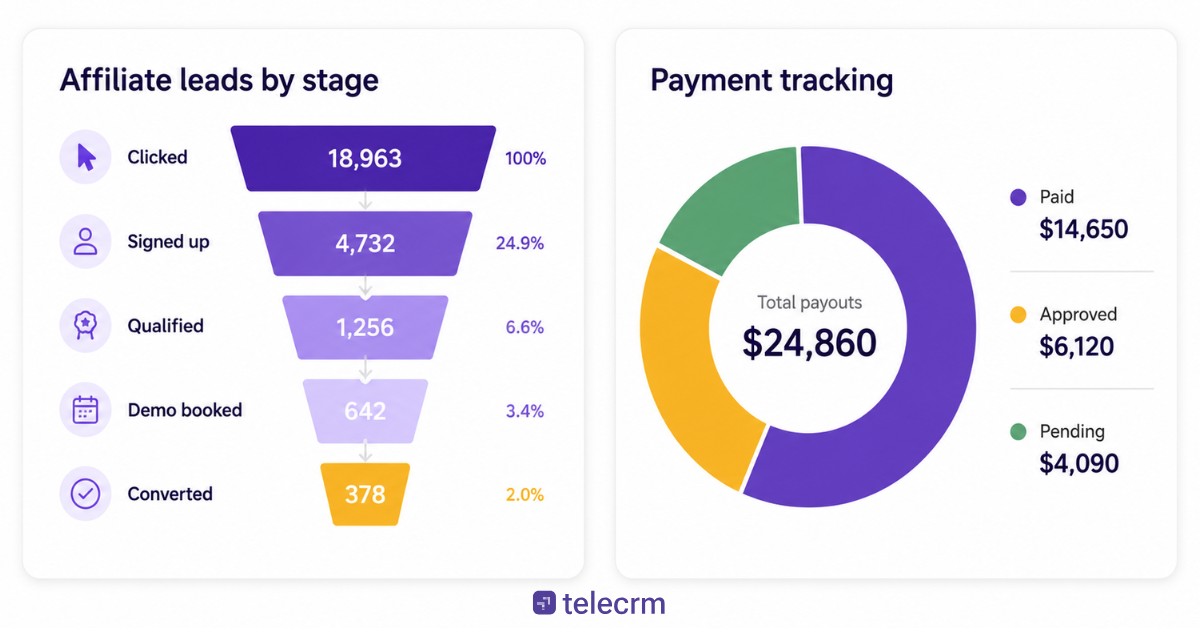
Digital marketers promoting B2B SaaS platforms like telecrm should also get a dashboard to track referred leads, their current status and completed payments.
Look for first-party cookie, server-to-server and API-based tracking instead of relying only on browser pixels.
The platform should also provide real-time updates. telecrm allows affiliates to track referred clients as they move through the sales process.
The software should connect with your CRM, website, billing system and payment gateway.
It should support flexible commission models, including fixed, percentage-based, recurring and lifetime commissions, like telecrm offers on eligible customer payments.
Check whether pricing depends on affiliates, clicks, conversions or revenue generated.
Estimate the cost at two to five times your current volume and confirm whether features such as recurring commissions, fraud checks and automated payouts cost extra.
Affiliates should be able to easily track:
Create a test affiliate account. Generate a tracking link. Click it from different devices. Complete a conversion. Verify the software correctly attributes the sale and calculates the commission.
For SaaS: simulate a trial signup, paid conversion, renewal and cancellation. Confirm recurring commissions are tracked correctly and that refunds trigger commission adjustments.
Try converting on Safari with ITP enabled, on mobile after clicking a desktop link and across different subdomains. Verify that advanced tracking holds up where cookies fail.
Cross-reference conversion data in the affiliate software against your billing system and existing analytics. Discrepancies reveal tracking gaps that could cost you money or erode affiliate trust.
Here are some of the mistakes that you should avoid committing if you are looking to find the perfect affiliate tracking software for yourself.
Define your commission structures, affiliate types, channels and marketing goals before evaluating software. Picking a platform based on generic feature lists leads to gaps that force costly migrations.
Cookie-only tracking fails in privacy-restricted browsers. Use hybrid methods: first-party cookies, server-side postbacks and fingerprinting as backup. Multi-method tracking prevents single points of failure.
If your system does not reverse commissions on refunds, you overpay affiliates and erode margins. Set clear policies and ensure your software handles negative adjustments automatically.
Ambiguous rules cause disputes. Document whether you use first-click, last-click or multi-touch attribution. Communicate lookback windows and overlap handling to all affiliates upfront. Transparency builds strong affiliate relationships.
The cheapest tracking software often lacks fraud detection, recurring commission support or reliable attribution. Poor tracking accuracy costs more in misattributed sales and fraudulent activity than a higher subscription fee. Evaluate total cost of ownership, not just the monthly price tag.
telecrm is easy to refer because it solves a clear problem for businesses that manage sales calls, WhatsApp conversations, follow-ups and leads from multiple sources. Affiliates can introduce telecrm to businesses that already need a better sales process, making the recommendation more relevant and easier to explain.
→ Become an affiliate partner of telecrm in 2 easy steps
S2S tracking sends conversion data directly between your server and the tracking platform, bypassing browser cookies. It is more reliable in privacy-restricted environments and is now the standard for accurate affiliate tracking.
Most programs use 30 to 90 days. SaaS businesses with longer sales cycles may extend to 90 or 120 days. Shorter windows reduce misattribution risk but may undercount legitimate conversions.
Yes, if your affiliate software supports webhook or API-based conversion events. You can pass affiliate parameters through call tracking systems or WhatsApp link parameters to maintain attribution.
The affiliate earns a commission each time the referred customer renews their subscription. The software tracks renewal events from your billing system and calculates payouts automatically.
Networks are marketplaces with built-in affiliates but charge override fees. Software gives you full control and data ownership without per-commission surcharges.
Platforms analyse click patterns, IP addresses, device fingerprints and conversion timing to flag fraudulent activity. Automated rules block suspicious traffic before it generates false commissions.
It can be, if the platform supports consent management, first-party tracking and data processing agreements. Trackdesk, for example, offers built-in GDPR compliance features.
You can start for free with platforms like Trackdesk or Trcker’s early access. Paid plans from Rewardful or FirstPromoter start at $49/mo, making affiliate marketing accessible even for small businesses.
Yes. Modern affiliate marketing platforms combine tracking, partner management, commission rules, fraud detection, reporting and payouts in one platform, eliminating the need to juggle repetitive tasks across disconnected tools. This gives affiliate managers actionable insights to optimise campaigns and identify high performing affiliates without switching between systems.



© Copyright 2026 telecrm.in (Flamon Cloudtech Pvt Ltd) - All Rights Reserved • Privacy Policy • T&C



© Copyright 2026 telecrm.in - All Rights Reserved • Privacy Policy • T&C