
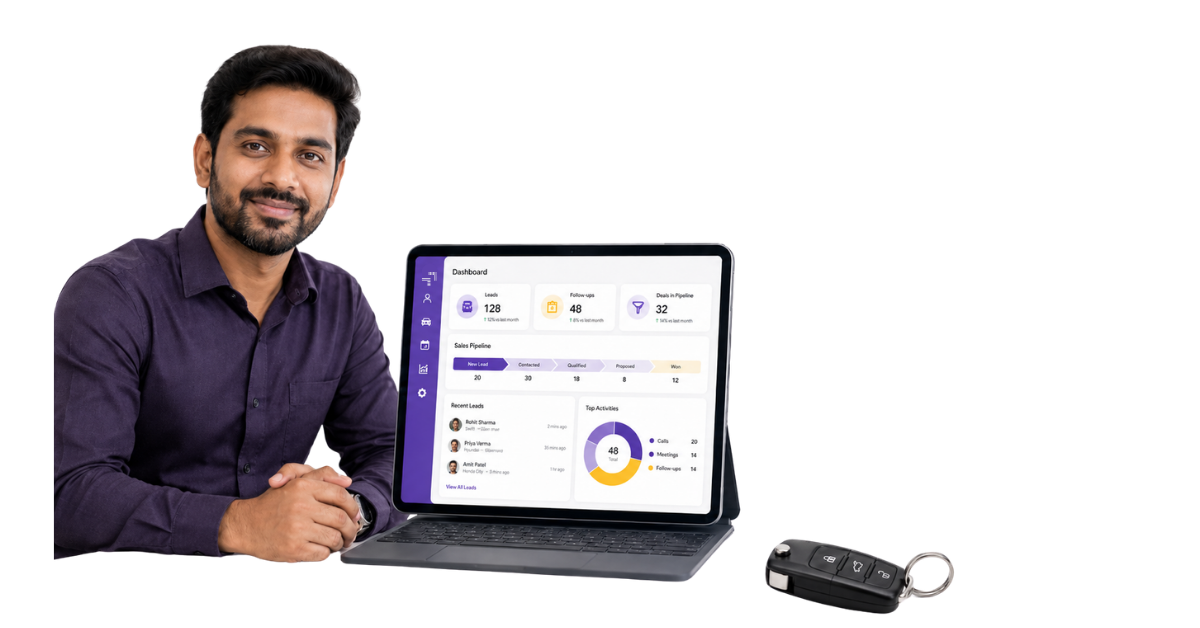
If you’re running a car dealership and searching for automotive CRM software, the first question on your mind is simple: how much will this actually cost? The honest answer is that automotive CRM pricing is far more complex than any vendor’s landing page suggests. Advertised rates of ₹800/user/month sound appealing until you factor in setup fees, DMS integrations, training and the AI-powered modules your sales team actually needs. This guide breaks down every pricing model, compares real costs across popular platforms and helps you find the right automotive CRM for your dealership size – without budget surprises.
What separates automotive CRM from general business CRM? An automotive CRM manages customer relationships across the full customer lifecycle of vehicle sales – from internet lead management and test drive scheduling to service reminders, trade-in workflows and purchase and service histories. That specialisation adds cost, but it also adds value that generic CRM systems simply can’t deliver.
The short answer: Automotive CRM pricing in 2026 ranges from ₹800 to ₹70,000 per user per month, depending on dealership size, features and pricing model. Small independent dealerships typically pay between $300 and $1,500 per month for CRM solutions. Franchise dealerships often budget $1,500 to $5,000 per rooftop per month for CRM services. Enterprise dealer groups with Salesforce Automotive Cloud or similar platforms can exceed $5,000 per rooftop monthly. The least expensive CRM might not provide the best overall value for businesses – and the most expensive one might include capabilities you’ll never use.
Automotive CRM pricing in 2026 ranges from ₹799 to ₹70,000 per user per month, depending on dealership size, features and pricing model. Small independent dealerships typically pay between $300 and $1,500 per month for CRM solutions. Franchise dealerships often budget $1,500 to $5,000 per rooftop per month for CRM services. Enterprise dealer groups with Salesforce Automotive Cloud or similar platforms can exceed $5,000 per rooftop monthly. The least expensive CRM might not provide the best overall value for businesses – and the most expensive one might include capabilities you’ll never use.
Automotive CRM pricing varies based on dealership size and features. Prices for automotive CRM can be monthly or annual and what you pay depends on three primary factors: your user count, the automotive-specific modules you need (inventory management, lead management, service scheduling) and whether you choose a per-user, flat-rate or enterprise custom pricing model.
Pricing is affected by the number of users also and the required features for automotive needs. Pricing may also be influenced by AI functionality, support levels and customisation options. Let’s break this down by the dealership sizes that matter most.
Automotive CRM systems offer various pricing models for different dealership sizes and needs. A five-user team at AutoRaptor pays roughly $3,588/year, while the same team on Salesforce Automotive Cloud Enterprise edition would spend approximately $21,000/year – a nearly 6x difference driven by feature depth and customisation options. Let’s look at all the options:
Dealership Size | Typical Monthly Cost | Per-User Equivalent | Popular Solutions | Key Features Included |
Small independent (1–10 users) | ₹20,000–₹41,500/store or ₹799–₹3,200/user/month | $50–$100/user/month | telecrm(799/user/month); AutoRaptor ($299/month for 3–5 users); Zoho CRM (₹800/user/month); Groweon CRM (₹2,999/month) | Basic lead management, contact management, test drive tracking, limited integrations |
Medium dealership (11–50 users) | ₹50,000–₹1,25,000/store or ₹4,200–₹12,500/user/month | $50–$150/user/month | telecrm(799/user/month);; eCars CRM ($498/month flat); CARVID ($499/month Growth plan); LeadSquared (₹1,250–₹4,500/user/month); DealerSocket (~$500–$700/month/store) | Marketplace lead ingestion, workflow automation, marketing automation, DMS connectors |
Large / franchise group (50+ users) | ₹4+ lakh/store or ₹12,500–₹70,000/user/month | $150–$750/user/month | telecrm(799/user/month);Salesforce Automotive Cloud ($350–$750/user/month); CDK Global; VinSolutions ($1,000–$1,500/month/store with add-ons) | Full sales and service teams support, AI-powered lead scoring, multi-location reporting, warranty tracking, data analytics |
Be it a 3+ users or 50+ users, telecrm is by far the best automotive CRM choice for you because it scales as you grow and has the capabilities of multiple tools. Check out telecrm pricing page to get detailed breakdown.
Pricing can significantly increase due to hidden fees and contract terms. Here’s where automotive dealers consistently get surprised:
Key pricing structures include free, tiered, enterprise and modular pricing models. Businesses need to assess pricing models based on their size and staffing requirements. Each model creates different cost dynamics – here’s how they compare for automotive dealerships.
The most common model across CRM software: you pay a fixed amount per user per month. Typical ranges run from ₹800/user/month for basic plans to ₹70,000/user/month for enterprise automotive cloud editions.
Advantages: Predictable scaling for small teams, you only pay for active users and entry costs are low. A three-person sales team can start with a tool like LeadSquared at ₹1,250/user/month and keep total costs under ₹4,000/month.
Disadvantages: Costs accelerate fast when you add BDC staff, service teams, parts managers and field sales teams. A dealership with 30 active users at ₹8,000/user/month is already spending ₹2,40,000/month – and passive users who only check dashboards still need full licenses. For growing automotive organisations, this model can become the most expensive option.
A single monthly fee per dealership location, regardless of user count. eCars CRM exemplifies this at $498/month flat with unlimited users. In India, Groweon CRM costs Rs. 2,999/month for full dealership operations, while Kylas CRM charges ₹12,999/month for unlimited users.
Advantages: Cost certainty, unlimited user additions and strong value for dealerships with large or seasonal teams. If you have 20+ staff touching your CRM – from sales assistants to service advisors – flat-rate pricing eliminates per-seat anxiety.
Disadvantages: You may pay the same rate even if only a few people use the system actively. Feature access may still be tiered within flat-rate plans and multi-location dealer groups may need separate subscriptions per rooftop.
For large automotive dealerships and dealer groups operating multiple rooftops, vendors like Salesforce Automotive Cloud and CDK Global provide custom quotes. These factor in user count, required integrations, AI modules, SLA levels, dedicated support and contract length.
Advantages: Tailored to exact needs, economies of scale (volume discounts of 20%+ are common), professional services included and dedicated support. A 50-user dealer group might negotiate Salesforce down from list price of $350/user/month to ~$280/user/month on a multi-year deal.
Disadvantages: Long sales cycles, high upfront commitments, complex contracts and risk of paying for capacity you don’t immediately use. Implementation timelines stretch months and switching costs are substantial.
Automotive CRM pricing typically ranges from free options to enterprise solutions. Some vendors offer free tiers – Zoho CRM’s free plan supports up to 3 users with limited records and TatvaCRM offers basic access at no cost.
Advantages: Zero entry cost, good for evaluation, sufficient for very small operations with minimal lead sources and manual follow-ups.
Disadvantages: Free plans almost never include automotive-specific modules like inventory management, test drive scheduling, trade-in workflows or DMS connectivity. Most dealerships outgrow free tiers within weeks once they need workflow automation, marketplace integrations or automated follow-ups. The jump from free to paid is often steep.
Here’s a comprehensive side-by-side of popular automotive CRM solutions with verified 2026 pricing:
CRM / Vendor | Starting Price | Pricing Model | Target Dealership | Key Automotive Features | Annual Cost (5-User Team) |
telecrm | ₹799/user/month (billed annually) | Per-user; annual or quarterly billing | Small to enterprise level dealerships and automotive sales teams | Lead capture from 15+ sources, auto-assignment, 1-click SIM calling, call recording, WhatsApp integration, follow-up automation, reports and leaderboards, AI-powered, deep customisation, unlimited lead uploads | ₹47,940/year for Core CRM (excluding add-ons) |
Zoho CRM | ₹800/user/month | Per-user tiered | Small dealers, general use | Contact management, sales pipeline, marketing tools, third-party integrations | ~₹48,000/year |
Groweon CRM | ₹2,999/month | Flat-rate | Small-medium Indian dealers | Full dealership operations, lead management, customer communication | ~₹35,988/year |
LeadSquared | ₹1,250/user/month | Per-user tiered | Medium dealers with active digital marketing operations | Internet lead management, marketing automation, sales process tracking | ~₹75,000–₹2,70,000/year |
AutoRaptor | $299/month (3–5 users) | Per-user / tier | Small independent U.S. dealers | Marketplace lead ingestion, DMS integrations, inventory matching | ~$3,588/year (~₹2,97,804) |
eCars CRM | $498/month flat | Flat-rate unlimited | Single-store medium dealers | Visual Kanban sales pipeline, SMS/email, marketplace integrations | ~$5,976/year (~₹4,95,408) |
CARVID | $249/month (1 user) | Per-user tiered | Social-first small dealers | Facebook Marketplace auto-posting, AI inbox, VDP optimisation | ~$5,988/year (~₹4,96,404) at Growth plan |
DealerSocket | ~$500–$700/month/store | Flat-rate per store | Mid-market franchise dealers | Sales + marketing + service, lead management, co-bundled inventory | ~$6,000–$8,400/year (~₹4,98,000–₹6,97,200) |
VinSolutions | ~$500–$700/month/store | Flat-rate per store | Franchise / showroom dealers | Sales pipeline management, marketing automation, DMS integration | ~$6,000–$8,400/year (~₹4,98,000–₹6,97,200) |
Salesforce Automotive Cloud (Enterprise) | $350/user/month (~₹29,050) | Per-user enterprise | Large dealer groups | Full automotive cloud, warranty, service records, AI-powered analytics, agentic AI | ~$21,000/year (~₹17,43,000) |
Salesforce Automotive Cloud (Unlimited) | $525/user/month | Per-user enterprise | Enterprise automotive organisations | Everything in Enterprise + premium support, Data Cloud | ~$31,500/year (~₹26,14,500) |
Salesforce Agentforce | $750/user/month | Per-user enterprise | Enterprise with AI needs | Autonomous lead follow-up agents, conversation analytics, deep customisation | ~$45,000/year (~₹37,35,000) |
Kylas CRM | ₹12,999/month | Flat-rate unlimited | Growing Indian SME dealers | Unlimited users, sales automation, communication tools | ~₹1,55,988/year |
Note: DealerSocket, VinSolutions, CDK Global and Salesforce enterprise editions typically require custom quotes. Prices above reflect published ranges and industry estimates. Support levels, including availability and training, should be compared among providers.
Now the question is which is the ebst suited CRM pricing model for you, let’s see how we can match the pricing model to your dealership operations, team structure and growth trajectory.
Best fits: telecrm for Indian dealerships that want to manage lead assignment, calls, WhatsApp conversations, follow-ups and sales performance in one place; LeadSquared for dealers with extensive digital marketing operations; and AutoRaptor for small independent dealerships in the US. Evaluating CRM tools for your sales team can help narrow down the right per-user option.
Best fits: eCars CRM for single-store operations, Kylas CRM for growing Indian dealerships, Groweon CRM for full dealership operations at a fixed cost.
Watch out for: Feature limitations within flat-rate plans. “Unlimited users” doesn’t always mean “unlimited features.” Verify that flat-rate pricing includes the inventory management, marketplace integrations and workflow automation your dealership actually needs.
Best fits: Salesforce Automotive Cloud for enterprise-grade automotive organisations, CDK Global for dealers needing combined CRM + DMS ecosystems.
Watch out for: Implementation timelines (often 3–6 months), long contract lock-ins and the risk of over-customisation that increases future maintenance costs. Evaluating the total cost of ownership is crucial when comparing CRM pricing at this level.
The cheapest automotive CRM on your shortlist may end up being the most expensive choice you make. Here’s how to compare what actually matters.
Don’t compare monthly subscription prices – compare 3-year total cost of ownership. Sum up:
Example: A CRM advertised at ₹1,500/user/month for 10 users looks like ₹1,80,000/year. Add 30% implementation costs (₹54,000), DMS integration (₹30,000) and training (₹25,000) and your real first-year cost is ₹2,89,000 – 60% more than the sticker price.
Not all CRM software is built for vehicle buyers. The features that separate the best automotive CRM from generic alternatives – and justify premium pricing – include:
CRM systems track sales performance and identify bottlenecks. Lead management improves sales performance and conversion rates. To determine whether a more expensive CRM pays for itself, track these metrics:
Dealerships that invest in proper car sales analytics and data management consistently outperform those choosing purely on price. Lead prioritisation helps focus on high-value customers and proactive alerts enhance customer engagement and loyalty.
A platform such as telecrm helps automotive sales teams capture enquiries from multiple sources, automatically assign them to the right representative, manage test-drive follow-ups and track calls, WhatsApp conversations and lead stages in one place. Managers gain clear visibility into response times, pending follow-ups and conversions across the team. This makes it easier to reduce lead leakage, prioritise high-intent buyers and measure whether the CRM is contributing to actual vehicle sales, rather than simply adding another monthly software cost.
Automotive CRM pricing can range from affordable per-user plans to enterprise platforms costing several lakhs each year. However, the right choice is not necessarily the CRM with the lowest subscription fee or the longest feature list. It is the one that fits your dealership’s team size, lead volume, sales process and growth plans.
Before selecting a CRM, compare the complete cost over at least three years. Include subscription fees, implementation, integrations, training, support and any paid add-ons. Then evaluate the value the platform can deliver through faster lead response, fewer missed follow-ups, better test-drive management and greater visibility into sales performance.
For dealerships focused on improving lead management and sales follow-ups, telecrm brings lead capture, automatic assignment, calling, WhatsApp communication, reminders and performance tracking into one system. Your sales representatives can respond faster while managers can track every enquiry, conversation, follow-up and conversion without relying on spreadsheets or manual updates.
Want to see how telecrm can fit into your dealership’s sales process and budget? Book a demo to explore the platform with your team.
The most common automotive CRM pricing models are per-user pricing, flat-rate pricing and enterprise custom pricing. Some vendors also offer freemium or modular plans where businesses pay separately for additional features, integrations or usage.
Yes. Small dealerships can begin with an affordable CRM that supports essential processes such as enquiry capture, lead assignment, follow-up reminders, call tracking and pipeline management. However, they should confirm that the platform can support more users, lead sources and workflows as the dealership grows.
Under per-user pricing, the dealership pays a fixed monthly or annual fee for every person using the CRM. This model can be suitable for small and stable sales teams but may become expensive when additional sales representatives, managers, service advisers and support staff require access.
Flat-rate pricing charges one fixed amount for the entire dealership or location, often with unlimited users. It provides greater cost certainty for dealerships with large or growing teams, although advanced features and additional locations may still cost extra.
Enterprise pricing is generally suitable for large dealer groups operating across multiple locations. It may include customised workflows, advanced integrations, dedicated support, AI capabilities, stronger security controls and consolidated reporting across dealerships.
The better model depends on the number of people who need access. Per-user pricing may be more affordable for a small team. Flat-rate pricing can offer better value when many sales representatives, managers and service employees need to use the CRM.
To compare the two, calculate the expected cost based on your current team as well as the number of users you expect to add over the next two or three years.
Dealerships should account for costs beyond the advertised subscription price, including:
These costs should be included when calculating the total cost of ownership.
Prices vary based on the number of users, dealership locations, available integrations, automotive-specific functionality, automation capabilities, reporting depth, support level and customisation requirements. A basic lead management CRM will generally cost much less than a platform supporting inventory, test drives, service records and multiple dealerships.



© Copyright 2026 telecrm.in (Flamon Cloudtech Pvt Ltd) - All Rights Reserved • Privacy Policy • T&C



© Copyright 2026 telecrm.in - All Rights Reserved • Privacy Policy • T&C