
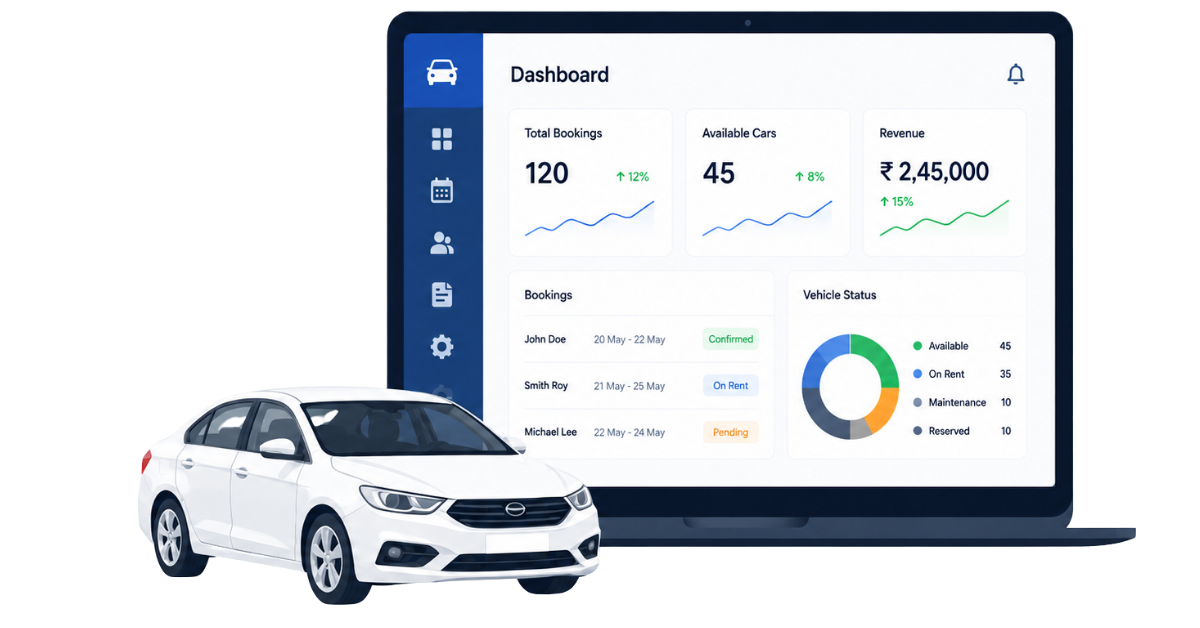
Between 2018 and 2026, Indian car rental businesses went from notebooks, missed calls, and walk-in counters to online reservations, car sharing models, and telecalling-driven sales funnels. Online bookings increase direct bookings and customer satisfaction, and operators who adopted digital tools early, like WheelShare in Delhi-NCR, reported a 300% increase in bookings within six months after going digital.
Today’s operators range from airport pickup services and outstation taxi fleets to self-drive platforms in Pune, Hyderabad, and tier 2 centres. Their enquiries arrive via Justdial, Google Ads, WhatsApp chats, Instagram messages, and aggregator apps. Most still close deals over the phone.
A car rental management system helps rental companies manage vehicles, bookings, billing, contracts, pricing and fleet operations across branches. But it does not fully solve the sales side. Rental businesses also need a CRM to manage leads, agent performance, WhatsApp conversations, follow-ups and repeat customers.
This article explains what each system handles, where the limits are and how telecrm helps car rental companies in India manage sales and customer communication better.
Think of a car rental management system as the operations backbone that keeps vehicles, reservations and payments in sync around the clock. It boosts business efficiency by eliminating manual paperwork, preventing double bookings and providing real-time fleet visibility. Here are the key features most systems cover:
Where it stops: Most management systems are weak at lead capture from Facebook or Google Ads, call-based follow-ups, telecalling campaigns, loss analysis and detailed tracking of agent performance. The system excels once a booking is confirmed and a vehicle is assigned-but it is not built to run the sales pipeline from first enquiry to repeat booking.
Benefits of a car rental management system
A car rental management system helps rental companies move away from scattered registers, Excel sheets, manual calls and disconnected booking updates. It gives the business one place to manage vehicles, reservations, payments, customer records and daily operations.
1. Reduces manual booking work
Without software, teams have to check vehicle availability manually, confirm dates over calls and update bookings in separate sheets. This increases the chances of confusion, especially when enquiries come from phone calls, WhatsApp, websites, travel agents and walk-ins.
A car rental management system makes booking management easier by showing available cars, confirmed reservations, pending payments and customer details in one place.
2. Prevents double bookings
Double bookings are one of the biggest problems in the rental business. They usually happen when vehicle availability is not updated in real time or when multiple team members are handling bookings from different channels.
With a rental management system, the team can see which cars are available, booked, under maintenance or already assigned. This reduces booking mistakes and helps customers get clear confirmation faster.
3. Improves fleet visibility
Fleet management becomes easier when every vehicle’s status is visible. The business can track which cars are available, which ones are on rent, which need servicing and which are not ready for the next booking.
This helps owners and managers make better decisions about vehicle usage, maintenance planning and fleet expansion.
4. Makes billing and payments easier
A car rental business has to manage advance payments, security deposits, extra kilometre charges, late return fees, refunds and invoices. Handling all of this manually can create errors.
A car rental management system helps standardise billing, generate invoices, track payment status and reduce confusion between the customer and the team.
5. Speeds up rental agreements and documentation
Rental agreements, ID proofs, driving licences, digital signatures and customer documents are important for every booking. When these are handled manually, documents can get misplaced or delayed.
With the right system, rental agreements and customer documents can be stored against each booking, making the process cleaner and easier to audit later.
6. Improves customer experience
Customers expect quick confirmation, clear pricing, pickup details, payment updates and reminders. A car rental management system helps the team send timely updates and avoid last-minute confusion.
This improves customer satisfaction because the customer does not have to repeatedly call your team for basic booking information.
7. Helps manage multiple branches
For rental companies working across different locations, managing cars, bookings and teams manually becomes difficult. A multi-branch rental system helps track vehicle availability, branch-wise bookings, revenue and customer demand from one platform.
This is useful for businesses operating in airports, city centres, tourist locations or multiple service areas.
8. Gives better reports for decision-making
A car rental management system helps business owners track utilisation, revenue, pending payments, popular routes, high-demand vehicles and seasonal booking trends.
Instead of guessing which cars or locations are performing better, the business can use reports to plan pricing, maintenance and marketing more clearly.
9. Supports customer retention
Repeat customers are important in car rental, especially for airport transfers, corporate rentals, monthly rentals and regular outstation trips. A system that stores customer history helps the team understand past bookings, preferences and payment behaviour.
This makes it easier to serve repeat customers better and bring them back with timely follow-ups or offers.
10. Brings more control to daily operations
The biggest benefit of a car rental management system is control. Owners can see what is booked, what is available, what is pending and where the business is losing time.
It helps the team run bookings, fleet operations, payments and customer records in a more organised way.
A car rental management system handles the booking once the customer is ready to rent. A CRM helps you reach that point. It manages the full sales and communication journey before, during and after the booking.
Car rental enquiries can come from many places:
A CRM keeps all these enquiries in one place so your team does not depend on scattered chats, missed calls or Excel sheets. It also helps capture key details like location, vehicle type, rental date, duration, budget and pickup requirement.
Most customers do not confirm instantly. They ask for pricing, compare vehicle options, check availability, request discounts or wait for internal approval.A CRM helps your team track every follow-up, call, WhatsApp conversation and quote update.
So the agent knows exactly what was discussed, what pricing was shared and when the customer needs to be contacted again.
The work does not end after the car is returned. A CRM helps rental companies manage feedback, repeat bookings, renewal reminders, corporate account follow-ups and customer retention campaigns.
For example, if a customer regularly books airport transfers or monthly rentals, your team can follow up at the right time instead of waiting for them to contact another provider.
A CRM also gives managers visibility into the sales team. They can track:
This helps car rental companies improve customer communication, reduce missed opportunities and manage the sales side more efficiently.
Quick read: 25 Ways To Generate Walk-In Leads For Automobile Dealership
Not every CRM works for call-heavy rental businesses in India. Telecalling-first features matter more than flashy dashboards. Here is what to look for:
telecrm is a CRM built for Indian SMBs, including outstation taxi operators, self-drive fleets and car rental businesses in tier 1 and tier 2 cities. Here is how it works in a rental context, functioning as a dedicated automobile CRM:
Also read: 10 Automobile Upselling Strategies To Boost Sales
Many car rental systems add “CRM” sections, but these are usually limited to basic contact lists and simple reminders-not full-fledged sales automation. Automated systems reduce manual tasks and improve efficiency, but only if they cover the right tasks.
Capability | Generic rental software CRM | telecrm |
Lead capture from ads, WhatsApp, aggregators | Limited or manual | Automated from 15+ sources |
Auto dialer and call queues | Rarely available | Core feature with power dialing |
Call recording | Basic or absent | Full recording with admin playback |
WhatsApp templates and broadcasts | Confirmation-only | Rich quoting, chat sync, campaigns |
Sales pipeline with drop-off analysis | Booking status only | Custom stages with conversion tracking |
Real-time agent dashboards | Fleet metrics, not sales metrics | Calls, conversions, response times, lost reasons |
Integration flexibility | Locked to own platform | Sits on top of any rental system |
For the sales side-lead capture, follow-ups, upsell and repeat bookings, telecrm is more powerful and focused than the lightweight CRM features bundled into most car rental systems. Anyone can set it up alongside your existing platform without disrupting operations. Book a free demo with telecrm to see how your car rental sales process can become faster, clearer and easier to manage.
Most growing car rental businesses benefit from both. The management system handles bookings, fleet, contracts, and pricing. telecrm handles lead capture, telecalling, WhatsApp communication, and sales performance tracking. Very small operators with a few cars might start with only a CRM plus spreadsheets, but as fleet size and booking volume grow, a proper rental system becomes necessary. Start by fixing the biggest leak-usually missed leads and poor follow-ups-then add the management system when operational complexity increases.
Most small and mid-sized rental teams get a working setup within a few days, including importing existing leads, creating basic pipelines and training agents on the auto dialer and WhatsApp workflows. telecrm offers remote onboarding with help mapping stages like enquiry, quote, tentative, confirmed and completed. Start simple-one pipeline, a basic set of templates and a small pilot team-before rolling out to all branches.



© Copyright 2026 telecrm.in (Flamon Cloudtech Pvt Ltd) - All Rights Reserved • Privacy Policy • T&C



© Copyright 2026 telecrm.in - All Rights Reserved • Privacy Policy • T&C