
The automotive industry has changed from showroom-led selling to relationship-led selling. Customers now compare models online, speak to multiple dealerships, ask questions on WhatsApp, expect quick callbacks and want a smoother buying experience.
A dealership CRM helps car dealers manage this shift by connecting customer data, lead management, sales pipeline tracking, customer communication, marketing automation, service reminders and actionable insights on one unified platform.
For dealerships, this creates more than operational convenience. It helps teams improve customer engagement, identify sales opportunities, track key metrics and make informed decisions across sales and service.
This blog explains what makes a CRM right for the automotive industry, how to compare the best dealer CRM software in India and how telecrm helps Indian dealerships close more deals with better visibility and follow-up control.
The best dealership CRM should help your team capture leads, track customer interactions, manage follow-ups, improve customer service and get clear visibility into the full sales pipeline.
Car dealerships have a different sales process from regular businesses. Customers compare models, ask for finance options, check inventory availability, book test drives, negotiate prices, delay decisions and come back later for service, renewal or exchange. Your CRM software should support this complete customer life cycle.
Here are the most important features to check before choosing an automotive CRM.
Feature | Why it matters for dealerships |
Multi-source lead capture | Captures more leads from website visitors, ads, calls, WhatsApp, walk-ins, OEM campaigns and digital retail platforms |
Lead management | Helps the sales team track every enquiry from first contact to closure |
Lead tracking | Shows where every potential customer stands in the sales funnel |
Customer data management | Helps centralise customer data across sales, service and marketing teams |
Call tracking | Tracks phone calls, call outcomes and sales rep activity |
WhatsApp communication | Keeps customer communication visible instead of hidden on personal phones |
Follow-up reminders | Ensures sales reps contact the right person at the right time |
Test drive management | Helps schedule, track and follow up after test drives |
Sales pipeline tracking | Shows every stage of the sales process clearly |
Marketing automation | Sends reminders, campaign messages and follow-ups without manual effort |
Inventory management | Helps teams connect customer interest with vehicle availability |
Customer service tracking | Helps improve customer service after delivery |
Embedded analytics | Turns CRM data into valuable insights and key metrics |
Sales manager dashboards | Gives sales managers visibility into performance, delays and team accountability |
Artificial intelligence | Can support faster actions, smarter recommendations and better customer engagement |
Customer life cycle tracking | Helps manage sales, service, renewals, exchange and repeat purchase journeys |
A good dealership CRM should not only store customer information. It should help your team act on that information.
For example, if CRM data shows that many leads are dropping after test drives, the manager can check whether the issue is pricing, finance, follow-up delay, sales rep performance or poor customer communication. This turns raw data into actionable insights.
The right CRM should also help dealerships save time. Instead of manually asking every sales rep for updates, sales managers should be able to open one dashboard and see lead status, follow-ups, calls, test drives, bookings, lost reasons and service opportunities.
For Indian dealerships, these features are not “good to have”. They directly affect customer satisfaction, conversion rates, sales performance and the ability to close more deals.
The best dealer CRM software in India depends on your dealership size, lead volume, team structure, sales process and how much visibility you need across sales, service and renewals.
Small dealers may only need a CRM system to manage lead tracking, phone calls, follow-ups and customer information. Larger automotive dealerships may need a more advanced management system that connects sales reps, sales managers, service teams, marketing campaigns, inventory management and customer data across multiple branches.
Here is a practical comparison of top dealership CRM and automotive CRM software options in India.
Rank | Dealer CRM software | Best for | Key strengths | What to check |
1 | telecrm | Indian car dealerships that depend on calls, WhatsApp, follow-ups and sales visibility | Lead capture, phone calls, WhatsApp tracking, lead assignment, automation, sales pipeline tracking, custom workflows and team accountability | Map your sales, service, insurance and renewal workflows before rollout |
2 | LeadSquared Automotive CRM | High-volume automotive dealerships and dealer networks | Lead management, digital lead capture, test drive tracking, automation, service reminders and sales performance visibility | Pricing, implementation effort and fit for small dealers |
3 | Salesforce Automotive Cloud | Large automotive industry players, OEMs and enterprise dealer networks | Customer data management, AI capabilities, advanced reporting, service journeys and enterprise scalability | Cost, setup complexity and need for dedicated CRM ownership |
4 | Zoho CRM for automotive | Dealerships that want a flexible CRM with a broad app ecosystem | Lead management, sales pipeline tracking, automation, customer communication and integrations | Setup effort if multiple Zoho products are used together |
5 | Freshsales | Dealership sales teams that want clean pipeline and activity tracking | Contact management, sales funnel visibility, automation, calls, emails and reporting | May need extra setup for dealership-specific service and renewal workflows |
6 | HubSpot CRM | Marketing-led dealerships focused on website visitors and inbound leads | Forms, email marketing, lead engagement, marketing automation and customer communication | Advanced features can become expensive as the team grows |
7 | Kylas CRM | Indian SMB dealerships that need sales tracking and team visibility | Lead management, task tracking, sales reps’ activity and pipeline visibility | May need more configuration for deeper automotive workflows |
8 | Pipedrive | Dealerships that mainly want visual deal tracking | Sales pipeline, deal movement, activity tracking and follow-ups | Less suitable for calling, WhatsApp, service and renewal-heavy workflows |
This ranking is not about which CRM has the biggest brand name. It is about which CRM fits Indian dealership operations better.
For example, a small used car dealer may need a cloud based CRM to track enquiries, phone calls, test drives and follow ups. A larger dealership group may need advanced lead assignment, branch-wise reports, customer life cycle tracking, embedded analytics, service reminders, inventory visibility and data driven decision making.
The right dealership CRM should help your team capture more leads, send the right message to the right person, improve customer service and give managers actionable insights into sales opportunities, conversion rates and team performance.
For most Indian car dealerships, the CRM choice should start with one question: will this tool help my sales team follow up faster and close more deals without adding unnecessary complexity?
telecrm helps car dealerships manage lead capture, phone calls, WhatsApp follow-ups, test drives, sales pipeline tracking, automation, reporting and service visibility from one CRM system.
For Indian dealerships, this matters because vehicle sales depend heavily on quick response, consistent follow-ups and complete customer context. A buyer may enquire today, ask for finance details tomorrow, book a test drive later and then compare offers from other car dealers before deciding. telecrm helps the sales team track this full journey without losing context.
Here’s how telecrm helps car dealerships:
telecrm helps dealerships capture lead data from ads, websites, phone calls, forms, walk-ins, WhatsApp and other lead sources into one CRM system. A CRM helps you manage dealership leads, but you first need a steady flow of showroom enquiries. Read our guide on generating walk-in leads for automobile dealerships to attract more serious buyers to your showroom.
Instead of keeping customer information scattered across Excel sheets, personal phones, call logs and showroom registers, telecrm keeps lead data, call history, notes, follow-ups and customer interactions in one place.
Dealerships can assign leads based on branch, city, model interest, lead source, sales rep availability or custom rules, so the right person can respond faster.
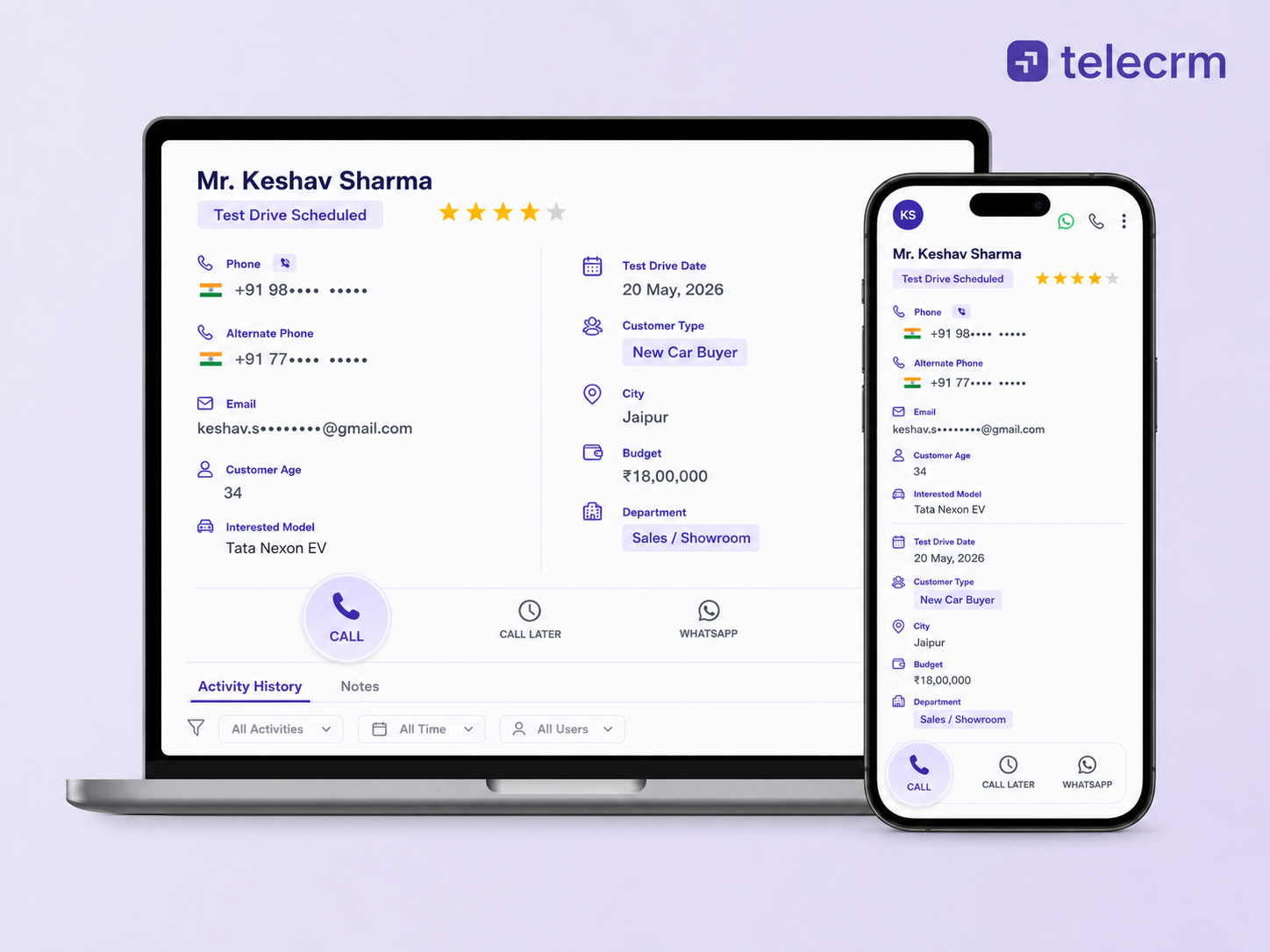
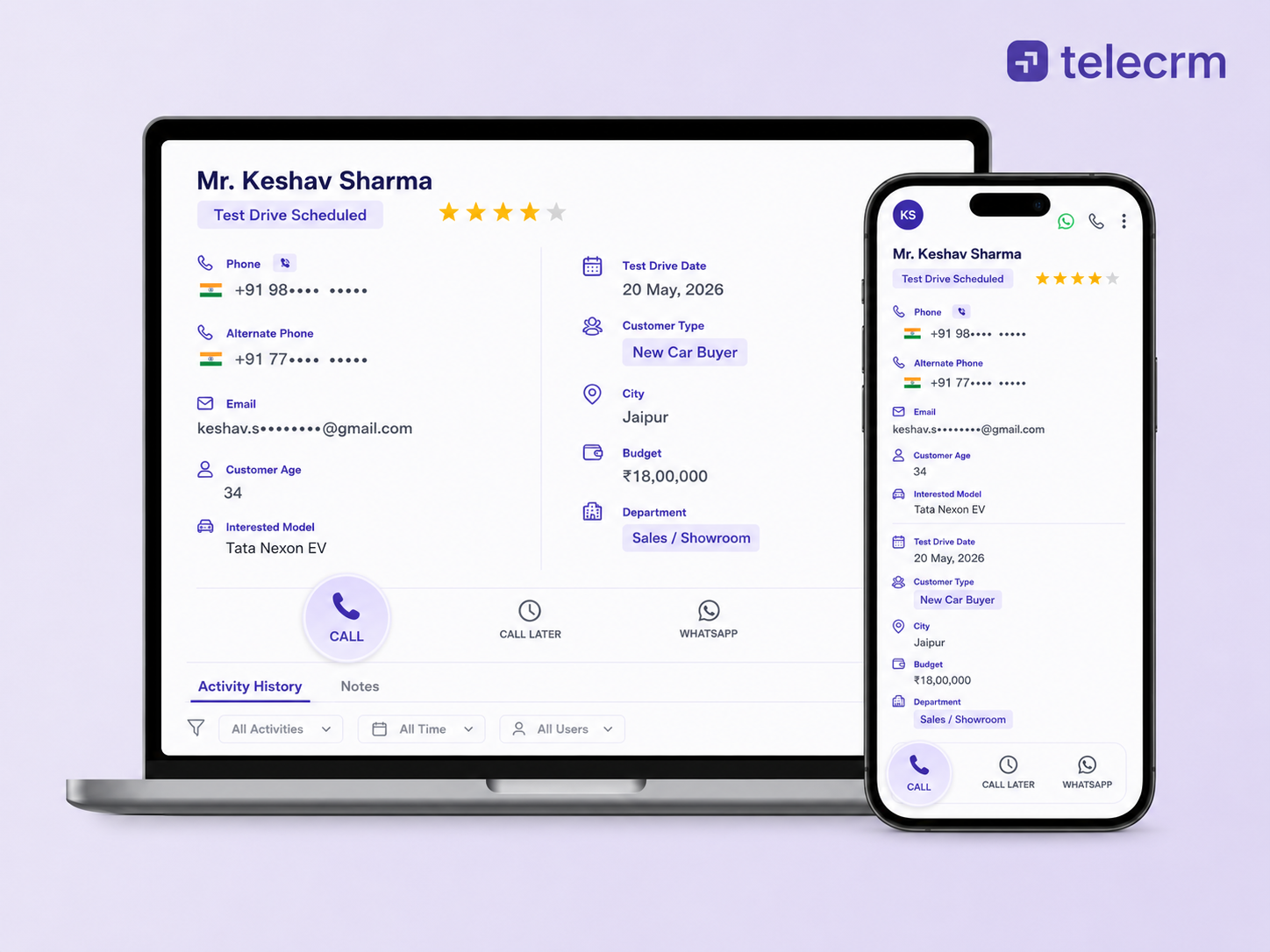
telecrm helps sales managers see who called the customer, what was discussed, what the outcome was and what the next step is.
Sales reps can set follow-up reminders for callbacks, test drive confirmations, finance discussions, booking updates, service reminders and insurance renewals.
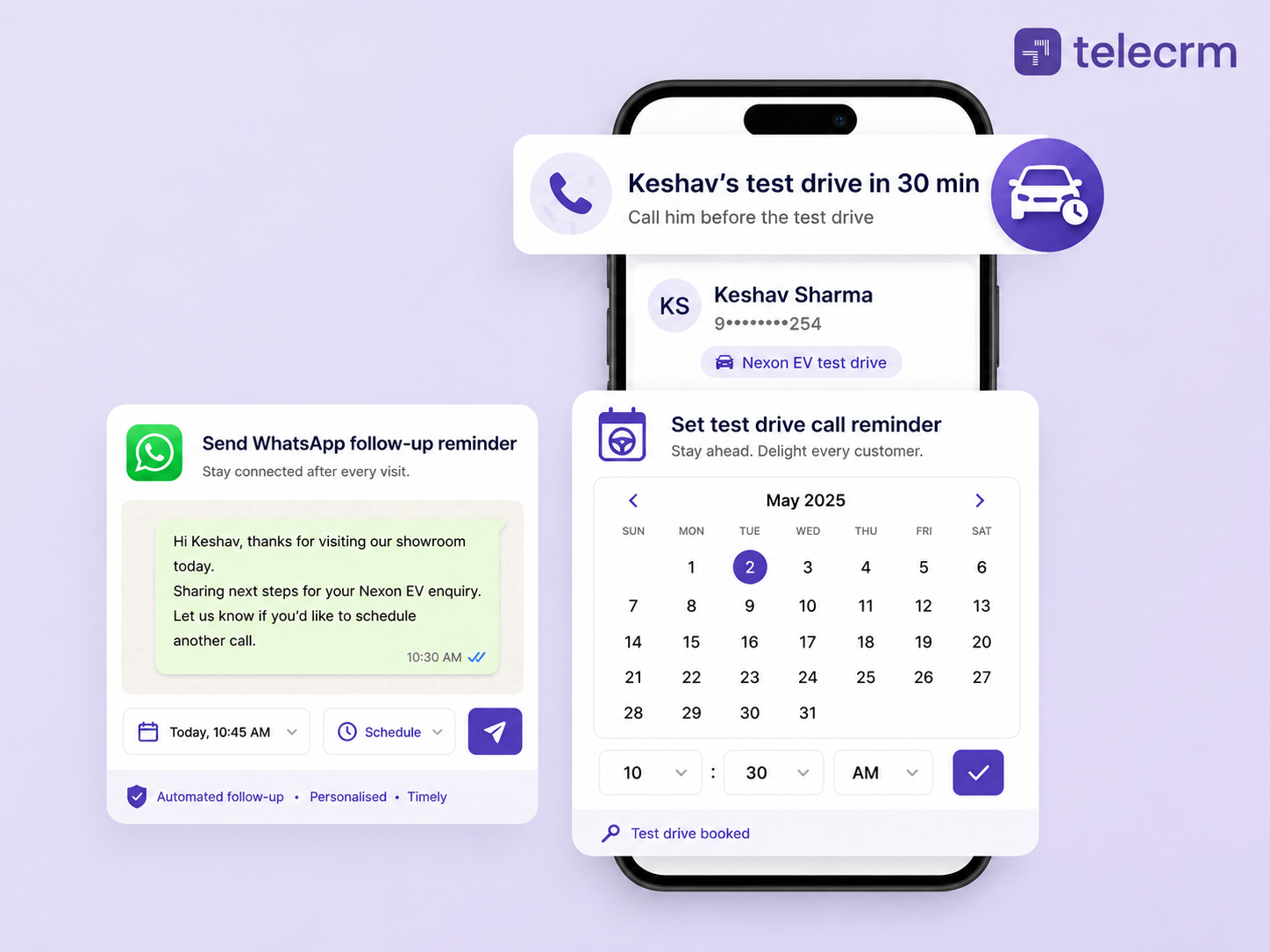
Since many Indian car buyers prefer WhatsApp for brochures, pricing, finance options and delivery updates, telecrm helps keep customer communication linked to the lead journey.
Dealerships can create pipeline stages like New enquiry, First call done, Test drive scheduled, Test drive completed, Finance discussion, Booking done, Vehicle delivered, Service follow-up, Insurance renewal and Exchange opportunity.
Sales managers can track lead movement, pending follow-ups, call activity, sales rep performance, test drive status, booking progress and customer engagement from one place.
If many customers take test drives but do not book, managers can review call notes, objections, WhatsApp conversations, follow-up gaps and sales rep activity.
Multi-branch dealerships can manage leads across locations, teams, vehicle models, service journeys, renewal workflows and repeat customer engagement.
telecrm helps connect the customer life cycle across sales, service, insurance and repeat purchase opportunities, instead of stopping after vehicle delivery.
By improving lead engagement, customer communication, follow-up discipline, team accountability and sales visibility, telecrm helps dealerships manage more leads and close more vehicle sales with better control.
If your dealership gets test drives but struggles to convert them into bookings, this guide on test drive conversion will help you fix the follow-up gaps.
The right dealer CRM depends on your dealership size, lead volume, number of sales reps, branch structure and how much visibility you need across sales, service and renewals.
Small dealers usually need simple crm software, fast setup, mobile access and WhatsApp-first workflows.
Choose a dealership crm that helps you:
Mid-sized car dealerships need stronger process control. They may have sales, finance, insurance and service teams working together.
Look for:
CRM tools assist in tracking loyalty indicators, allowing staff to connect with customers at key touchpoints, such as during service visits. This is where customer experience and customer retention improve. telecrm is a strong option here because it gives small teams actionable intelligence without overwhelming them.
Large automotive dealerships need a cloud-based system with deeper DMS, ERP, OEM, finance and service integrations.
They should prioritise:
Enterprise teams may also evaluate equity mining, where the system identifies customers with positive equity who may be ready to upgrade to more vehicles. This helps sales teams make informed decisions and create timely offers.
Before choosing software for your dealership, it is important to know the difference between a DMS and a CRM. This guide on DMS vs CRM explains which system fits which part of your dealership workflow.
A dealership CRM is not just a place to store customer details. It is the system that helps your team capture every enquiry, track every call, manage test drives, follow up on time and understand which leads are actually moving towards booking.
For automobile dealers, this visibility matters. A missed callback, delayed WhatsApp reply or forgotten test drive follow-up can easily become a lost sale. But when your sales, service and showroom teams work from one CRM, every customer interaction stays organised and every rep knows the next step.
The right dealership CRM helps you reduce lead leakage, improve team accountability, track showroom visits and give customers a smoother buying experience.
telecrm is built for Indian automobile dealerships that want to manage leads, calls, WhatsApp conversations, test drive follow-ups and sales activity from one simple CRM.
Book a free demo with telecrm to see how your dealership can track every lead, improve follow-ups and close more bookings.
An automotive crm is designed for automotive retail workflows such as vehicle enquiries, test drives, service history, inventory management, renewals and dealership sales. Regular crm tools are broader and may need customisation for car dealerships.
Not always. Small dealers may start with CRM first. But as operations grow, a dealer management system helps manage inventory, billing, sales processing, service and back-office workflows more effectively
Yes. A dealership crm stores customer information, service history, preferences and communication records. This helps teams send timely service reminders, renewal alerts and personalised offers.
Yes, telecrm is suitable for used car dealers that need calling, WhatsApp, lead tracking, follow-up reminders and team performance tracking. For advanced RC verification or deep stock valuation, it may need integrations with specialised tools.
Artificial intelligence can score leads, identify customer behaviour patterns, suggest the next best actionand create personalised messages. This helps sales reps prioritise potential customers and improve conversion rates.



© Copyright 2026 telecrm.in (Flamon Cloudtech Pvt Ltd) - All Rights Reserved • Privacy Policy • T&C



© Copyright 2026 telecrm.in - All Rights Reserved • Privacy Policy • T&C