
Salesforce CRM is one of the most searched CRM platforms in the world, and for good reason. It helps businesses manage leads, customers, sales pipelines, service requests, marketing activities and reporting from one central system.
But for Indian SMBs, the bigger question is not just “What is Salesforce CRM?” The real question is whether it fits the way your team actually sells. If your sales team depends on phone calls, WhatsApp follow-ups, field visits, demos, renewals or daily lead tracking, you need to understand what Salesforce offers, where it works well and where it may feel too complex or expensive.
In this guide, we will break down Salesforce CRM in simple terms. You will learn what it does, how its pricing works, which features matter, where it fits best and when a CRM like telecrm may be a more practical choice for Indian sales, marketing and service teams
Salesforce CRM is a cloud-based customer relationship management platform that helps businesses manage sales, service, marketing, commerce, customer data and automation from one central system.
It gives teams a shared view of every lead, customer interaction, sales opportunity and support request. Salesforce also includes AI and data tools like Agentforce, which help businesses automate routine workflows, improve productivity and make better use of customer information.
For Indian SMBs, Salesforce CRM can bring structure to customer management, but its real value depends on whether the platform fits the team’s budget, sales process and day-to-day workflow.
Indian SMBs often find Salesforce difficult to justify because the platform is powerful, but the total cost and setup effort can feel too heavy for their actual sales process.
Salesforce works best when the business is ready for it. If an SMB has a defined sales process, internal ownership, training capacity and budget for proper setup, Salesforce can become a strong long-term CRM foundation.
So the right way to look at Salesforce is not “too expensive” or “too complex”. The better question is: “Are we ready to use this level of CRM properly?” For businesses with complex teams and long-term expansion plans, Salesforce can be a good investment. For teams that first need faster calling, WhatsApp follow-ups, lead tracking and sales visibility, a more India-centric CRM may deliver value faster.
Salesforce CRM software is a strong choice for businesses that need deep customisation, multi-team workflows and enterprise-level scalability. But Indian businesses should compare CRM tools based on how well they support daily sales execution, calling, WhatsApp, automation, reporting, implementation effort and team adoption.
CRM software | Best for | Key strengths | Limitations to check |
Salesforce CRM | Large and growing businesses that need advanced CRM customisation across sales, service, marketing and commerce | Deep customisation, strong reporting, large app ecosystem, AI tools, automation and enterprise scalability | Higher cost, setup effort, learning curve and add-on complexity |
telecrm | Indian SMBs and enterprises that need calling, WhatsApp, lead capture, automation and complex workflow management in one CRM | Multi-source lead capture, call tracking, WhatsApp visibility, custom workflows, lead assignment, automation, follow-up tracking, reporting and sales/service visibility | Best evaluated by mapping your exact workflow, team size and integration needs before rollout |
Zoho CRM | Indian businesses that want a broad CRM ecosystem at a flexible price point | Sales automation, email, reporting, integrations and strong Zoho app ecosystem | Setup can feel complex if multiple modules are used together |
LeadSquared | High-volume sales teams in education, finance, healthcare and field sales | Lead management, automation, field sales tracking and industry-specific workflows | Pricing and implementation may feel heavy for smaller teams |
HubSpot CRM | Marketing-led teams, startups and businesses focused on inbound sales | Easy interface, free CRM tools, strong marketing and content ecosystem | Advanced features can become expensive as the team grows |
Freshsales | Sales teams that want a clean CRM for contact and pipeline management | Contact management, pipeline tracking, built-in communication tools and automation | Wider marketing and support use cases may need other Freshworks products |
Pipedrive | Teams focused mainly on deal pipeline management | Simple pipeline view, deal tracking and sales activity management | Less suitable if you need deeper calling, WhatsApp or service workflows |
Kylas CRM | Indian SMBs looking for a sales-focused CRM | Lead management, pipeline tracking, task management and team visibility | May not fit teams needing highly advanced custom workflows |
Bigin by Zoho CRM | Very small teams moving from spreadsheets to their first CRM | Simple CRM, easy setup and affordable entry point | Limited for businesses with complex sales, service or automation needs |
Salesforce is best when customer relationships span many departments, approval layers and countries. HubSpot is strong when content and email drive leads. Zoho is affordable and broad. telecrm is focused on high-volume customer interactions over phone and WhatsApp.
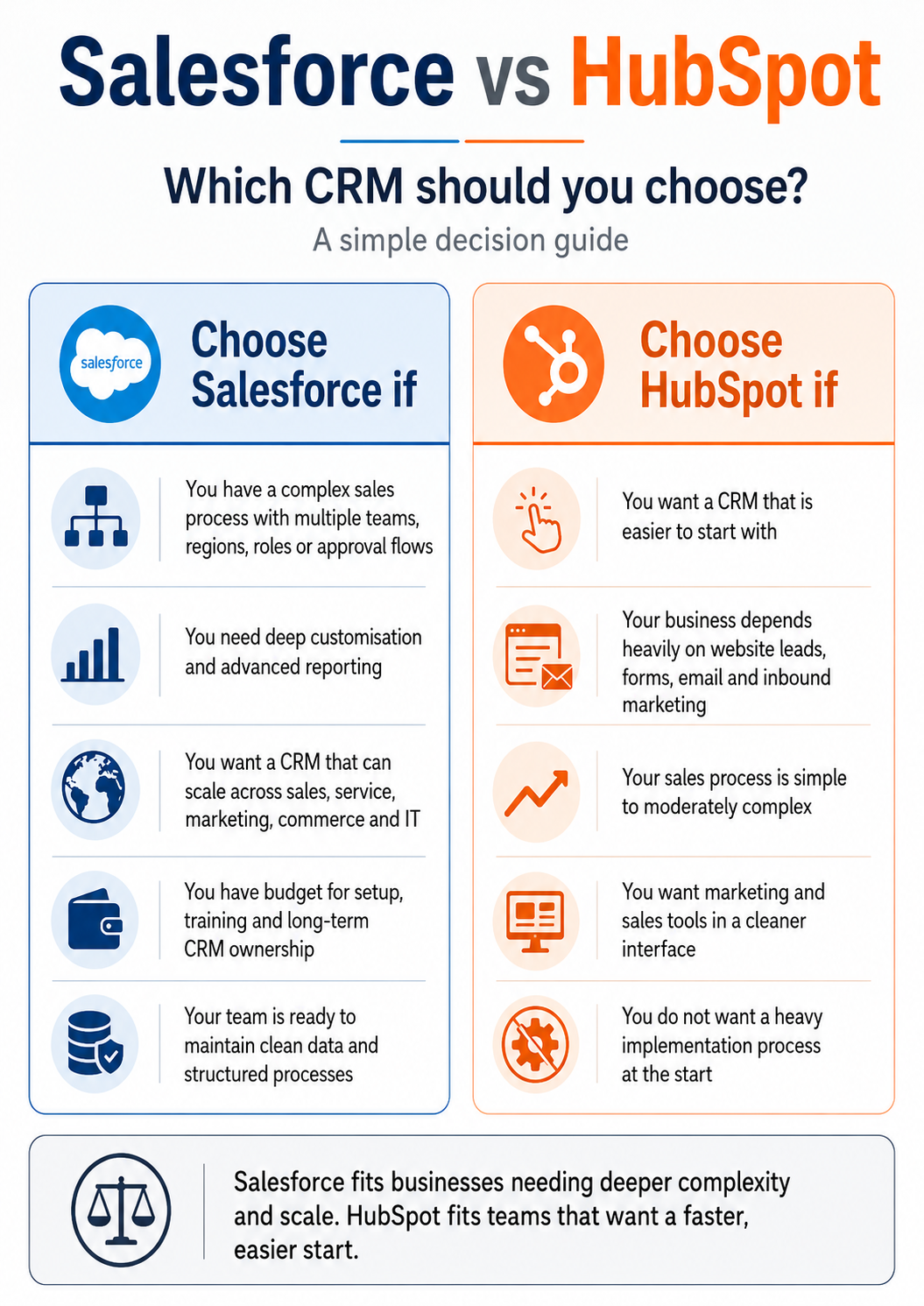
Salesforce is better for Indian SMBs that need deep CRM customisation, advanced sales processes and long-term enterprise scalability. HubSpot is better for SMBs that want an easier CRM experience with strong marketing, content and inbound lead management.
For most Indian SMBs, the better choice depends on one question: Are you trying to build a complex CRM system or do you need a tool your sales and marketing team can adopt quickly?
Salesforce says its Sales Cloud plans include Starter Suite, Pro Suite, Enterprise, Unlimited and Agentforce 1 Sales, with increasing levels of AI, automation, integration and customisation. Salesforce positions itself as the “#1 AI CRM” across sales, service, marketing, commerce and IT.
HubSpot offers a free CRM and paid tiers. Its CRM page lists Free, Starter starting at $15/month per seat and Professional starting at $50/month per seat, while its Starter Customer Platform page positions the bundle for small businesses and startups. Here’s a simple guide for you
Zoho CRM is often the first Indian-friendly alternative when Salesforce quotes feel too high. Zoho publishes INR pricing: Standard around ₹800/user/month, Professional around ₹1,400/user/month and Enterprise around ₹2,400/user/month.
If your teams still work in silos, this guide on CRM sales team collaboration explains how a CRM helps SMBs keep sales reps, managers and service teams on the same page.
If you are evaluating alternatives in 2026, focus on what creates real value for your agents.
telecrm is the best fit for phone and WhatsApp-first teams: real estate projects, coaching institutes, loan DSA teams, insurance agencies and local sales floors. Pricing is commonly around ₹799/user/month annually, with WhatsApp chat sync add-ons around ₹200/user/month. Go-live can happen in in 1-2 working days.
Zoho CRM is good for SMBs that want a wider suite across sales, support, accounting and email. It works well when your team can spend time configuring modules.
HubSpot is useful if inbound marketing is central. Its free CRM is attractive, but high-volume teams should check contact, email, automation and reporting limits.
LeadSquared fits education, finance and field-sales teams that need lead capture, scoring and nurturing, but pricing and onboarding should be checked carefully.
Freshsales is a simpler global option with decent sales features, though Indian WhatsApp and lead-source depth may vary.
Before rolling out a new CRM, make sure your team is ready to use it. Read our guide on CRM adoption resistance to improve adoption and reduce friction.
The right Salesforce alternative depends on how many people sell, how complex your follow-ups are and how much visibility managers need.
A 5-member sales team does not need the same CRM setup as a 100-member team. Smaller teams usually need contact management, pipeline tracking and follow-up discipline. Larger teams need role-based access, automated assignment, call visibility, WhatsApp tracking, custom workflows and detailed reporting.
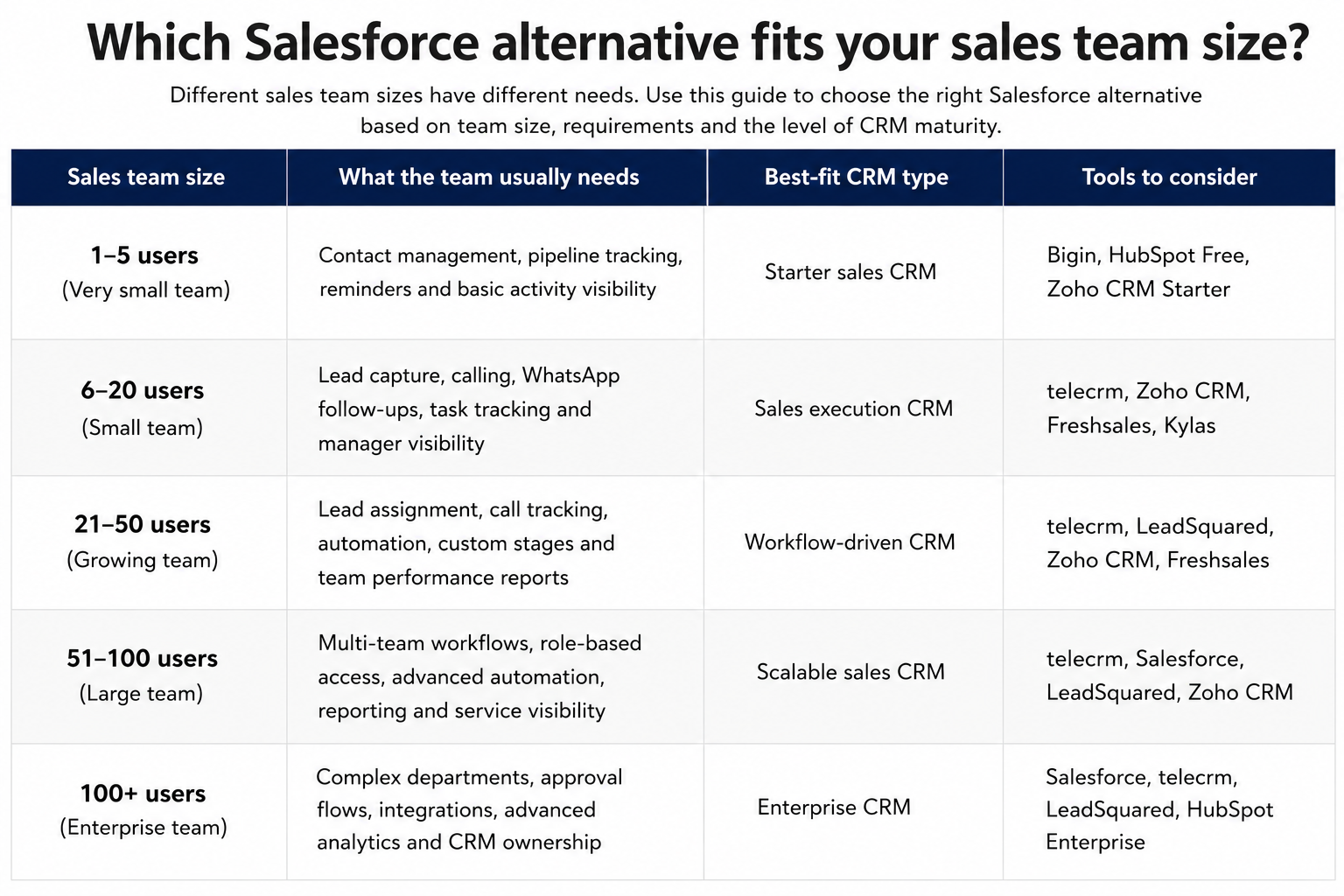
For a very small team, the priority is usually adoption. A founder or small sales team may need a CRM to store leads, track conversations, manage deal stages and keep follow-ups organised without adding too much process overhead.
For a 10 to 50-member Indian sales team, the CRM needs to do more. Leads may come from Meta Ads, Google Ads, IndiaMART, Justdial, website forms, referrals, incoming calls and WhatsApp. At this stage, a CRM like telecrm becomes useful because it helps teams capture leads, assign them, call faster, track WhatsApp conversations and give managers visibility into what is actually happening.
For larger teams, the decision becomes more about control. You need clear permissions, custom workflows, team-wise reporting, automation rules and service visibility. Salesforce is strong for large-scale enterprise CRM architecture, while telecrm is a strong option for Indian sales-driven teams that need complex workflows without losing day-to-day usability.
The practical rule is this: choose a CRM that matches your current operating reality, not just your future ambition. If your team is still struggling with missed follow-ups, scattered WhatsApp chats and poor calling visibility, fix that first. If your process is already mature and needs deeper enterprise customisation, then a platform like Salesforce may make more sense.
Still managing leads on spreadsheets? Read our detailed guide on migrate from excel to CRM step by step and move your sales process to a cleaner, trackable system.
telecrm is built around the daily work of Indian business’ teams: calling leads, tracking follow-ups, using WhatsApp, assigning enquiries, recording activity and giving managers live visibility. Salesforce is a broader CRM platform built for sales, service, marketing, commerce and highly customised business workflows.
For Indian telecalling teams, the better fit depends on whether the team needs a calling-first CRM or a large configurable CRM platform.
Factor | telecrm | Salesforce |
Best fit | Indian telecalling, inside sales, field sales and service teams that depend on calls, WhatsApp and fast follow-ups | Larger or growing teams that need a highly configurable CRM across sales, service, marketing and commerce |
Core strength | Calling, WhatsApp, lead capture, follow-ups, automation, assignment and manager visibility | Deep customisation, enterprise workflows, reporting, integrations and AI-led CRM capabilities |
Calling workflow | Built around daily calling, call tracking, call history and rep activity visibility | Calling can be managed, but may need setup, integrations or additional tools depending on workflow |
WhatsApp workflow | Designed for WhatsApp-led sales teams, including conversation visibility and follow-up tracking | WhatsApp can be connected, but usually needs integrations, configuration or third-party tools |
Lead capture | Captures leads from multiple Indian lead sources such as ads, websites, marketplaces, forms, WhatsApp and calls | Strong lead management, but source integrations and routing may need planned setup |
Lead assignment | Supports practical assignment rules based on team, source, region, product, language, industry or custom logic | Highly customisable assignment rules, but setup may need admin or implementation support |
Follow-up tracking | Built for daily reminders, missed follow-ups and rep accountability | Available through tasks, workflows and automation, but it depends on configuration and adoption |
Manager visibility | Gives managers visibility into calls, lead status, follow-ups, rep activity and pipeline movement | Offers advanced dashboards and reports, but useful reporting depends on setup and clean data |
Complex workflows | Can support complex Indian sales and service workflows while staying practical for frontline teams | Very strong for complex, enterprise-level workflows across multiple departments |
Ease of adoption | Designed for sales reps and telecallers who need a system they can use daily | Powerful, but may need more training, configuration and internal CRM ownership |
Implementation effort | More practical for quick rollout across calling and WhatsApp-heavy teams | Can require deeper implementation, customisation and ongoing admin support |
Pricing fit | Better suited for Indian teams that want practical CRM value without enterprise-style cost pressure | Salesforce Sales Cloud starts at $25/user/month and higher plans can become expensive for large calling teams |
Ideal buyer | telecrm is perfect for small teams to large enterprises | Businesses with larger CRM budgets, mature processes and dedicated CRM/admin teams |
Salesforce CRM is a benchmark platform. It is a cloud-based crm platform designed to manage the entire customer lifecycle, connecting sales, service, marketing and commerce in one system while bringing AI and data, AI and automation, collaboration, scalable support operations and deep control over the entire customer journey.
Cloud-based CRM systems like Salesforce provide real-time collaboration among team members, which is crucial in today’s globalised and remote working environment. Salesforce offers integration with a wide variety of third-party applications, allowing for extensive business automation and workflow improvement.
But staying in step with the world’s best does not mean buying every enterprise module. For Indian SMBs, the better question is: what helps agents call faster, follow up on time and close more deals this month?
So the right choice depends on your business need. Choose Salesforce if you need a broad enterprise CRM platform. Choose telecrm if you need a CRM that supports the way Indian business teams actually work every day.
Book a free demo with telecrm to see how your lead capture, calling, WhatsApp follow-ups and sales workflows can run from one place.
Yes. Salesforce CRM can be right if the small team belongs to a larger global group, needs advanced Service Cloud capabilities or must connect with an existing Salesforce instance used by partners or a parent company.
Yes. Many Indian SMBs begin with a free CRM and later migrate. Keep clean fields, standard lead stages and export-friendly data so migration is easier.
A typical telecrm setup for 10–50 users can go live in 1–2 working days with calling and WhatsApp workflows. Salesforce CRM projects often take weeks or months because of configuration, integrations and training.
Not always. Salesforce markets advanced AI strongly, but many practical AI-style benefits for Indian SMBs, such as lead prioritisation, follow-up reminders and performance insights, are available in lighter CRMs without full enterprise deployment.
A focused platform like telecrm can scale gradually with more users, workflows and reporting. Reassess every 12–18 months and consider Salesforce only when complex approvals, multi-country processes, or deep IT integrations truly require it.



© Copyright 2026 telecrm.in (Flamon Cloudtech Pvt Ltd) - All Rights Reserved • Privacy Policy • T&C



© Copyright 2026 telecrm.in - All Rights Reserved • Privacy Policy • T&C