
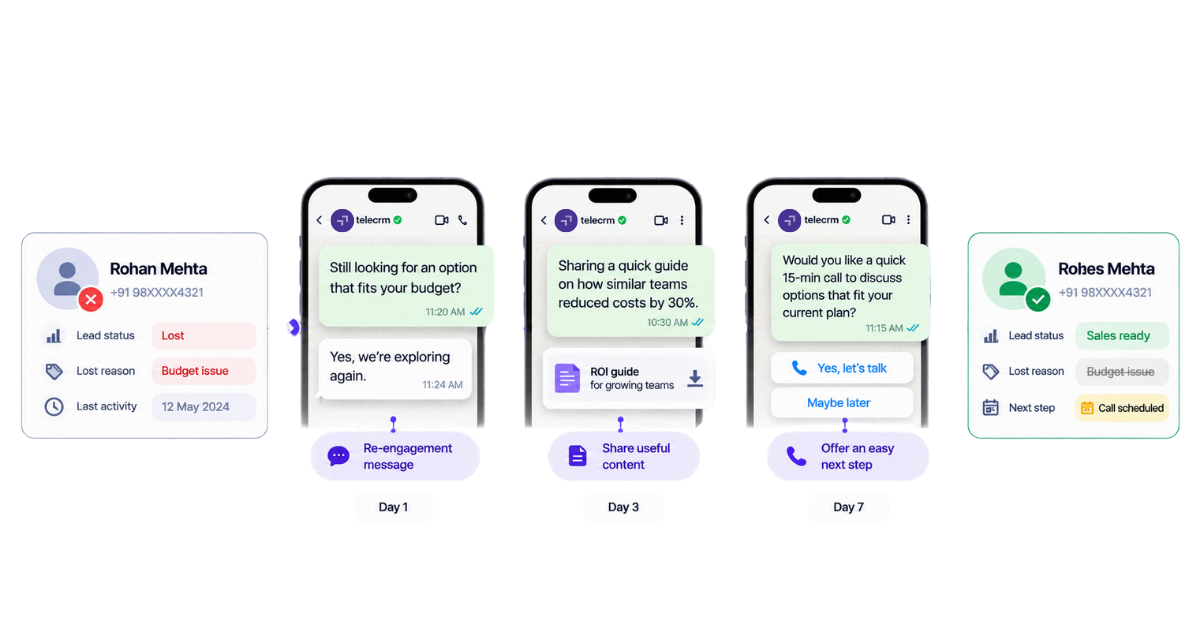
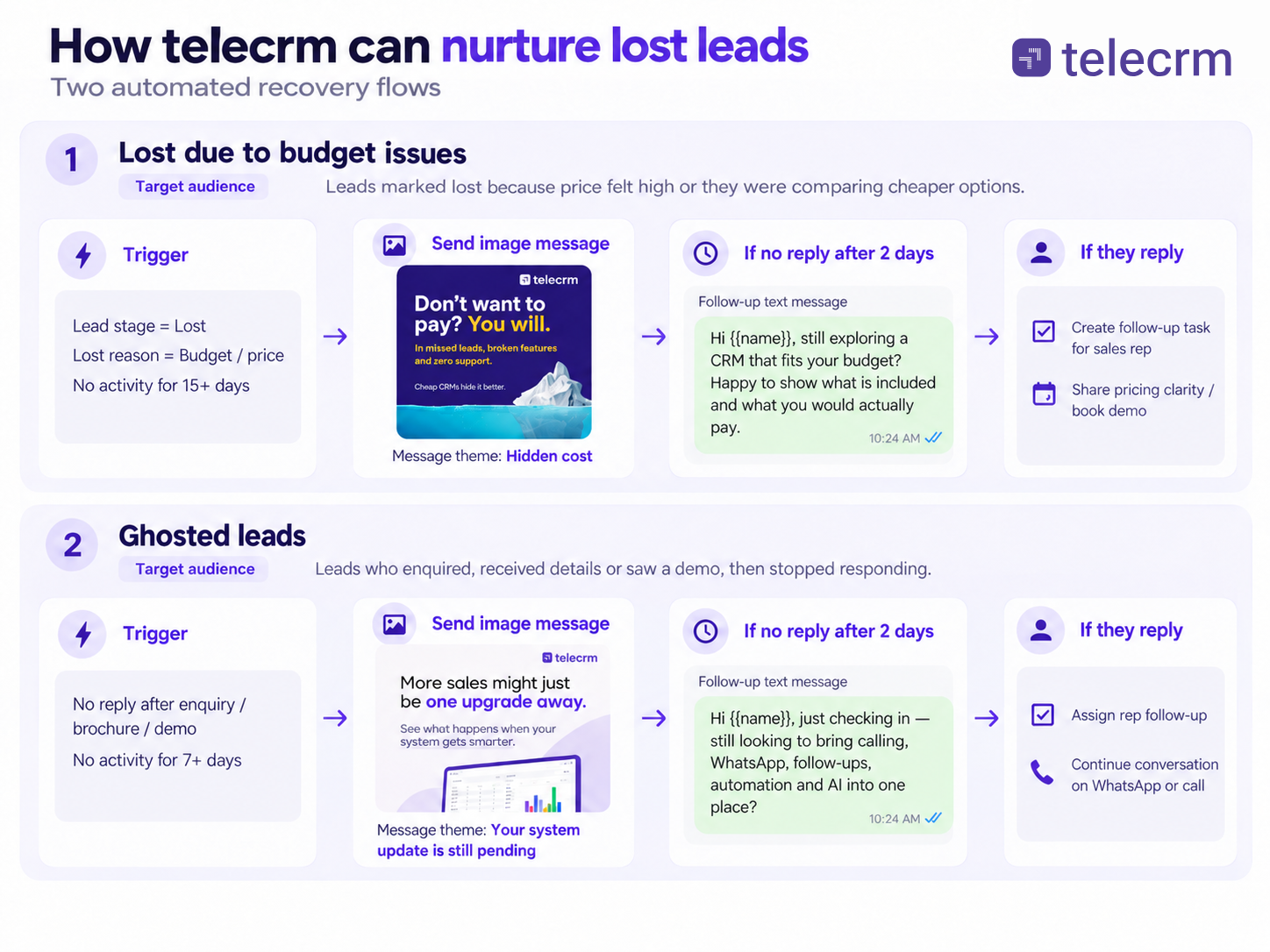
Lead nurturing is the process of staying in touch with leads who are not ready to buy yet and helping them move closer to a decision. Think of it like growing a plant. You do not expect it to bloom the day you plant it. You give it time, care and attention.
The same happens with leads. Someone may visit your website, ask a few questions and then stop responding. That does not always mean they are no longer interested. There could be many reasons why a lead did not choose your product or service at that point.
So instead of forgetting these leads completely, you can continue to engage them with useful information, timely follow-ups and relevant communication. This helps bring old leads back into the buying journey and gives you another chance to convert the time and money already spent acquiring them.
In this guide, we will look at why leads go cold, how to nurture them and what you can do to bring them back when the timing is right.
Reviving lost leads isn’t about sending more sales pitches. It’s about understanding why they dropped out, reaching out at the right time and giving them a good reason to re-engage.
A simple lead nurturing process helps bring these contacts back into your sales funnel without making your follow-ups feel pushy.
Start by looking at your past lead data to understand why each prospect stopped moving forward. There is almost always a specific reason, and grouping them by that reason makes your outreach more relevant:
Different leads have different pain points. Instead of sending everyone the same generic message, group them so you can address their actual hesitation.
Related read: Lead Source Tracking: Know Which Channels Bring Better Leads
Your first message should be short, casual and easy to reply to. Don’t start by listing features or explaining why your company is better. The only goal here is to restart the conversation.
Tailor the message to why they left:
Short messages work because they feel like a real human check-in, not a marketing campaign. You can also automate this through a lead nurturing CRM to send these broadcasts to the right groups.
When a lead replies or shows interest again, resist the urge to immediately jump into a sales call. Use the next few touchpoints to build trust and answer their remaining doubts:
Useful content matters far more than frequent follow-ups. The goal is to build a relationship so leads can progress through the buying process at their own pace.
Once the lead is warm and engaging with you again, make the next step as simple as possible:
Not every lost lead will come back, and that’s fine. Effective lead nurturing isn’t about chasing everyone. It is about spotting the leads that still have interest, reaching them on the right channels and giving your sales team a warm opportunity to close the deal.
Once you know what should guide your next move, the next step is turning those signals into a consistent lead nurturing process.
Why did they go cold in the first place? If they left because of price, your next move could be to explain flexible payment plans, long-term value or ROI. If they left because of timing, check whether their priorities or budget have changed.
Understanding the original pain points helps make your lead nurturing efforts more relevant. Instead of sending the same message to every prospect, you can build a lead nurturing strategy around the reason each lead stopped progressing through the sales funnel.
Look at what the lead has already clicked, read, watched or asked about. These actions can give sales and marketing teams valuable insights into what the prospect is actually interested in.
For example, if a lead repeatedly opens content about one feature, your next nurturing action could be a deeper guide, product video or demo focused on that feature. If they have visited your pricing page several times, they may already be further along in the buyer’s journey, so sending more early-stage educational content may not help.
This is also where lead scoring can help. It allows marketing and sales teams to identify engaged and qualified leads based on their behaviour and prioritise the leads showing stronger buying intent.
Timing should influence both the message and the nurturing process.
If a lead went cold two weeks ago, a short follow-up may be enough to restart the conversation. If six months have passed, their budget, priorities, team or requirements may have changed completely.
In that case, treating them like a brand-new conversation may work better than continuing an old sales pitch. A good lead nurturing plan should account for how long a lead has been inactive and adjust the communication accordingly.
Not every lead needs the same type of content. Your next action should depend on where they currently sit in the sales funnel and how close they are to making a decision.
The aim of effective lead nurturing is to help leads progress naturally through the buying process instead of pushing every lead towards a sales conversation too early.
Pay attention to where the lead actually responds.
If they ignore your emails but reply quickly on WhatsApp, continuing to send follow-up emails makes little sense. If they are more active on LinkedIn or prefer calls, move your nurturing efforts to those channels.
Successful lead nurturing often happens across multiple channels, but that does not mean you should use every channel for every lead. The right approach is to engage leads where they are most comfortable and where your sales team is most likely to get a response.
A successful lead nurturing strategy is not based on sending more messages. It is based on using the right context, timing, content and channel to decide what should happen next.
Before choosing the tools and channels you will use to reach your leads, it helps to understand why people decide to buy in the first place.
Long before CRMs, automated workflows or social media existed, businesses relied on basic psychological principles to turn prospective buyers into paying customers. Those same principles still influence how modern lead nurturing works across different channels today.
Understanding these principles is only half the job. The next step is delivering your message where your target audience is most likely to notice and respond to it.
Not every lead prefers the same channel. Your lead nurturing process should consider how your audience communicates, how quickly they expect a response and how much information they are likely to consume in that setting.
The goal is not to be everywhere at once. It is to choose the channels that make your nurturing efforts feel natural and relevant.
Who it’s for: Leads who prefer fast, conversational communication and industries where quick follow-ups are common.
How to use it: Send short check-ins, brochures, appointment reminders, updates or simple questions that are easy to reply to.
Why it works: WhatsApp feels more personal than many other channels because people already use it for everyday conversations. That makes it useful for maintaining relationships and restarting conversations with leads without making every message feel like a formal sales pitch.
Who it’s for: Leads who need immediate, time-sensitive updates and may not regularly check email or WhatsApp.
How to use it: Send appointment confirmations, reminders, alerts or very short follow-ups.
Why it works: SMS is highly visible and requires very little effort from the recipient. It works best when your message has one clear purpose and needs quick attention.
Who it’s for: B2B buyers, corporate decision-makers and leads who prefer more structured communication they can review in their own time.
How to use it: Share detailed follow-ups, newsletters, proposals, case studies, relevant content and longer nurturing campaigns.
Why it works: Email gives people more control over when they engage. This makes it useful during parts of the sales process where a lead needs time to review information, compare options or share details with other decision-makers.
Who it’s for: Leads with specific questions, stronger buying intent or objections that are difficult to resolve through messages alone.
How to use it: Use calls for qualification, detailed discussions, objection handling, demos or conversations where the lead needs a more personalised response.
Why it works: A call creates direct human interaction. It allows sales reps to understand tone, ask follow-up questions and respond to concerns immediately, which can be especially useful when a lead is further along in the buyer’s journey.
Who it’s for: Leads who have interacted with your website, content or campaigns but have not yet taken the next step.
How to use it: Show brand reminders, customer testimonials, educational posts, product updates or relevant offers across the platforms they already use.
Why it works: Repeated exposure helps your brand stay familiar even when the lead is not actively speaking with your sales team. Social proof also becomes particularly useful here because seeing real customers and results can make your business feel more credible.
A successful lead nurturing strategy does not depend on using every channel available. It depends on understanding where your leads are most responsive and using multiple channels only when they improve the experience.
If someone consistently replies on WhatsApp but ignores email, move more of your nurturing efforts there. If a decision-maker prefers calls followed by formal email communication, build the process around that. The right channel should make it easier for the lead to continue the conversation, not create another obstacle.
A nurtured lead is ready for sales when their behaviour starts showing clear buying intent.
Look for signals such as:
Lead scoring can help sales and marketing teams identify these signals, but context still matters. A high score is usecful, but sales reps should also look at the lead’s recent activity, previous objections and stage in the buyer’s journey before reaching out.
The goal is simple: move the lead to sales when they are showing real intent, not just because they have received enough nurturing messages.
Lead nurturing becomes much easier when you have the right tools to manage follow-ups, track conversations and keep every interaction organised.
You could use separate tools for CRM, WhatsApp, calling, automation and lead scoring. Or you can use a platform like telecrm that brings these parts of the lead nurturing process into one place.
A lead nurturing CRM helps you keep track of every interaction with a prospect, including calls, WhatsApp chats, follow-ups, lead stages and previous conversations.
With telecrm, leads from sources such as your website, Meta, Google, WhatsApp and other platforms can be captured into one system. Sales reps can then see the lead’s history, current stage and past interactions before following up, instead of starting every conversation without context.
Might like: What Is Lead Management: Process, Best Practices, Top Software
WhatsApp can be used for welcome messages, reminders, quick follow-ups, broadcasts and longer nurturing campaigns.
telecrm supports WhatsApp templates, broadcasts, automated messages, drip campaigns and workflow automation through the official WhatsApp API. This makes it easier to stay in touch with larger groups of leads while still organising those conversations inside the CRM.
Some leads need an actual conversation rather than another automated message.
telecrm lets sales teams make calls, schedule callbacks, set reminders and track incoming, outgoing and missed calls. Call activity and follow-up history stay connected with the lead, so sales reps can continue the conversation from where it stopped.
Not every nurtured lead deserves the same level of attention. Lead scoring can help identify which prospects are becoming more engaged and should be prioritised by the sales team.
telecrm can use lead activity and engagement to help teams score and prioritise prospects, making it easier to focus nurturing efforts on leads showing stronger buying intent.
A major part of successful lead nurturing is simply making sure the next action actually happens.
With telecrm, teams can automate repetitive tasks such as lead assignment, welcome messages, WhatsApp sequences, reminders and other workflow actions. This reduces the chances of a good lead being forgotten because someone missed a follow-up.
You also need to know whether your nurturing efforts are actually moving leads forward. telecrm provides reports around calls, follow-ups, lead stages and sales activity, giving sales and marketing teams visibility into what is happening across the funnel.
The real advantage is that these activities do not have to happen in isolation. With telecrm, your team can capture a lead, understand their previous interactions, reach them through WhatsApp or calls, automate repetitive follow-ups and track their progress from the same system.
That makes it easier to nurture leads consistently without losing the human context that actually helps move them towards a buying decision.
Lead nurturing is not about chasing every old lead with more messages. It is about understanding why they dropped off, staying relevant and reaching out with the right message when the timing makes sense.
With the right mix of useful content, timely follow-ups, multiple channels and automation, you can bring good opportunities back into the sales process instead of letting them disappear.
And when your CRM, WhatsApp, calling, lead tracking and automation work together, nurturing becomes much easier to manage.
Want to see how telecrm can help you nurture leads without losing context? Book a demo.
Lead nurturing is the process of staying in touch with potential customers who are not ready to buy yet. It uses relevant follow-ups, useful content and timely communication to build trust and help leads move closer to a buying decision.
The main goal is to keep promising leads engaged until they are ready to move forward. Instead of letting interested prospects disappear, businesses continue providing useful information and relevant follow-ups throughout the buyer's journey.
Lead nurturing generally follows the buyer's journey from awareness and interest through consideration and eventually action. The communication should change as the lead progresses and shows stronger buying intent
There is no fixed period. Some leads may be ready within days, while others can take weeks or months depending on the product, sales cycle, budget and timing. You should continue nurturing while the lead remains relevant and has not opted out or clearly indicated they are no longer interested.
Lead generation focuses on attracting and capturing new prospects. Lead nurturing begins after that, helping those prospects stay engaged and move towards becoming qualified, sales-ready leads.
Lead scoring helps sales and marketing teams identify which nurtured leads are showing stronger intent. Actions such as visiting a pricing page, requesting a demo or repeatedly engaging with content can help sales reps prioritise the right leads.
Yes. Businesses can automate repetitive activities such as WhatsApp messages, email sequences, reminders and follow-up tasks. However, high-intent conversations, objections and complex buying decisions still benefit from human involvement.



© Copyright 2026 telecrm.in (Flamon Cloudtech Pvt Ltd) - All Rights Reserved • Privacy Policy • T&C



© Copyright 2025 telecrm.in - All Rights Reserved • Privacy Policy • T&C