
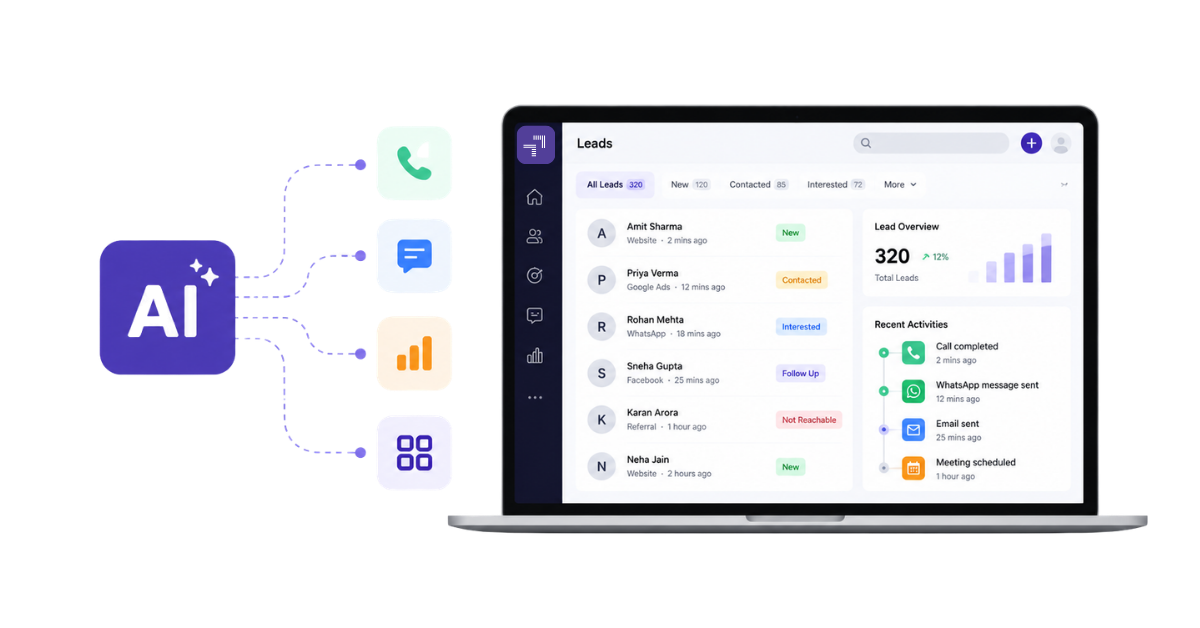
An AI CRM is a customer relationship management system that uses artificial intelligence to analyse your business data, uncover useful insights and tell you what to do next, or even take action for you.
Think about it. Businesses have been manually reviewing hundreds of sales calls, trying to understand customer sentiment, connecting the dots across reports and spending hours on tasks that shouldn’t take nearly as long.
Now, AI is changing that.
According to McKinsey’s 2025 State of AI survey, 88% of organisations reported using AI in at least one business function. And it’s not hard to see why. AI is making everyday work easier, faster and far less dependent on manual effort.
But how exactly is AI changing the way CRM software works? Let’s break down how AI-powered CRM has evolved, what it can do for your business and which tools are worth considering.
To understand what makes AI CRM different, it helps to look at how CRM software has evolved.
Traditional CRM systems were primarily built to organise customer information, track interactions and manage sales processes. Over time, they became more capable, with features such as automated follow-ups, lead scoring, sales forecasting and detailed reporting.
But the introduction of machine learning took things further.
Instead of relying entirely on predefined rules, CRM systems could start analysing historical data to identify patterns in customer behaviour, predict which leads were more likely to convert and flag potential risks in the sales pipeline.
Then came generative AI, which changed how people could interact with their CRM data. Rather than navigating multiple reports or manually interpreting information, users could ask questions in plain language, generate customer communications and get recommendations based on available information. Today, some AI-powered CRM systems also support AI agents that can carry out tasks across connected workflows, depending on their permissions and capabilities.
So, AI CRM has gradually evolved from predicting what might happen to helping businesses understand why something is happening and, in some cases, taking the next step.
The easiest way to understand the difference is to look at how both handle everyday sales activities.
Scenario | Traditional CRM | AI-powered CRM |
Reviewing sales calls | Stores call recordings for managers to review manually. | Analyses conversations to identify sentiment, objections and missed SOP steps. |
Following up with leads | Shows previous calls, messages and notes for sales reps to review. | Analyses the lead’s history and recommends what to say or do next. |
Understanding sales performance | Provides dashboards and reports showing sales activities and results. | Helps identify patterns, explain performance changes and suggest improvements. |
Prioritising leads | Uses predefined rules, filters or manually assigned scores. | Uses predictive lead scoring to identify leads more likely to convert. |
Preparing customer messages | Provides templates that sales reps can personalise. | Drafts personalised messages using available customer data and interaction history. |
Managing repetitive tasks | Automates tasks based on predefined rules and triggers. | Some AI agents can interpret context and execute permitted actions across workflows. |
The difference isn’t that traditional CRM systems cannot automate work. They can, and often do it well. AI CRM adds the ability to interpret information, recognise patterns and make context-aware recommendations, with some systems also capable of acting on them.
Note: AI capabilities vary by CRM provider and plan. Not every AI CRM supports all the functions shown above.
An AI CRM works by combining customer information with technologies like machine learning, natural language processing (NLP) and generative AI. These technologies help the CRM understand information, recognise patterns and generate useful recommendations.
Here’s how the process works.
An AI CRM starts with the information already available in your CRM software. This can include lead details, call recordings, WhatsApp conversations, emails, follow-up notes, sales activities and past purchases.
Depending on the platform, it can also use information from connected tools through CRM integrations.
The more relevant and accurate the information, the better the context AI has to work with. That’s why data quality plays an important role in getting useful results.
Once the information is available, AI uses different technologies to make sense of it.
For example, AI might identify that leads from a particular campaign are taking longer to convert or that certain objections are repeatedly coming up during sales calls.
This is where the information becomes useful.
Generative AI can turn analysis into readable summaries, suggested follow-up messages, call scripts or answers to questions about your business data.
Some AI-powered CRM systems also have AI agents that can perform permitted tasks, such as updating records, assigning leads or initiating follow-ups, depending on the platform and permissions.
Of course, AI is only as reliable as the information and instructions it receives. Important decisions and customer-facing actions still need appropriate checks.
An AI CRM can make everyday sales activities easier, but its real value becomes clearer when you look at how businesses actually use it.
Here are six practical examples.
Imagine running an education institute where your counsellors make hundreds of calls every day. Reviewing every recording to check whether they explained the course correctly, addressed objections or followed the counselling SOP is practically impossible.
AI-powered call analysis can review these conversations, identify sentiment and flag important points that need attention.
The benefit? Managers can focus on calls that need improvement instead of spending hours listening to recordings.
A real estate buyer has enquired about a property, attended a site visit, discussed the budget and exchanged several WhatsApp messages. Now it’s time for another follow-up.
Instead of asking the agent to go through the entire customer history, AI can analyse past interactions and suggest what to discuss next based on the buyer’s requirements and concerns.
The benefit? Sales reps can have more meaningful conversations without spending time piecing together the lead’s journey.
Consider a financial services company where every sales representative is expected to explain certain product terms and follow a specific conversation structure.
AI can analyse recorded conversations against those expectations and highlight missed steps, unclear explanations or recurring objections.
The benefit? Managers get specific examples to coach their teams, helping improve consistency across customer interactions.
Suppose a healthcare organisation notices that enquiries have increased, but appointment bookings have declined over the last two months.
Instead of manually comparing multiple dashboards, managers can use AI-powered analytics to examine lead sources, response times, follow-up activities and conversion trends.
AI can highlight potential reasons behind the decline and suggest areas worth investigating.
The benefit? Businesses can identify problems sooner and make decisions based on evidence rather than guesswork.
Imagine a manufacturing company handling enquiries from dealers across different regions. Every dealer has different product requirements, quantities and purchasing timelines.
AI can use available customer data and previous conversations to help draft relevant follow-ups, recommend talking points or identify pending requirements.
The benefit? Customers receive communication that reflects their actual needs instead of generic messages sent to everyone.
As a business grows, so does the amount of CRM data it generates. More leads, more conversations, more follow-ups and more reports to analyse.
AI can help sales managers identify important trends, prioritise opportunities and find potential risks without manually examining every record.
The benefit? Teams can handle larger volumes of information while spending more time on decisions and customer relationships.
Also Read: MCP vs API: From Software Integrations to AI
Not every AI CRM does the same job. Some focus on analysing sales conversations, others help predict which deals are likely to close, while some use AI agents to automate entire workflows.
Here are six AI CRM tools worth considering, depending on your business requirements.
Best for: Indian businesses looking for AI-powered sales intelligence, calling, WhatsApp and custom business workflows.
telecrm is an AI-powered CRM that brings lead management, calling, WhatsApp and business intelligence into one platform. It helps sales teams understand customer interactions, identify gaps in their sales processes, make informed decisions and analyse business performance. Unlike AI tools that offer generic summaries, telecrm allows businesses to customise how AI interprets their information based on their sales processes, requirements and goals.
Its AI capabilities include
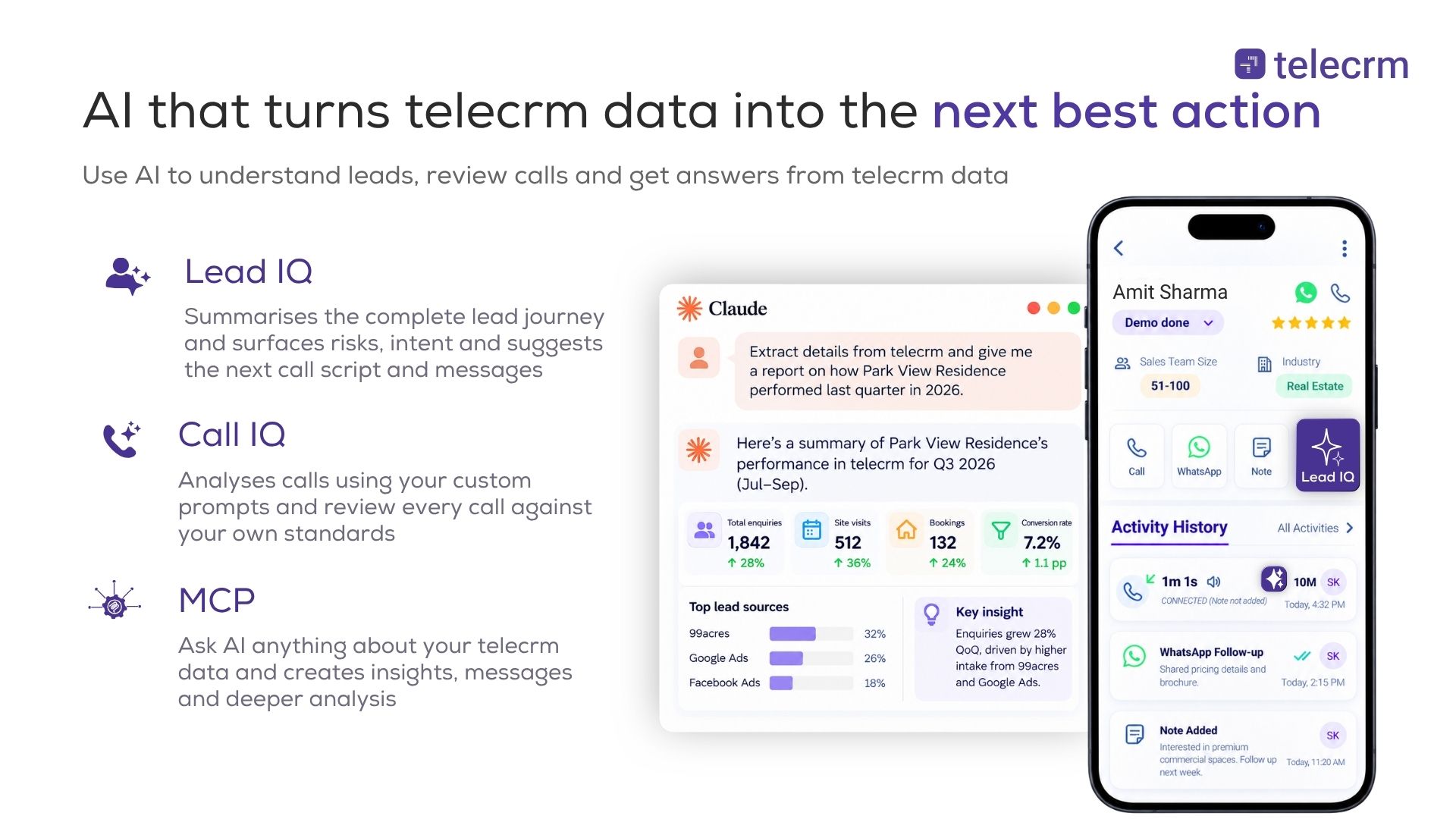
Why choose telecrm? It is well suited to businesses that want AI to understand their sales conversations, lead journeys and business data while supporting their unique workflows.
Best for: Enterprises with complex sales operations and advanced automation requirements.
Salesforce combines its CRM platform with Agentforce, allowing businesses to create AI agents that can work across sales processes. These agents can assist with prospect research, lead qualification, customer engagement and other configured activities using information available within Salesforce.
It also offers predictive analytics, sales forecasting and AI-assisted recommendations to help teams identify opportunities and manage their sales pipeline. Businesses can configure agents to carry out permitted tasks across connected workflows, subject to their access permissions.
Why choose Salesforce? Suitable for enterprises that need AI automation, extensive integrations and customisable sales processes.
Best for: Businesses looking to connect sales, marketing and customer engagement.
HubSpot Breeze brings AI capabilities into its customer platform to assist with prospecting, content generation and customer interactions. Its AI prospecting capabilities can help sales reps research potential customers, identify relevant contacts and prepare personalised outreach.
It also supports AI-assisted workflows across marketing and customer service, making it easier for sales and marketing teams to work with shared customer data throughout the customer lifecycle.
Why choose HubSpot? A good fit for businesses that want their marketing, sales and customer engagement activities connected within one platform.
Best for: Businesses looking for predictive analytics and AI-assisted CRM management.
Zoho CRM comes with Zia, an AI assistant that uses machine learning and predictive analytics to analyse CRM data and help teams make informed decisions. Its capabilities include predictive lead scoring, sales forecasting, anomaly detection and recommendations based on customer behaviour.
Zia also supports generative AI capabilities such as summarising records, drafting emails, creating reports and building workflows using natural language instructions.
Why choose Zoho CRM? Worth considering for businesses that need predictive insights, extensive CRM customisation and AI-assisted reporting.
Best for: Sales teams focused on lead prioritisation and pipeline efficiency.
Freshsales uses Freddy AI to analyse customer information and sales activities, helping teams identify opportunities that need attention. It offers contact scoring, deal insights and AI-assisted recommendations based on available CRM data.
Freddy AI can also highlight deals that appear to be progressing, becoming inactive or showing potential risks, helping sales representatives prioritise their activities.
Why choose Freshsales? Useful for businesses that want AI assistance with lead scoring, deal management and everyday sales productivity.
Best for: Businesses that prefer visual sales pipeline management with AI assistance.
Pipedrive combines its visual sales pipeline with an AI Sales Assistant that helps teams understand their deal activity and sales performance. It can highlight important opportunities, identify potential bottlenecks and provide suggestions based on information available in the CRM.
Its AI capabilities also support deal summaries, performance analysis and sales recommendations, helping representatives focus on opportunities that need attention.
Why choose Pipedrive? Suitable for sales-focused businesses looking for simple pipeline management with AI-powered insights.
The right AI CRM depends on where your team spends the most time and what you want AI to help with.
Before making an AI CRM investment, look beyond the number of AI features available. Consider how well the software understands your customer data, integrates with your existing sales processes, protects sensitive customer information and helps your team work more efficiently.
Also, check which AI capabilities are available in your chosen plan and whether additional usage charges apply.
Ultimately, the best AI CRM is the one that fits the way your business works and helps your team make better use of the information it already has.
AI CRM can make everyday work easier, but it isn’t a magic fix for every business problem. How well it works depends on the quality of your data, the AI capabilities available and how your team uses them.
Here are a few limitations worth considering.
If your CRM contains incomplete lead details, outdated records or missing customer interactions, AI may produce inaccurate or misleading insights. Maintaining good data quality is essential for reliable results.
AI can misinterpret customer sentiment, miss important context or suggest actions that aren’t suitable for a particular situation. Its recommendations should support human judgement, not replace it entirely.
AI-powered CRM systems process sensitive customer data, including contact information and communication histories. Businesses should check data access permissions, privacy policies and security practices before enabling AI features or third-party integrations.
Not every AI CRM can perform the same tasks. Some offer basic summaries and recommendations, while others support more advanced AI agents and automation. Certain capabilities may also require higher-tier plans or additional usage charges.
The key is to understand what your business actually needs from AI and choose a CRM that delivers those capabilities reliably, rather than paying for features you may never use.
If your team spends hours reviewing calls, understanding lead histories, preparing reports or figuring out what to do next, an AI CRM is worth considering.
But the real value isn’t in having AI for the sake of it. It’s in using the customer data you already have to make better decisions, reduce manual work and improve how your team operates.
That’s exactly what telecrm helps you do. From analysing sales calls with Call IQ and identifying the right next steps with Lead IQ to exploring business data through telecrm MCP and building custom workflows with telecrm apps, it brings AI into the work your team does every day.
Want to see what AI can do with your CRM data? Book a free demo and explore telecrm.
AI CRM is customer relationship management software that uses artificial intelligence to analyse customer data, identify patterns, automate tasks and recommend next steps. It helps businesses manage customer interactions, understand sales performance and make better decisions using information already available in their CRM.
Traditional CRM software primarily helps businesses organise customer information, track interactions and automate predefined workflows. AI CRM goes further by using technologies like machine learning, predictive analytics and generative AI to interpret data, identify opportunities and suggest actions based on customer behaviour.
Some of the best-known AI CRM tools include telecrm, Salesforce Agentforce, HubSpot Breeze, Zoho CRM with Zia, Freshsales with Freddy AI and Pipedrive. The right choice depends on your business requirements, existing sales processes, budget and the AI capabilities you need.
AI CRM can help improve sales conversions by identifying promising leads, analysing customer interactions and recommending more relevant follow-ups. It can also help sales teams spot objections, missed opportunities and gaps in their sales processes. However, actual results depend on data quality, implementation and how teams use the recommendations.
Yes, some AI-powered CRM systems can automate follow-ups through emails, messages and connected workflows. More advanced AI agents may also personalise communication based on customer data and previous interactions. However, automation capabilities vary by platform, and some systems provide recommendations rather than executing actions automatically.
Yes. Small businesses can use AI CRM software to reduce repetitive tasks, manage customer relationships and improve sales productivity without significantly increasing manual work. The key is choosing a CRM that offers relevant AI features, fits the team’s existing workflows and is affordable as the business grows.
AI CRM software can be secure when providers implement appropriate safeguards, such as access controls, encryption and data protection policies. Businesses should review how their CRM provider processes sensitive customer data, which third-party AI services can access it and whether the system meets applicable privacy and security requirements.



© Copyright 2026 telecrm.in (Flamon Cloudtech Pvt Ltd) - All Rights Reserved • Privacy Policy • T&C



© Copyright 2026 telecrm.in - All Rights Reserved • Privacy Policy • T&C