
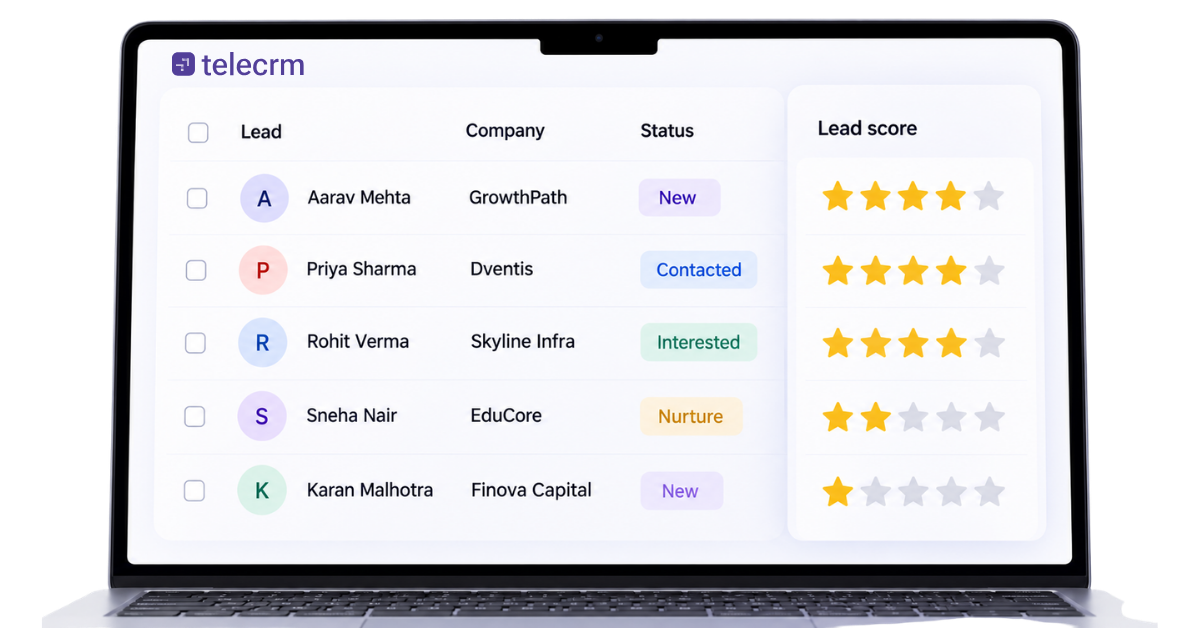
Lead scoring is all about scoring your leads. Yes, it really is just that.
Think of it like running a retail store. Twenty people walk through your front door on a busy afternoon:
If your sales clerk ignores Shopper B to pitch rain jackets to Shopper A, you lose a guaranteed sale. Lead scoring is the system that tells your team: Ignore the window shoppers and focus on the person holding their wallet.
We score prospects based on their curiosity and their intent to buy from us. We rank them based on their profile and no, we don’t get personal, but we look at their job title, company size and online behaviour to see if they fit.
The goal? Make life easy for your sales team by ranking every lead automatically, so the high-intent prospects holding their metaphorical wallets get top priority every single time.
Score leads based on who they are and how ready they are to buy.
Engagement raises priority, while poor fit or inactivity lowers it.
Predictive models can identify patterns that static rules may miss.
Its AI-powered lead management software helps capture, prioritise and route leads.
At its core, lead scoring is the methodology that turns window shoppers into clear, mathematical data. It is a point system that ranks your prospects on a numerical scale, giving your sales and marketing teams a shared language to judge how close a buyer is to the cash register.
Instead of guessing whether someone is just browsing or ready to purchase, lead scoring automatically assigns points to a prospect based on two key metrics: who they are (their job title, company size or industry fit) and what they do (visiting your pricing page, downloading a product sheet or opening marketing emails).
The total points add up to a final lead score that determines what happens next. A prospect with a low score stays with Marketing to receive more automated emails and helpful content until they show stronger interest. But the moment a prospect’s score crosses your agreed-upon threshold, they are officially recognised as a sales qualified lead.
Behind the scenes, lead scoring functions as an automated engine that connects your entire marketing and sales technology stack. It constantly pulls data from multiple platforms, tracks every digital footprint a prospect leaves behind and recalculates their priority instantly.
The process relies on three straightforward steps.
Your scoring system gathers customer data and behavioural data from every touchpoint where a prospect interacts with your brand:
Every signal gets evaluated across two dimensions using the scoring criteria to assess fit (who they are) and intent (what they do), so teams can assign points for positive signals and lower scores for negative traits.
To prevent a student from looking like a prime buyer just because they read 20 blog posts, platforms like telecrm and Salesforce Pardot use a dual rating system that combines points and stars or letter grades:
When a prospect reaches your agreed target score, for example, a 3-star fit plus 50 points, the system fires off automated actions across your tech stack and moves that prospect into the next stage of the sales process:
Quick read: Lead Response Time: How Fast Should Your Sales Team Follow-Up?
So, how do you actually spot the difference between someone casually browsing your store display and someone about to pull out their credit card? You look for the obvious green and red flags.
In the digital world, you can’t read body language or catch someone making eye contact with a cashier. Instead, you judge them by the trail of clues they leave behind — their credentials, their actions and their subtle warning signs, because lead scoring enables organisations to rank potential customers and prioritise leads more effectively.
Here are the key factors your scoring system needs to watch for to separate the most promising leads from casual browsers:
Before you spend 20 minutes pitching a product, you need to know if this person can actually make a buying decision and how demographic factors help define your target market before outreach begins. This is the explicit information they give you on a form and reviewing existing customers can reveal the shared traits your best prospects have in common.
What people do on your site is always more honest than what they write on a form. Their browsing behaviour reveals how close they are to pulling out their wallet, and behavioral data helps track where someone is in the buying process and buying cycle.
Just like a store manager knows when someone is only there to use the restroom, your scoring engine needs negative scoring rules to filter out low quality leads.
These signals tell you two different things about a lead: who they are and how they behave. That distinction matters because lead scoring works best when you evaluate both separately. This is where explicit and implicit scoring come in.
When you look at all those green and red flags, you will notice they fall into two distinct buckets: explicit data and implicit data.
Understanding the difference is what keeps you from making wild assumptions about your prospects.
Explicit data is the cold, hard information a prospect willingly hands over. They fill out a form, register for a webinar or hand you a digital business card. They tell you directly who they are like job title, company name, industry and location, etc.
This is important because it should match your ICP ( ideal customer profile ); the closer it matches, the higher you rate them. That kind of explicit scoring helps marketing and sales teams identify a marketing qualified lead before handoff.
For example, if someone fills out a form and they are the CTA at a 1000 person firm then that is high explicit value because they have the key to budget i.e. quick decision-making and that profile information helps qualify sales leads earlier in the marketing and sales process.
Implicit data is what you observe by watching how leads move through the marketing funnel based on their behaviour. It is the digital body language they don’t explicitly tell you about, but their actions reveal anyway, like website visits, a lead visiting your pricing page three times, reading multiple blog posts or watching a product demo.
This tells you their intent to buy the product. It could be sooner or later, so a prospect might never fill out a contact sales form, but if their IP address shows they spent 15 mins comparing your features page against a competitor, then that is implicit behaviour and can help you spot promising prospects even before they request sales contact.
Traditional lead scoring relies on manual rules: you and your sales team sit in a room, guess which actions matter most and assign arbitrary points like $+10$ for a PDF download or $+20$ for a pricing page visit, but implementing lead scoring is now common, with 68% of marketers use lead scoring models to prioritise leads.
While that rule-based approach works, a predictive lead scoring model powered by AI uses historical data to produce more accurate predictions and take the guesswork out of the equation.
Instead of relying on human assumptions, AI lead scoring models analyse historical data in your CRM and customer data from past deals to discover what actually causes a prospect to buy:
Uncovering hidden patterns: An AI model might reveal that prospects who read your blog and visit your integration page within three days are 400% more likely to close—a correlation a human team would easily miss.
Self-correcting point values: If a certain whitepaper stops driving actual revenue, AI automatically lowers its point value without requiring you to manually audit your scoring rules.
Predictive intent signals: Modern AI tools analyse third-party web traffic across the internet to alert your sales reps when a target account is actively researching your competitors—before they even visit your website.
Traditional lead scoring gives you a solid framework to start with, but predictive AI shows why lead scoring is important by helping teams surface the best leads and high-quality leads with more accurate predictions as buyer behaviour changes.
Building a lead scoring system doesn’t need to be complex. With the right process, you can identify high-intent leads, prioritise them and reduce manual effort. telecrm helps automate lead capture, qualification and routing so reps know who to follow up with first. Here’s how to set it up:
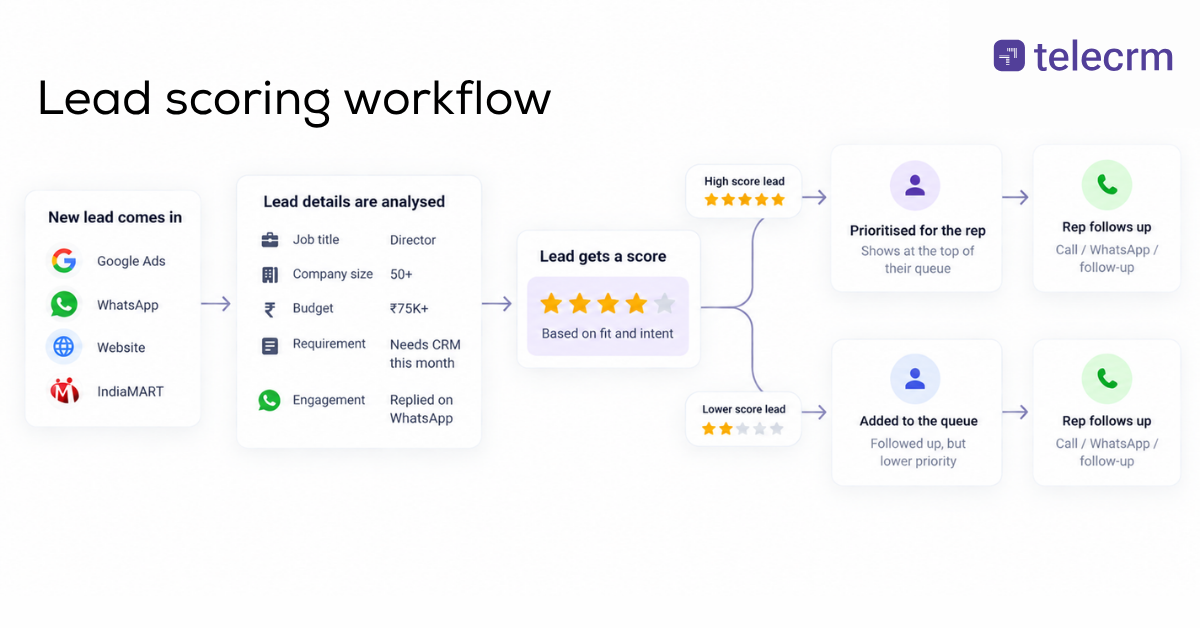
You can’t score a prospect if you don’t even know they’re looking in your window. The first step is consolidating every inbound lead source into one central hub, so all leads generated are visible in one place and you get a clearer view of potential customers.
Using telecrm’s auto-lead capture, you can plug in your website forms, Facebook and Google Ads, WhatsApp inquiries and incoming call logs. The moment a prospect raises their hand anywhere across your digital touchpoints, their profile is instantly created, which is often then managed through lead scoring software connected to marketing automation.
Once your leads are flowing into one place, this step defines the scoring process and the specific criteria used to qualify leads. Inside telecrm, you can create custom fields and custom pipeline stages that map directly to your ideal customer profile.
Skip the confusing point math and keep things simple with a visual star rating system right on your dashboard:
This is where the real payoff happens. Setting up thresholds inside telecrm turns static scores into immediate sales actions:
A lead scoring model is never a “set it and forget it” system. You need to continuously test whether high-scoring leads are actually turning into closed deals.
With telecrm’s call recording and tracking features, managers can review actual sales calls, analyse conversion reports by lead source and see where prospects drop off. If sales reps report that leads marked “Hot” are turning out to be cold window shoppers, you can quickly log into telecrm, adjust your point values and fine-tune your scoring threshold.
Related read: Automated lead scoring blueprint: Sort leads like a pro
Lead scoring should be a fundamental strategy that dictates how fast your business can scale because speed to lead is everything. When you treat every lead like a top priority, you don’t give better service — you just burn out your sales team on people who have no interest in buying your product.
A smart lead scoring system transforms your entire business by improving marketing alignment between marketing and sales teams, multiplying your team’s output without adding headcount and turning messy lead lists into a predictable output.
With telecrm you can automatically capture leads from every channel, instantly surface promising leads and potential customers sooner and route them to your best reps in seconds so teams can focus on the best leads. Stop letting ready buyers slip through the cracks while your team calls casual window shoppers — schedule a demo with telecrm today and build a high-converting sales system that scales with you.
A lead score is calculated by assigning values to different fit and intent signals, then adding or subtracting points based on the lead’s profile and behaviour. For example, matching your target company size may add points, while inactivity or poor fit may reduce them.
There is no universal good lead score. A good score depends on your scoring model, sales process and conversion history. The important part is setting a threshold that reliably separates high-priority leads from lower-priority ones.
Lead scoring usually looks at two things: fit and intent. Fit includes details like job title, company size, industry, location and budget, while intent includes actions such as demo requests, pricing page visits, WhatsApp replies, calls and other engagement signals.
Suppose a lead is a decision-maker at a 50-person company, has a suitable budget and wants to buy this month. They may receive a high score. Another lead with a poor fit and little engagement may receive a much lower score and be followed up later.
A CRM can collect lead information and engagement data, apply scoring rules and rank leads based on their priority. High-scoring leads can appear higher in the rep’s queue so the team knows who to contact first.
Lead scoring ranks leads based on how promising they are, while lead qualification determines whether a lead is actually a suitable sales opportunity. Scoring helps prioritise leads, while qualification helps decide whether they should move further in the sales process.
Predictive lead scoring uses historical CRM and conversion data to identify patterns associated with successful deals. Instead of relying only on manually assigned rules, it uses data to estimate which leads are more likely to convert.
Yes. A CRM or lead management system like telecrm can automatically update scores based on lead details, activities and engagement. This helps sales teams prioritise leads without manually reviewing every record.



© Copyright 2026 telecrm.in (Flamon Cloudtech Pvt Ltd) - All Rights Reserved • Privacy Policy • T&C



© Copyright 2026 telecrm.in - All Rights Reserved • Privacy Policy • T&C