
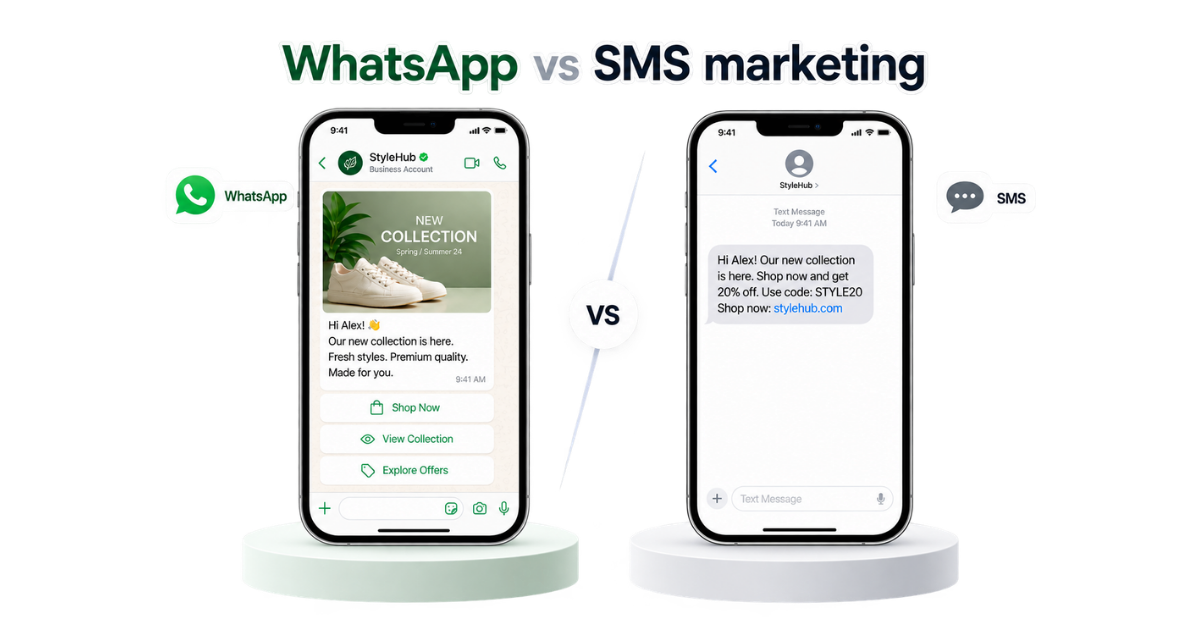
For years, SMS was the default way for businesses to reach customers on their mobile phones. It was simple, direct and could work without a mobile internet connection.
Then WhatsApp changed what business communication could look like. Instead of limiting communication to standard text messages, businesses can use WhatsApp to send media, interactive messages, product information and continue conversations with customers.
That is why WhatsApp vs SMS marketing is no longer just a question of which channel sends messages faster. It is about what you want those messages to achieve.
Do you need to send short, time-sensitive messages to mobile numbers without depending on mobile data? SMS can be useful. Or do you want to run WhatsApp marketing campaigns that allow customers to reply, explore products, tap buttons and continue the conversation? WhatsApp offers significantly more interactive messaging options.
In this guide, we will compare SMS and WhatsApp across reach, messaging experience, pricing, compliance, use cases and customer conversations so you can decide which channel fits your business.
SMS marketing is the use of text messages to communicate with customers and prospects for promotions, updates, reminders and other marketing purposes.
Businesses typically use SMS to send short, direct messages such as offers, discount codes, product announcements, appointment reminders, order updates and event notifications. For example, a business might use SMS marketing to:
SMS marketing is usually more broadcast-oriented than conversational. The main goal is often to get the customer to take a specific action, such as clicking a link, using a coupon or visiting a store.
In simple terms, SMS marketing means using text messages to reach customers quickly with short, timely and action-focused communication.
WhatsApp marketing is the use of WhatsApp to communicate with potential and existing customers for marketing, sales and customer engagement.
Businesses use it to send messages such as product updates, offers, reminders, recommendations and follow-ups, as well as to have one-to-one conversations with interested customers.
Unlike channels that mainly broadcast messages, WhatsApp marketing can be two-way and conversational. A customer can receive a message, reply immediately, ask a question and continue the conversation with a salesperson or an automated system. For example, a business might use WhatsApp marketing to:
In simple terms, WhatsApp marketing means using WhatsApp to reach, engage, nurture and convert customers through messages and conversations.
The main difference between WhatsApp marketing and SMS marketing is the type of communication experience each channel provides.
SMS is built for short, direct and time-sensitive communication, while WhatsApp is better suited to richer, more interactive customer conversations where businesses may need to share more information, collect responses or continue the conversation.
Factor | WhatsApp marketing | SMS marketing |
Internet requirement | Requires an internet connection or mobile data | Works without internet |
Device reach | Requires WhatsApp on a compatible mobile device | Can reach smartphones and feature phones |
Message format | Supports text, images, videos, documents, rich media and interactive buttons | Primarily text-based |
Customer interaction | Supports two-way conversations and ongoing customer interactions | Better suited to short, action-focused messages |
Message detail | Suitable for more detailed and engaging messages | Better for brief communication |
Urgency | Better when interaction and context are important | Useful for urgent alerts and time-sensitive communications |
Customer engagement | Offers more interactive features for engaging customers | Provides a simpler messaging experience |
Automation | WhatsApp Business API can support automated conversations, workflows and CRM integration | SMS platforms can automate bulk SMS, transactional SMS and alerts |
Typical use cases | Lead nurturing, sales conversations, customer support and WhatsApp marketing campaigns | Appointment reminders, delivery notifications, fraud alerts, emergency alerts and promotional messages |
Also read: WhatsApp Business API Pricing Decoded (2026)
Consider these factors before choosing the right channel for your business:
For many businesses, the choice does not have to be WhatsApp vs SMS. The two communication channels solve different problems, so using them together can create a more reliable messaging strategy.
Instead of making every message fit one channel, businesses can combine SMS and WhatsApp based on reach, urgency and the level of interaction required. WhatsApp can support deeper customer interactions, while SMS remains useful when businesses need simple, direct communication with fewer dependencies.
Also read: WhatsApp vs Email Lead Nurturing: Which Drives Better Sales Results in 2026?
Here is a practical decision matrix:
Scenario | Recommended channel | Why |
Flash sales and promotional offers | WhatsApp first; SMS where appropriate | WhatsApp supports media, buttons and richer promotional messages |
Lead follow-up | WhatsApp + calls | Customers can reply and continue the conversation |
Product discovery | WhatsApp | Catalogues and product messages can be shared in-chat |
Post-purchase onboarding | WhatsApp | Documents, instructions and media can be shared |
Short payment reminder | WhatsApp or SMS | Choose based on customer preference and reach |
Delivery update | SMS or WhatsApp utility message | Both can support short transactional communication |
OTP/authentication | SMS or WhatsApp authentication | WhatsApp officially supports authentication messages |
Appointment reminder | WhatsApp with SMS fallback where needed | WhatsApp allows interaction; SMS reduces dependency on mobile data |
Critical short notification | SMS can be useful | Does not require the recipient to use WhatsApp |
WhatsApp officially supports marketing, utility, authentication and service messages, so the channel can cover much more than promotional marketing alone.
The major advantage of WhatsApp is not a universal percentage increase in open rates or conversions. It is the number of actions a customer can take inside the conversation. Meta allows businesses to use interactive reply buttons, meaning a customer can respond using predefined choices instead of typing a reply manually.
Businesses can also use interactive list messages, allowing customers to select from organised options inside WhatsApp. For commerce use cases, Meta supports multi-product messages, allowing products from a catalogue to appear inside the conversation. This makes WhatsApp useful when a customer journey requires more than simply reading a notification.
A lead can:
For sales teams, that makes WhatsApp particularly useful for lead qualification, counselling, property enquiries, admissions, financial-product discussions and other workflows where conversation matters.
WhatsApp’s richer experience does not eliminate the need for SMS. It still remains useful in situations where the message needs to reach a mobile number without requiring the recipient to actively use WhatsApp or have mobile internet available.
For many businesses, the question therefore is not whether SMS is outdated. It is where SMS fits better than WhatsApp in the customer journey.
Compliance is especially important when running WhatsApp marketing or bulk SMS campaigns.
Commercial SMS in India is governed by TRAI’s telecom commercial communications framework. According to TRAI’s guidance for senders, Principal Entities using telecom resources for bulk communication are required to complete applicable regulatory requirements including:
TRAI also states that commercial communication must use registered headers and requires senders to register content templates. For commercial communications requiring customer consent, TRAI states that businesses must acquire customer consent through the registered consent framework.
Meta states that businesses are required to obtain opt-in before messaging people on WhatsApp. Businesses also need to understand the WhatsApp customer service window.
Meta states that template messages are the message type used outside the customer service window, while customer-initiated conversations open a 24-hour service window. WhatsApp templates can contain text, media and interactive components, depending on the template and message type.
Regardless of channel:
For SMS in India, follow TRAI’s sender requirements. For WhatsApp, follow Meta’s WhatsApp opt-in requirements.
With telecrm ( a WhatsApp CRM), businesses can manage WhatsApp marketing conversations alongside the leads they generate, instead of keeping messaging and customer data in separate tools.
Teams can send WhatsApp templates, media and automated follow-ups, manage ongoing customer conversations and keep every interaction connected to the relevant lead. This makes it easier to nurture enquiries over WhatsApp while keeping the complete context available for future communication.
telecrm also supports SMS messaging when a simple text message is more suitable. And when a prospect shows interest, the same lead can be assigned to a salesperson, followed up through calls or messages and tracked through the sales pipeline.
This helps businesses connect WhatsApp marketing with lead management and follow-up, rather than treating every campaign or conversation as an isolated interaction.
Also read: WhatsApp Broadcast: How it Works, Limits and Best Practices
WhatsApp and SMS both have a place in business communication, but they serve different purposes. SMS works well for short, direct and time-sensitive messages, while WhatsApp is better suited for richer, interactive and ongoing customer conversations.
For businesses that want to make WhatsApp a stronger part of their marketing strategy, telecrm helps manage conversations, templates, media and automated follow-ups while keeping every interaction connected to the relevant lead. It also supports SMS messaging when a simple text is more appropriate.
This gives teams a more connected way to manage customer communication and move interested prospects into the sales process without losing context. If you want to see how calls, WhatsApp and lead follow-ups can work together for your sales team, book a live demo with telecrm.
Do not make the decision only on per-message price.
SMS can be useful when you need short, high-volume text communication without depending on mobile internet.
WhatsApp may make more sense when every lead is valuable and the sales process requires customers to reply, explore products, ask questions or interact with buttons.
The right way to decide is to compare cost per qualified lead or cost per sale, not simply cost per message.
Businesses can use WhatsApp for business messaging, but they must follow Meta’s policies.
Meta states that businesses must obtain opt-in before messaging people on WhatsApp. Business-initiated messaging outside the applicable customer service window uses approved message templates.
Avoid tools that bypass official WhatsApp systems or attempt to imitate normal WhatsApp devices for bulk sending.
For more details, read our guide on how to send bulk messages on WhatsApp.
Start with four questions:
If the customer is opted in and the interaction requires a conversation, WhatsApp is often the more practical option.
If mobile-data availability cannot be assumed or you only need to send a short notification, SMS may make more sense.
It can if you send the same message repeatedly across both channels.
Instead, give each channel a defined role.
For example, use WhatsApp for detailed conversations and interactive communication, while reserving SMS for selected alerts, authentication or fallback messages.
That keeps the experience coordinated instead of repetitive.
Yes.
The WhatsApp Business Platform officially includes authentication messages, which allow businesses to use one-time passwords for identity verification. (WhatsApp for Business)
Whether WhatsApp or SMS should be used for a particular authentication flow depends on the business’s technical setup, customer reach and applicable requirements.
Not for every message.
When a customer messages a business, Meta opens a 24-hour customer service window during which the business can respond with service messages.
Outside that customer service window, template messages are required. (Facebook Developers)
Not necessarily.
When communication is integrated with your CRM, the same sales team can manage calls, WhatsApp conversations, SMS activity and follow-ups around a single lead record.
That makes the decision less about maintaining separate channel teams and more about choosing the right communication channel at each stage of the customer journey.


© Copyright 2026 telecrm.in (Flamon Cloudtech Pvt Ltd) - All Rights Reserved • Privacy Policy • T&C



© Copyright 2026 telecrm.in - All Rights Reserved • Privacy Policy • T&C