
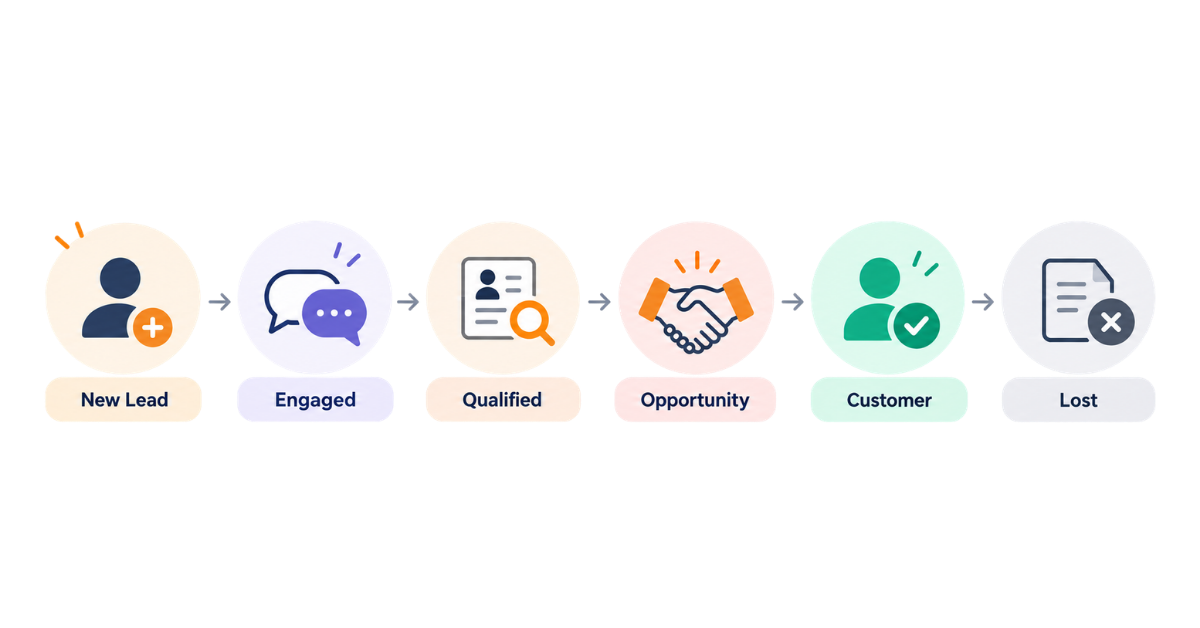
Every lead moves through different stages before becoming a customer.
They may start as someone who has just shown interest, move into an active conversation and eventually become ready to buy. These stages are called lead stages. They help you understand where each prospect stands in the buying journey, what should happen next and which leads need the most attention.
Without clear lead stages, your sales funnel can quickly become messy. Your team may not know which leads need a follow-up, which ones are genuinely interested and which ones are unlikely to convert.
In this guide, we’ll break down the most common lead stages, how they work and how to build a lead stage process that makes your sales cycle easier to manage.
While exact names vary depending on your industry, every effective sales pipeline follows the same logical progression. Here are the six most common stages leads move through on their way to becoming paying customers:
This is a person who has just entered your system. Maybe they filled out a form, downloaded a guide or subscribed to your newsletter — basically showing initial interest in the product or service you offer. They have voluntarily provided their contact details, but their exact intent to buy or ability to afford what you’re selling has not been confirmed yet.
This is usually the awareness stage of the buyer’s journey. Your lead generation efforts, such as paid ads, social media, content marketing, a landing page or lead magnets, may have attracted their attention and brought them in.
Related Read: 8 Proven Lead Capture Methods to Double Your Conversions
At this stage, the contact starts showing repeated, active interest rather than just a one-time click. They might be opening multiple emails, browsing your service or pricing pages or replying to an initial follow-up. They have moved from a passive name on a list to an active prospect who is exploring what you have to offer.
You could think of this as the interest stage or early consideration stage. They are not ready to buy immediately, but they are paying attention.
This is where you double-check whether they are a real fit for your business. Either through a quick phone call, a detailed form response or a brief chat, you confirm that they actually have a problem you can solve, a realistic timeline and the budget to buy.
They are not just curious — they are genuine potential buyers. Your qualification criteria will vary depending on your business. Some teams may also use lead scoring to separate high-intent leads from unqualified leads.
At this stage, you’ve had your meeting, presented your solution and handed over a proposal or quote. The deal is officially on the table. They are actively evaluating your offer, discussing prices with their team or comparing you with other choices. Their purchase decision is getting closer, but there may still be questions, concerns or internal decision making involved.
Good objection handling can play a significant role here because this is often the point where promising opportunities either move forward or stall.
They said yes!
The deal is signed, the invoice is paid and the journey is a success. They move out of the sales pipeline and officially become a paying customer. But converting leads is not where the relationship ends.
A smooth handover, strong customer experience and good customer success can help turn new buyers into loyal customers, happy clients and even returning customers.
Not every prospect turns into a sale. This stage is for people who realised they did not have the budget, chose another option or simply stopped responding.
Some of these leads may have been strong opportunities, while others may have been unqualified from the beginning.
Tracking why leads are lost can also reveal weak points in your funnel and help improve conversion rates over time. People often mix up these three terms, but they actually track completely different things in your business.
Here is the simplest way to understand the difference:
Feature | Lead stage | Lead status | Sales pipeline stage |
Main focus | The person or business | The daily activity | The actual deal or revenue |
Viewpoint | Big-picture customer journey | Small daily check-in | Step-by-step business deal |
Who handles it? | Marketing and sales together | The sales representative | The sales manager or owner |
How it moves | Step-by-step forward | Moves back and forth frequently | Step-by-step forward to win or lose |
Examples | New lead, serious buyer, customer | Called, busy, call back later | Meeting done, quote sent, final discussion |
Without clear lead stages, running your sales process is like working with a messy stack of paper, you have to read every sheet just to remember who to call today and who was already called yesterday. Here is why setting up defined lead stages is essential for your business:
If your sales team spends all day calling people who just downloaded a free guide or filled out a form by mistake, they waste valuable time. Lead stages show your sales representatives exactly who is serious so they can focus on high-intent leads first.
Instead of treating every lead equally, your team can spend more time on the people most likely to convert.
Without clear stages, contacts easily get forgotten in spreadsheets, phone logs or notebooks. Assigning a stage to every lead makes it easy to see who needs a callback, who is waiting for a price quote and who needs a gentle follow-up.
That becomes even more important as your lead quantity grows and your team starts handling more leads at the same time.
Marketing teams often focus on generating as many enquiries as possible, while sales teams want people who are actually ready to buy. Lead stages create a shared agreement on when an enquiry is qualified enough to be handed over to sales.
This also helps marketing understand whether its funnel strategies are attracting the right audience, rather than simply generating more leads.
Organising leads by stage gives you a more realistic view of expected sales. For example, if you have 10 prospects sitting in the final proposal stage, you can roughly estimate how many may close and how much revenue could come in that month.
Over time, tracking key metrics such as stage-wise conversion rates can make these estimates even more useful.
Tracking stages reveals where people drop out of your process. If many leads complete an initial call but very few ask for a price quote, you know exactly where to look for problems in your pitch, offer or follow-up.
These insights help you understand your funnel performance and find weak points before they start affecting business growth.
Creating lead stages does not have to be complicated. You do not need a 10-step model to get started. You just need a simple, logical path that matches how your buyers actually make decisions. Here is a straightforward, step-by-step way to set up lead stages for your business:
Sit down with your sales team and trace a recent customer’s journey from their very first enquiry to their final payment. Ask simple questions:
Write down these main milestones. These real-world steps form the blueprint for your stages and should reflect the actual buying process, not what you think the process should look like.
A common mistake is creating too many stages, such as 10 or 12, which confuses your team and leads to messy data. Stick to 4 to 6 core stages. For most businesses, this simple setup works well:
The goal is not to create more stages. It is to make it easy for your team to understand exactly where each lead stands.
To stop your team from guessing, establish one clear action or trigger that moves a lead from one stage to the next.
If everyone uses the same rules, your stage data stays reliable. It also becomes easier to compare conversion rates and understand how effectively your team is converting leads.
Avoid confusion by deciding exactly who handles the lead at each point:
For a small team, the same person may handle several stages. That is completely fine as long as ownership is clear.
Your sales process will evolve over time. Once a month, review your lead flow with your team:
Keep refining until the movement feels smooth and natural for everyone involved. This can help improve conversion rates, reduce wasted effort and support long-term business growth.
Keep in mind that while this framework gives you a solid foundation, every industry moves a little differently.
A real estate firm, B2B software company, education consultancy and manufacturing business will each have their own checkpoints and milestones.
The good news is that you do not have to manage all of this manually in messy spreadsheets.
With CRM system like telecrm, you can customise lead stages to match your exact business process, set up automatic follow-up reminders and keep your entire sales team aligned — book a demo so no valuable lead falls through the cracks.
A simple lead stage structure can include New Lead, Engaged, Qualified, Opportunity, Customer and Lost.
For most businesses, 4 to 6 core lead stages are enough. Too many stages can make the sales process harder to manage and lead to inconsistent data.
A lead should move to the next stage only after a clear action or condition is met, such as responding to a conversation, meeting qualification criteria or receiving a proposal.
A qualified lead is a prospect who matches your business’s qualification criteria, such as having the right requirement, budget, timeline or buying intent.
Lost leads should be moved out of the active sales pipeline and tagged with a clear reason, such as budget, timing, no response or choosing another option.
Yes. Lead stages should reflect your actual sales cycle, so different businesses may use different stages depending on how their customers make buying decisions. Tools like telecrm will help you do that



© Copyright 2026 telecrm.in (Flamon Cloudtech Pvt Ltd) - All Rights Reserved • Privacy Policy • T&C



© Copyright 2025 telecrm.in - All Rights Reserved • Privacy Policy • T&C