
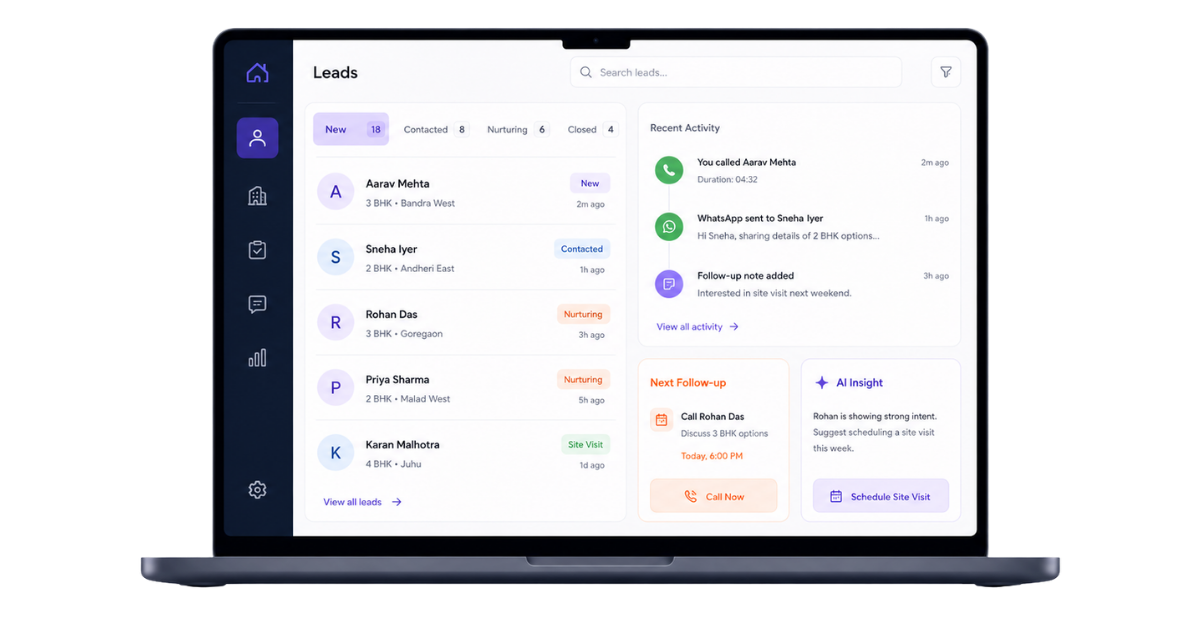
Real estate lead nurturing is one of the tougher things to get right in sales. The cycle runs for months, sometimes longer, and for most of that time the buyer is not doing anything visible.
So a natural habit sets in. Every new enquiry gets attention, because it is fresh and it might be the one. The older ones get a call now and then, whenever someone remembers. This is what happens when follow-up depends on memory rather than a system.
And it works, up to a point. You close deals that way but it’s not scalable.
An effective lead nurturing system is what makes that follow-up systematic instead of occasional. Get it right and the economics of everything upstream change. Same ad spend, same portal subscriptions, same leads, more site visits, because you stop losing the ones you have already paid for.
This article covers why real estate leads go cold, eight strategies to keep them warm through the full buying process, and how AI is changing what a nurturing team can realistically do.
Real estate lead nurturing is the process of staying in structured contact with potential buyers from their first enquiry until they book. It involves qualifying the lead, following up over calls and WhatsApp at planned intervals, sharing information that helps them decide and keeping the relationship warm across a buying process that usually runs for months.
What makes it harder in real estate is the length and the silence. A buyer can be genuinely interested and still be months away from a decision, with long stretches where they do nothing you can see. During that time they are usually in conversation with several other projects. There is no signal telling you whether a quiet lead is still deciding or has already booked elsewhere, which is why nurturing here has to run on a system rather than on judgement.
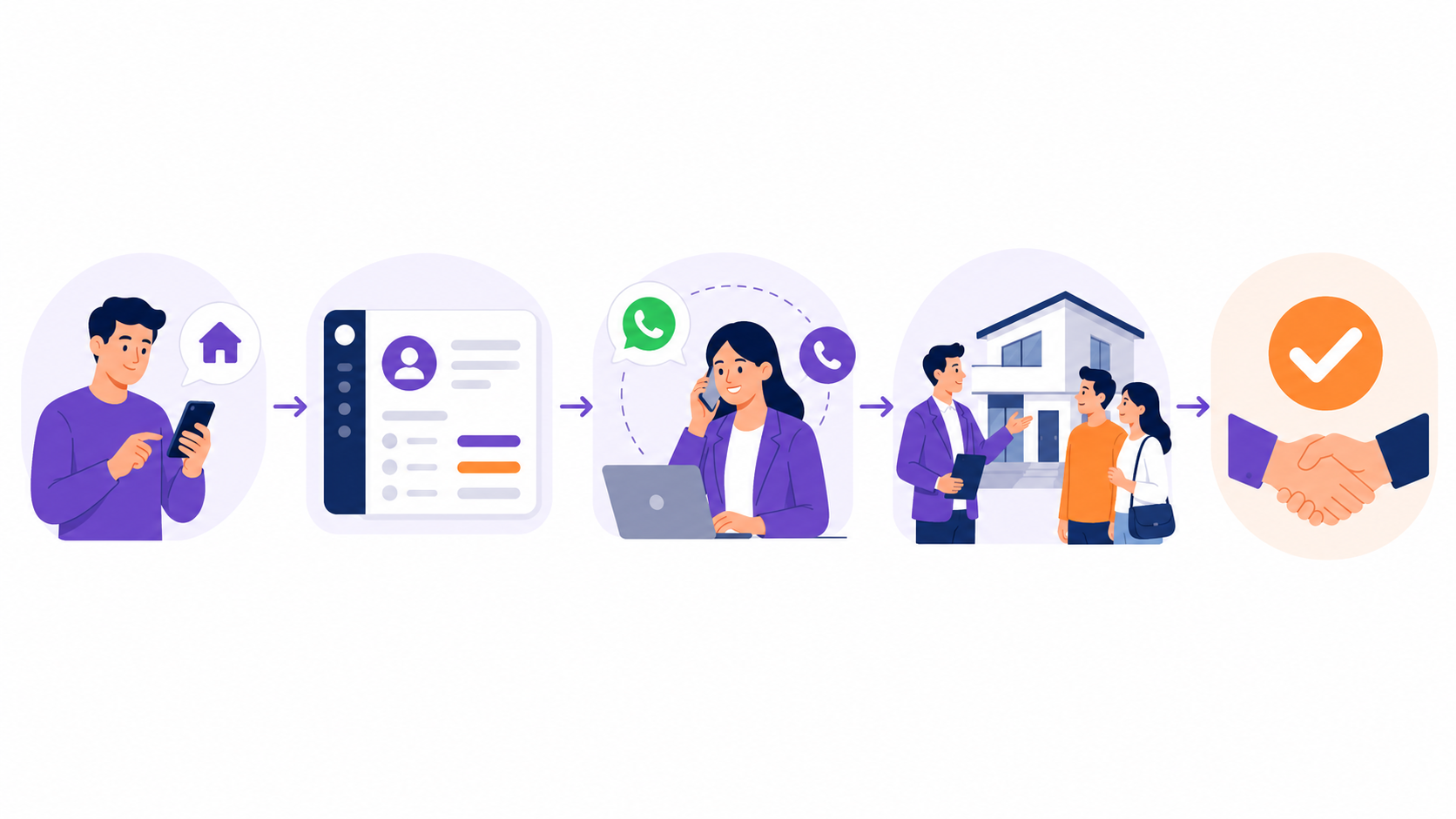
Leads rarely die for dramatic reasons. They cool off in small, ordinary ways that are hard to notice while they are happening. Here are the five that account for most of it.
A buyer enquiring on 99acres, MagicBricks or Housing is rarely enquiring with you alone. The same lead often reaches several projects at once, and portal leads are frequently shared outright. Whoever calls first gets to shape the conversation. Everyone else is arguing with an impression that has already formed.
The problem is that enquiries do not arrive during working hours. They arrive at 9pm on a Tuesday, and by the time someone opens the list the next morning, the buyer has already spoken to two other agents.
A lead does not answer the first call. Or the second. It gets marked as not interested and drops off the list.
But a missed call means very little. The buyer was in a meeting, driving, or screening an unknown number. Most real conversations start well after the first attempt, and the leads that need the most persistence are often the ones with the longest timelines, which is to say the serious ones.
A buyer with finance arranged and a three-month timeline is being handled exactly like someone who clicked an ad out of curiosity. Both get the same calls, the same messages, the same effort.
The serious buyer does not get the attention the decision deserves. The casual one absorbs hours that should have gone elsewhere. It is a manual follow up problem dressed up as a lead quality problem.
This is the most expensive gap of the five. A buyer visits, spends an hour walking the project, says they will discuss it with family, and then nothing happens.
A site visit is the strongest signal of intent you will ever get. It costs the buyer a Sunday. Yet post-visit follow-up is usually the least structured part of the process, because the visit itself feels like progress, and everyone moves on to the next enquiry.
Most teams do send messages. The problem is what is in them.
A buyer who asked about a 2BHK in a specific location receives the same forwarded brochure everyone else gets, then the same festive greeting, then the same project post. Nothing in any of it references what they asked about, the budget they mentioned or the visit they already did. Buyers recognise a broadcast instantly, and once they do, they stop opening them.
Everything below works with the lead volume you already have. None of it requires more ad spend. What it does require is a system underneath, because most of these strategies fall apart when they depend on someone remembering to do them. Each one ends with what your CRM needs to support it.
Immediate follow-up within 5 minutes significantly boosts engagement rates and conversions.
The moment an enquiry lands, the buyer should get a WhatsApp acknowledgement. Project name, location, price range, and a line saying someone will call shortly. It works at 11pm on a Sunday, which is when a good share of enquiries arrive. It also puts your name in their WhatsApp before anyone else’s, so when four projects call the next morning, yours is the one they recognise.
Then get a call out fast. A lead sitting unassigned for three hours is a lead nobody owns, and the right moment to reach a buyer is usually the hour they enquired.
What this needs from your system. Automatic lead capture from portals, ad platforms and your website, so contact details never have to be downloaded and uploaded by hand. Instant assignment on arrival, and a WhatsApp message that triggers the moment the lead lands.
The mistake to avoid: letting the automated message be the whole response. It buys time, it does not replace the conversation.
Treating every enquiry equally is how serious buyers get under-served while casual ones absorb the day. Four questions tell you most of what you need:
The point is not to disqualify people. It is to separate quality leads from casual enquiries so your effort matches the intent. A warm lead with finance in place needs a site visit slot this week. Someone buying next year needs to hear from you every few weeks and nothing more.
What this needs from your system. Custom lead fields for budget, timeline, purpose and stage, so answers sit on the lead record. The rep handling this buyer in month four is rarely the one who spoke to them in week one.
The mistake to avoid: turning qualification into an interrogation on the first call. Two or three questions, the rest picked up as you go.
Read More: 9 Best Real Estate CRM in 2026
A portal enquiry and a referral from a past buyer are not the same asset, and working both the same way wastes effort on one and under-serves the other.
| Source | What to expect | How to approach it |
|---|---|---|
| Portal leads | High volume, low intent, often shared with competitors | Speed matters most. Qualify fast, expect a low contact rate |
| Facebook ad and Google leads | Curious rather than committed, quality varies by campaign | Nurture patiently. Prospects need 12-18 months before they’re ready to buy |
| Website enquiries | Warmer, they found you deliberately | Higher intent, worth a faster and more personal response |
| Referrals and past clients | Highest conversion of any source | Handle personally, these deserve your most experienced person |
| Walk-ins and expos | Already in market and actively looking | Move to a site visit quickly, the window is short |
| Channel partner leads | Vary widely by partner | Track conversion by partner, not just volume |
Segmenting leads improves the relevance of everything you send them, and relevance decides whether a message gets opened. It also makes your reporting honest, because you start seeing which sources produce bookings rather than which produce enquiries.
What this needs from your system. Source captured automatically on every lead, and reporting that shows conversion by source through the sales funnel to site visit and booking.
The mistake to avoid: judging a source on cost per lead. A portal delivering cheap leads nobody can reach is more expensive than a campaign delivering half the volume and twice the site visits.
Most follow-up failures are memory problems, not effort problems. A rep handling 80 live leads cannot hold in their head who was called when and who went quiet after a visit. A cadence decides that in advance.
| Stage | Timing | What happens |
|---|---|---|
| First contact | 0 to 5 minutes | WhatsApp acknowledgement, then a call attempt |
| Qualification | Day 1 to 3 | Up to five attempts, alternating calls and messages |
| Site visit ask | Day 3 to 7 | Project details, walkthrough video, a specific slot offered |
| Warm hold | Week 2 to 4 | One touch a week for buyers interested but not ready |
| Long nurture | Month 2 to 6 | One touch a fortnight, plus an occasional check-in call |
What to send during the warm hold and long nurture. A buyer months away from deciding does not want a sales message every week, but they will read something useful. Market updates on their preferred location, property values and how they have moved, possession timelines, loan eligibility and documentation guides, RERA explainers. Educational content helps build trust and assists buyers in their decision-making, which is what keeps you in the conversation across an extended period without chasing.
Testimonials and success stories build instant credibility with leads who have never met you. A note about a family who bought in the same project does more than another brochure. Agents should do this for five to seven leads daily.
What this needs from your system. Follow-up reminders on every lead, sequences that run by stage, and sequences that stop the moment a buyer replies. Run manually, a cadence like this survives about three weeks before it becomes whoever someone remembers to call.
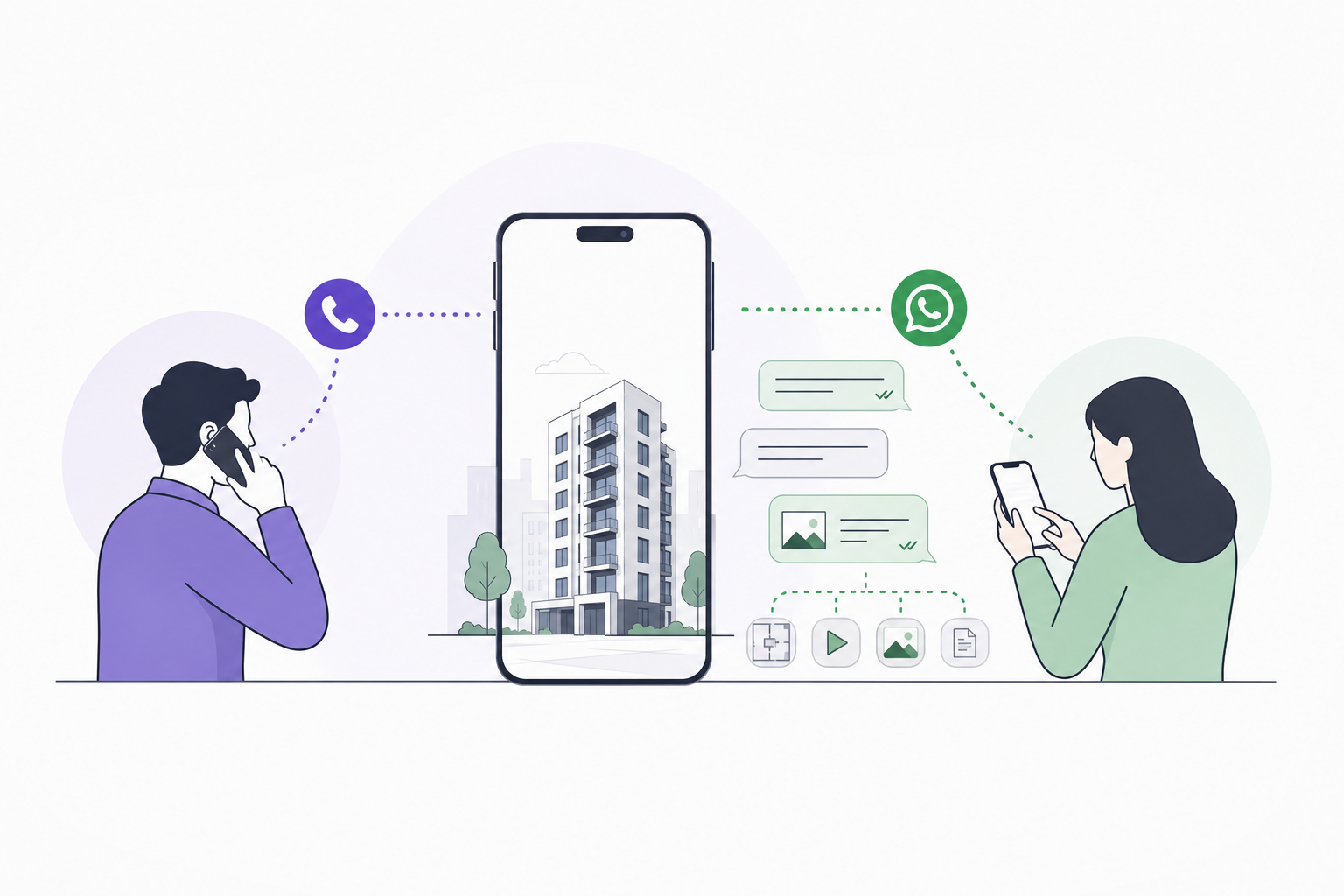
Phone calls are where the selling happens. Qualification, objections and the site visit ask all need a conversation. But plenty of buyers will not answer an unknown number, which makes those leads invisible to a team that only dials.
WhatsApp gets read and keeps you present between calls without demanding anything. It will rarely close a site visit on its own, because a message cannot handle an objection.
Used together, each covers the other’s gap:
Staying visible between conversations helps too. Agents active on social media platforms like Instagram give a buyer somewhere to check them out during the months they are deciding, through project walkthroughs and handover posts.
What this needs from your system. Calling and WhatsApp in one place, with every call recording and message saved against the lead. Nurturing history spread across personal phones disappears when a rep leaves, and relationship building starts from zero on a lead you already paid for.
The mistake to avoid: using WhatsApp only to broadcast. Four forwards and no personal message, and you have burnt the one channel they actually check.
The most valuable leads in most pipelines are people who have visited and not yet decided. They are also the most neglected, because the visit feels like an achievement and attention moves to the next enquiry.
A site visit costs a buyer their Sunday. Nobody does that casually. The week after is where the booking is won:
If they go quiet, they move to long nurture rather than off the list. A buyer who visited and did not book is often three months from a decision, not out of the market.
What this needs from your system. A pipeline stage for visited leads, so the sequence above starts automatically when the stage changes rather than depending on a rep to remember.
The mistake to avoid: reading silence as rejection. Most buyers go quiet because they are discussing it at home or waiting on a loan.
Every real estate business is sitting on thousands of old enquiries nobody has touched. Some are genuinely dead. But many of those people have not bought yet, and you already paid to acquire every one of them.
Split the list first, because these groups need different messages:
Then give each group a reason to reply that is not “just checking in”. Old leads respond to news: new inventory in a different band, a project nearing possession, a revised payment plan, a launch where they were originally looking. Reference what they enquired about, because a generic broadcast gets ignored.
Expect most of the list to stay silent. Surfacing even a handful of live buyers costs almost nothing against acquisition spend you have already committed.
What this needs from your system. Filters by source, stage, last activity and enquiry details, plus the ability to run WhatsApp campaigns against those segments without exporting to a spreadsheet. Replies must land back on the original lead record.
The mistake to avoid: blasting the whole database with one message. It performs badly, burns the list and puts your WhatsApp number at risk.
Read More: 31 Real Estate Marketing Tools for Agents and Brokers [2026]
Most reporting stops at leads generated and deals closed. Everything interesting happens in between.
| Metric | What it tells you |
|---|---|
| First response time | Whether speed is costing you leads before the conversation starts |
| Contact rate | How many enquiries you reach at all |
| Attempts per lead | Whether your team gives up too early |
| Lead to site visit | Whether qualification and the site visit ask are working |
| Site visit to booking | Whether post-visit follow-up exists in practice |
| Cost per site visit | What you actually pay for a buyer who shows up |
Read them in sequence. A low contact rate with slow response is a speed problem. A healthy contact rate with poor lead-to-visit numbers means the conversation is happening but not converting. Strong visits with weak bookings points at the week after the visit.
Cost per site visit is worth adopting deliberately. A source producing leads at ₹150 that nobody can reach costs more than one at ₹400 that fills your visit calendar.
What this needs from your system. Automatic call and message logging so response times record themselves, stage tracking through to booking, and source-wise reporting that builds on its own. A report that takes two days to assemble is a report nobody reads.
The mistake to avoid: reviewing monthly. Response time and contact rate drift fast and correct fast, so watch them weekly. Improving conversion rates is an ongoing process, not a quarterly review.
AI is being integrated rapidly across industries and processes, and the real estate industry is no different. It is already running qualification calls, drafting follow-ups and reading through months of lead history in seconds for teams that have adopted it.
For lead nurturing specifically, two uses have proven genuinely useful. Everything else is largely still marketing.
Every call and WhatsApp exchange your real estate agents have is information about what works. Which objections come up on which projects. What answer moves a buyer towards a site visit. What gets said in conversations that end in a booking, and what gets said in the ones that go quiet.
Most of it sits unused, in call recordings nobody replays and chat threads nobody reads back.
AI reads across those lead interactions and turns them into something a rep can use on the next call. It surfaces what this specific buyer has already asked about, what stage they are at, what worked with similar buyers, and what to say or send next. Personalised recommendations based on a buyer’s behaviour improve the likelihood of conversion, because the rep is not working from a generic script.
The effect on a sales floor is straightforward. Instead of every rep learning by trial and error over two years and taking that learning with them when they leave, the whole team gets the pattern immediately. Your newest joiner works with what your best performer already knows.
The second use is the qualification conversation itself.
An automated message asks nothing and learns nothing. AI can hold an actual conversation with a new enquiry, ask about budget, timeline, location preference and purpose, follow the answers wherever they lead, and pass a summary to a rep. Your team starts the day with qualified buyers and context, rather than a list of numbers of unknown value.
It also covers the hours nobody works. Enquiries arrive at 11pm and on Sunday afternoons, and a real conversation at that moment is worth considerably more than a template.
One limit worth stating plainly. AI keeps conversations alive and tells your team what to say. It does not close a property sale. Buyers commit to people at these values, and a team that hands the entire relationship to automation will find that out expensively.
If you are choosing a CRM now, pick one with AI lead nurturing built in. Fewer moving parts, and the AI works off your full lead history, which is what makes its suggestions specific rather than generic.
If you already have a CRM, find out what it can already do. Plenty of teams pay for capabilities nobody has switched on.
If it does not cover what you need, either evaluate AI tools that integrate with your existing real estate CRM, or move to one that covers both your sales process and the AI capability. The second is often cheaper than it looks, because two systems that were not built to work together carry an integration cost that never goes away.
Either way, one thing comes first. All your leads, calls and conversations need to sit in one place. AI applied to data scattered across spreadsheets, personal phones and half-used crm tools produces confident suggestions built on nothing.
telecrm is a CRM built for Indian sales teams that run on calling and WhatsApp, which describes almost every real estate business in the country.
That matters because most CRMs are built around email and treat calling as an add-on. Here, the dialer, WhatsApp and follow-up reminders are the core of the product, so the way your team already sells is the way the software works.
For nurturing, that means enquiries from portals and ads reach a rep within seconds of arriving, every call and message stays on the lead record no matter who handles it, and no lead sits without a next action against it. The sequences in this article, including the week after a site visit, run on their own.
Lead-IQ is the AI layer on top. It reads a lead’s full history and tells your rep what to say next, based on what has already been discussed and what has worked with similar buyers. Your newest joiner works with the patterns your best performer spent two years learning.
Watch the demo to experience telecrm’s real estate CRM firsthand!
The leads you already have are worth more than the ones you have not bought yet.
Most teams accept a low conversion rate as the cost of doing business in real estate, then spend more on generating leads. But a buyer who went quiet in March and booked elsewhere in July was never a bad lead. They were a lead nobody was still talking to.
Nurturing is what closes that gap. Not by staying top of mind in a vague sense, but by having a system that keeps every buyer in a real conversation across a decision that takes months, and tells you which ones are worth your team’s time this week.
Get that right and the numbers move on their own. Same spend, more site visits, more closed deals.
Book a demo and we will show you what that looks like on your own lead flow.



© Copyright 2026 telecrm.in (Flamon Cloudtech Pvt Ltd) - All Rights Reserved • Privacy Policy • T&C



© Copyright 2025 telecrm.in - All Rights Reserved • Privacy Policy • T&C