
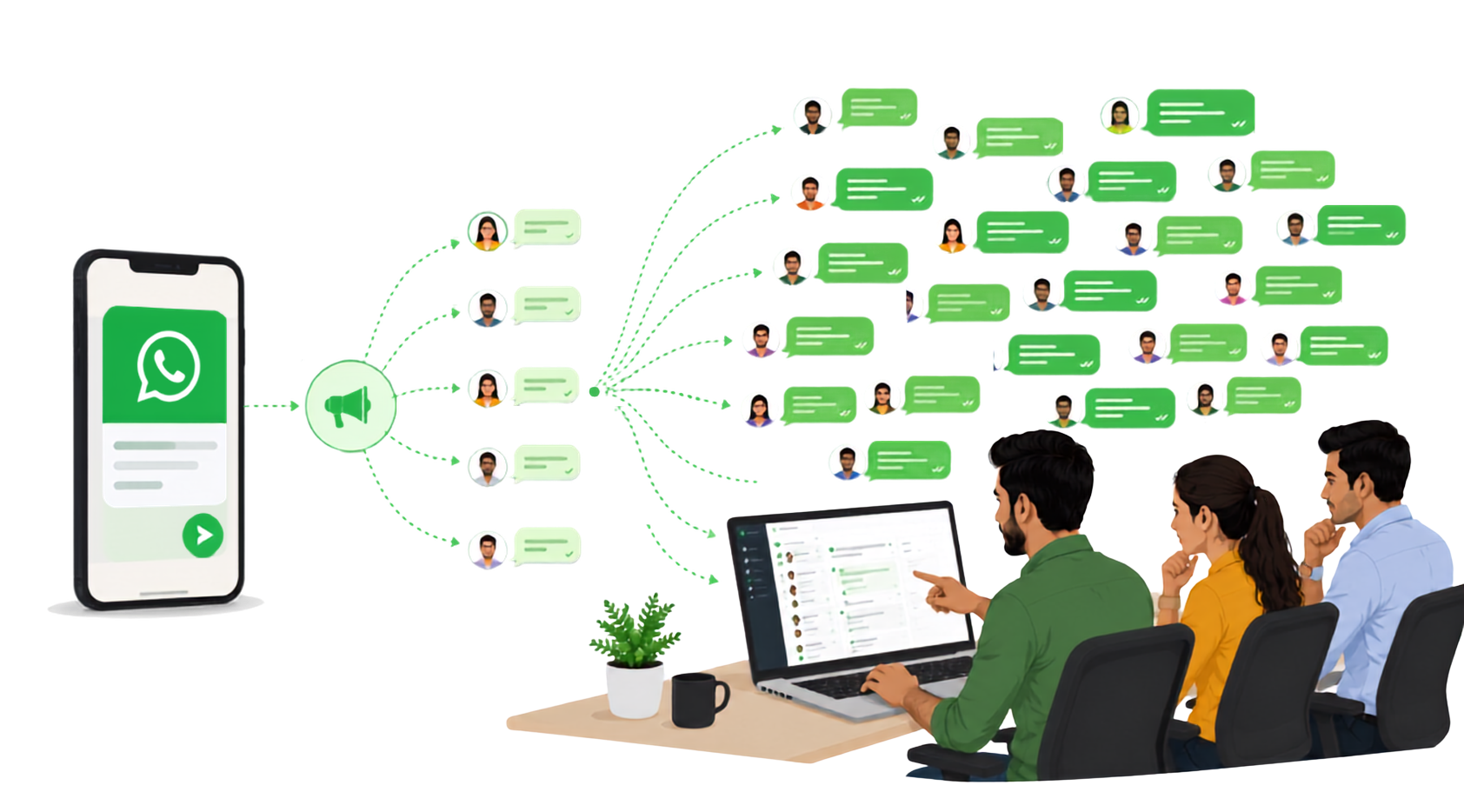
You send a broadcast to 5,000 people. By evening, 400 have replied. Some want prices. Some want to book a visit. Some want to know more about your product/service. Nobody on your team knows who is calling whom, and by Thursday, half those replies have gone cold.
That is where most WhatsApp campaigns in India fall apart. Not at the send. After it.
WhatsApp marketing works because it is the one messaging app almost every Indian customer already has open. But a messaging app is a two-way channel, and most teams still plan it like a one-way one.
This guide covers what a WhatsApp marketing campaign actually is, the types worth running, what they cost in rupees and how to handle the part everyone skips.
A WhatsApp marketing campaign is a set of promotional messages sent from a verified WhatsApp Business account to people who have opted in, using approved templates on the WhatsApp Business Platform. The goal is a measurable business outcome: a sale, a booking, a site visit, a reactivated lead.
That is not the same as replying to whoever happens to message your business profile. A campaign is planned, segmented and aimed at a specific point in the customer journey.
Businesses run them for three jobs: lead generation, promotions and customer loyalty. The same channel handles all three, which is why it tends to replace two or three other tools once a team gets going.
The word that matters there is marketing. WhatsApp sorts every business message into three categories, and the category decides what you pay and how strictly Meta reviews it.
Get the category wrong and one of two things happens. You pay marketing rates for a message that should have been utility, or you dress up a promotion as an order update and Meta rejects the template. Neither is fun at scale.
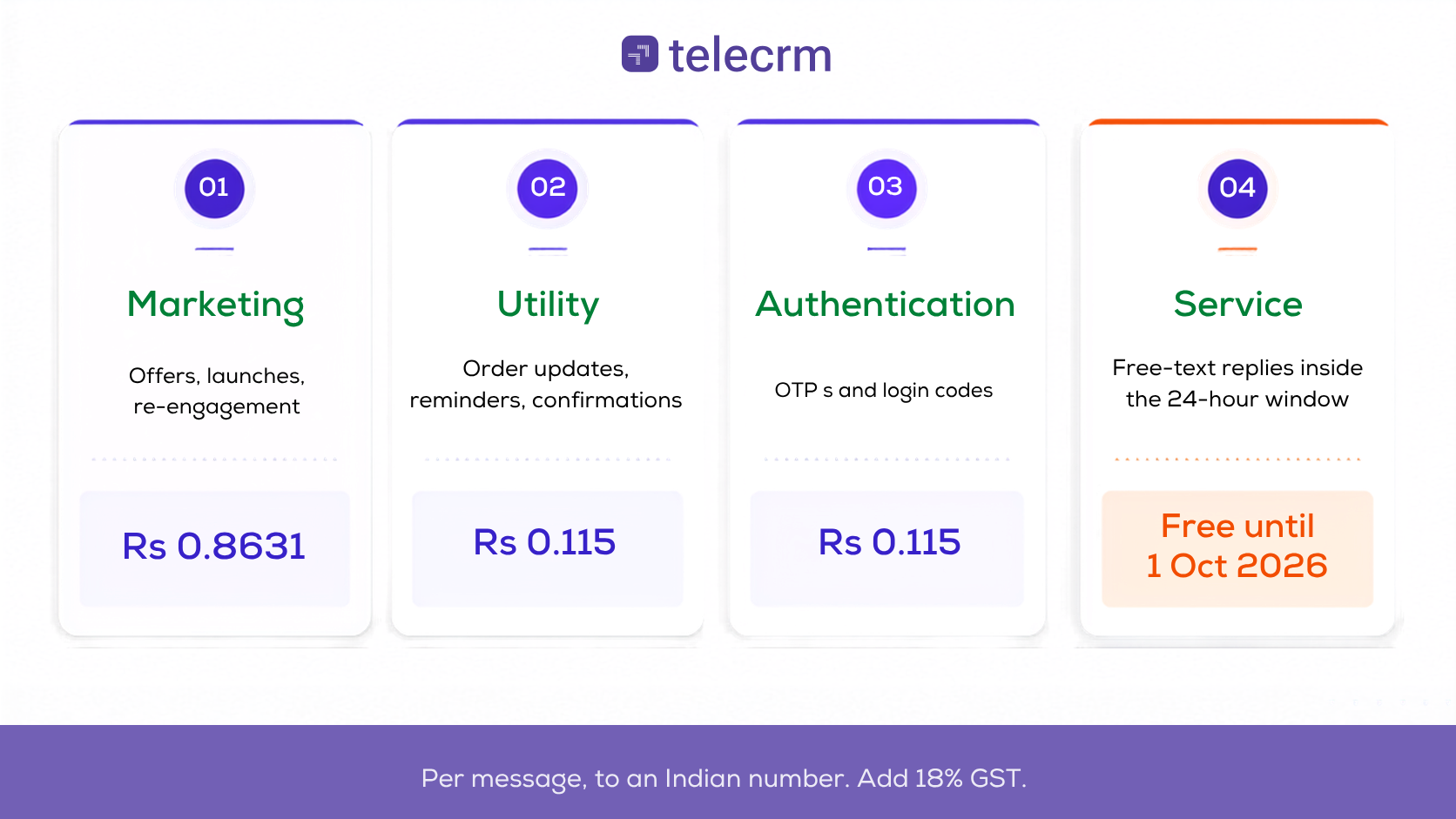
There is a fourth kind, called a service message. That is any free-text reply you send after a customer messages you first, inside a 24-hour window. These have been free since November 2024. From 1 October 2026, they get billed at the same rate as a utility message. Worth knowing before you plan next year’s budget.
Email gets ignored. SMS gets ignored faster, though SMS still beats WhatsApp for a few specific jobs. Push notifications only reach people who kept your app installed, and most did not. WhatsApp is different for one boring reason: the average user in India already has the WhatsApp app open several times a day, so your WhatsApp messages land in the same place as messages from their family.
That does not make it a replacement for your other channels. It makes it the one that carries the conversation. Email still does the long explanation. Your website still does the research. WhatsApp is where someone actually replies to you.
The useful way to plan it is by stage of the customer journey.
Customer journey stage | What WhatsApp does |
Discovery | Click-to-WhatsApp ads turn an Instagram scroll into a chat |
Consideration | Answer questions in real-time conversations, send brochures and other rich media |
Decision | Personalised recommendations, a call-back button, a slot to book, in-chat payments if you drive online sales |
After the sale | Onboarding, satisfaction surveys, cross-selling opportunities |
Gone quiet | Re-engagement campaigns for dormant customers and lapsed customers |
Most Indian businesses only use the first and last rows. The middle three are where WhatsApp marketing quietly beats traditional marketing channels, because that is where people want to ask something and would rather not fill in a form or sit on hold.
A WhatsApp marketing strategy that only covers offers leaves the middle of the funnel to whoever answers faster. Used across all five stages, it does something your other communication channels cannot, which is hold customer relationships in one continuous thread instead of scattering them across inboxes.
Three things, and none of them are optional.
Opt-in. The person must have agreed to receive WhatsApp messages from you. A form submission with a clear checkbox, a QR code they scanned, a click-to-WhatsApp ad they tapped or a message they sent you first. A phone number you bought from a data vendor is not an opt-in. It is a fast route to getting your number blocked.
Collect explicit opt-ins from the start and you end up with a first-party data list that no algorithm change can take away from you. It is the one marketing asset you fully own.
An approved template. Marketing messages have to be pre-written and submitted to Meta for review. Approval usually takes anywhere from 30 minutes to two days. Plan for it. Teams that build the campaign first and think about templates last lose three or four days every launch.
API access through a tech partner. You cannot send a campaign from the free WhatsApp Business app. It caps broadcast lists at 256 contacts, has no automation and no proper reporting. For anything real you need the WhatsApp Business API and you get that through a tech partner rather than going to Meta yourself.
Here is where the choice actually matters. Most marketing tools give you a send button and a delivery report. That is enough to run a campaign and not nearly enough to profit from one, because the value sits in the replies, not the sends.
There is a second problem. If you integrate WhatsApp with one system and run sales out of another, you create a fragmented customer experience. The customer thinks they are dealing with one business. Your team is looking at two screens and neither has the full story.
telecrm is one option here and the reason to consider it is specific: It is a WhatsApp CRM, not a broadcast tool with a contact list attached. Campaign replies land directly on the lead’s record, next to their call history and their follow-up schedule. More on that below.
Comparison point | WhatsApp Business app | WhatsApp Business API |
Broadcast limit | 256 contacts | No limit |
Users on one number | Up to four | Unlimited |
Automation | None | Full |
CRM integration | No | Yes |
Cost | Free | Per message, plus partner fees |
Right for | Very small businesses with one person replying | Any team with a sales function |
Type | What it does | Best for | Sample opening line |
Broadcast offer | One promotional message to a segment | Festive sales, new launches | Diwali offer: 20% off all bookings till 5 November. |
Click-to-WhatsApp ads | Facebook or Instagram ad that opens a chat | Cold lead generation | Hi! Saw our ad? Tell me which city you are looking in. |
Drip nurture | A timed sequence over days or weeks | Long sales cycles | Day 3: here is the floor plan you asked about. |
Re-engagement | Wakes up dormant customers and leads that went quiet | Any list older than 60 days | Rahul, still looking? Prices have changed since we last spoke. |
Abandoned cart recovery | Nudges people who left something unpaid | Online sales, unfinished checkouts | |
Dropped enquiry recovery | Follows up with people who started and stopped | Form drop-offs, unfinished bookings | You started a demo booking yesterday. Want me to finish it for you? |
Event and webinar | Invite, reminder, follow-up | Demos, open houses, seminars | Your slot is tomorrow at 4pm. Reply YES to confirm. |
Festive sale campaigns | Timed to a calendar moment | Retail, real estate, jewellery | Akshaya Tritiya rates are live for 48 hours. |
Most teams only run the first one. The other seven are where the money usually is, because they target existing customers and warm leads who already know you. Your most loyal customers are also your cheapest audience and almost nobody messages them on purpose.
1. Pick one outcome. Not “engagement”. A number of site visits, enrolments or orders. If you cannot name the number you are aiming for, you cannot tell later whether it worked.
2. Segment before you send. Sending to everyone is the most expensive mistake available to you. Every message costs money and every irrelevant message pushes someone closer to blocking you. Segment users by what they enquired about, how recently and what stage they reached. If you have behavioural data, use it. Audience data on customer behaviour beats demographics every time here. Someone who opened your last three messages and someone who has ignored six are not the same audience and user behaviour like that should decide who gets the next send. What you want is targeted WhatsApp campaigns, not broadcasts. The right message to a small segment beats a decent message to everyone and it costs less to send.
Two things make segmentation worth the effort. The first is dynamic segmentation, where lists update themselves against real-time behaviour instead of sitting frozen from the day you exported them. Someone who books a demo should drop out of the “chasing a demo” list the moment they book, not next month when you remember to clean it.
The second is behaviour-triggered messaging. Instead of picking a send date, you pick an event: a form submitted, a page viewed twice, a stage changed, a payment missed. The message goes out when the person does the thing. Triggered sends beat scheduled ones for the same reason a returned call beats a cold one, because the timing belongs to them rather than to your calendar.
3. Write the template like a person. Short. One idea. One clear action. Read it out loud and if it sounds like a brochure, rewrite it. Personalised messages work, but personalisation means using customer data they will recognise, like the project or course they asked about. Dropping a first name into a generic line is not personalisation and people can tell.
4. Add buttons and rich media. Quick replies and call-to-action buttons beat asking people to type, by a wide margin. A price list PDF or a 20-second walkthrough video does more work than three paragraphs. Give two button options, not five.
5. Submit for approval early. Do this before you finalise the send date, not after. If you plan to automate campaigns off a trigger, like a form fill or a stage change, get those templates approved at the same time.
6. Test on a small group. Send to 200 people first. Check the delivery rate, the reply rate and read what people actually say back. Fix the message, then send to the rest.
7. Decide who handles the replies, before you send. This is the step everyone skips, and it is the one that decides whether the campaign makes money. Automated messages can carry the first response and buy your team an hour. But marketing automation does not close anyone. Decide which replies get a human, and how fast.
Most WhatsApp marketing campaign examples you find online are e-commerce. Useful if you sell shoes. Less useful if you sell flats, policies or coaching seats. Here is what these campaigns actually look like in four industries where the sale ends in a conversation rather than a checkout.
The situation. Enquiries from the last two quarters that went quiet. People shopping for a flat rarely stop shopping. They just stop replying to you.
The campaign. One short message when something genuinely changes: a new tower opening, a launch price, a possession date. Two buttons underneath: “Send me the price list” and “Book a site visit”.
Why it works. The button is the whole thing. Asking someone to type a reply loses most of them. Asking them to tap once does not. You also learn where each person is, because the two buttons sort your list into browsers and buyers for you.
The situation. Parents who enquired about a batch, took the fee structure and never came back.
The campaign. Two weeks before the batch starts, a message with the seats remaining, the fee and a button to talk to a counsellor.
Why it works. Scarcity is real here in a way it is not in retail. A batch genuinely does fill, and the start date genuinely does pass. You are not manufacturing urgency; you are reporting it and parents can tell the difference.
The situation. Policies expiring this month, and a renewal team that cannot call all of them in time.
The campaign. A three-part sequence. A renewal reminder first, sent as a utility template. A week later, the marketing message comparing the new premium. A week after that, a nudge with a call-back button.
Why it works. Splitting utility and marketing across the sequence is the cost-saving. Most teams send all three as marketing and pay roughly seven times more than they need to for the first one.
The situation. A cancellation leaves a slot nobody fills, and patients due for a check-up forget to book.
The campaign. A standing weekly message to patients due for a six-month visit, offering the open slots for that week. They pick a time in chat, which is exactly the job a WhatsApp Flow does without a single back-and-forth.
Why it works. It runs on a list that regenerates itself, so you are not burning through a finite database. And a specific slot is easier to say yes to than “book an appointment”.
Notice what all four have in common. Sending is the easy part. Every one of them ends the same way, with a pile of replies that somebody has to work through, quickly, before they go cold.
Most WhatsApp tools are built for sending messages. The screen your marketing team looks at is a list of campaigns and delivery numbers. Then a few hundred people reply, and those replies sit in a shared inbox that nobody owns, while your sales team works out of a different system entirely.
telecrm is built the other way round. It is a CRM first, with WhatsApp running inside it. Calls, WhatsApp chat and the lead record sit on one screen, which is the only real way to streamline communication once your customer interactions are spread across channels.
Replies land on the lead, not in an inbox –> With Chat Sync and the Cloud API connected, a campaign reply appears on that person’s lead record. You see the WhatsApp conversation next to every call that was made to them, the recordings, the notes and what they enquired about three months ago. Your rep does not have to piece the story together from two apps.
The follow-up is scheduled, and you can see if it happened –> Every lead page carries a full timeline: calls made, call recordings, the follow-up that was scheduled and whether it was actually taken on time. That last one is the number most sales managers never get to see, and it is what WhatsApp tracking should mean in practice rather than one more dashboard nobody opens.
Hot replies get assigned automatically –> Someone taps “Book a site visit” and the lead can be routed to a rep, a follow-up call scheduled and the rep prompted to call. No manual sorting through a queue.
And then someone actually calls –> telecrm uses native SIM-based calling, so the follow-up happens from a normal mobile number that people pick up and the call is logged against the lead automatically. WhatsApp gets the conversation started. In most Indian sales cycles, a phone call is what closes it. From October 2026 there is a cost argument for it too, because every free-text WhatsApp reply becomes billable while a call from your own SIM does not.
Who this fits –> Teams where a lead needs a conversation, not a checkout: real estate, edtech and coaching, insurance and NBFCs, healthcare and manufacturing. If your campaign ends in a phone call rather than a payment page, this is the shape of tool you need.
Any customer who purchases automobile insurance from us might also need additional insurance for their second vehicle, or they might need health or life insurance policies as well.
With telecrm, capitalising on this set of customers has become extremely easy. Customers are segmented into multiple buckets. People who have two vehicles but insurance only for one, and people aged 50 and above with health insurance but no life insurance.
Then, based on this categorisation, personalised messaging is sent on WhatsApp at scale. All the responses are populated in telecrm, so as soon as a customer shows interest, my team gets on a call with them.
Our cross-sell figures have improved by 17% since we started doing this!
Pratik Mirajkar, Team Lead
Navnit Insurance
Two costs, and they are charged by two different people.
Meta’s per-message charge. Sending a marketing message to an Indian number costs ₹0.8631 after the January 2026 increase. Utility and authentication messages cost about ₹0.115 each. Add 18% GST on all of it.
What changed on 1 October 2026? Two things that are free today start getting billed. Service messages, meaning the free-text replies your team sends inside the 24-hour window are free only for the first 1,000 a month per business number. And utility templates sent inside that same window, which have been free since July 2025. Now, both get charged at the utility rate, so roughly ₹0.115 each in India.
That sounds small until you count replies. A conversation your agent resolves in six messages costs nothing today. From October, it is six line items, and if you handle 5,000 conversations a month, a number that reads zero on your invoice today will not read zero then.
What your provider charges. Two models. Some charge a flat monthly platform fee. Others add a markup to every message, typically landing between ₹0.95 and ₹1.20 per marketing message once Meta’s cost and their margin are combined. If you want it line by line, we have a full breakdown of WhatsApp Business API pricing.
telecrm sits in the first camp. It does not charge a WhatsApp Cloud API fee at all. You pay Meta’s per-message cost and nothing on top of it, with a one-time setup cost only where the setup is genuinely complicated.
Here is what that difference looks like on one campaign of 10,000 marketing messages to Indian numbers.
Cost component | telecrm | A provider charging ₹1.10 per message |
Meta’s per-message charge | 8631 | 8631 |
Provider markup | Nil | 2369 |
GST at 18% | 1554 | 1980 |
One send | 10185 | 12980 |
Twelve sends a year | 122220 | 155760 |
That is ₹33,540 a year in markup, for nothing that shows up in your results. Platform access on telecrm sits inside the CRM subscription instead, which starts at ₹799 per user per month and covers your whole sales process rather than just the sending.
Three ways to keep the bill down, and all three matter more after October.
To know more about Meta’s pricing change, visit Meta Pricing
Put genuinely transactional messages in utility templates. ₹0.115 against ₹0.8631 is a seven-times difference on the same send.
Resolve in fewer replies. Once you are paying per reply, one clear message beats five short ones. Collecting details through a WhatsApp Flow instead of a back-and-forth does the same job for less.
Run click-to-WhatsApp ads. A chat that starts from a Facebook or Instagram ad opens a free 72-hour window, and that window survives the October change. After 1 October 2026, it is close to the only properly free messaging you get. Here is how to route Facebook ad leads into WhatsApp and your CRM.
Opt-in is not a formality. No consent, no message. Explicit opt-ins are what protect your sender reputation, and sender reputation is what decides whether your messages get delivered at all. Enough people blocking or reporting you and your quality rating drops; your send limits shrink and eventually the number is banned.
Every marketing message needs an exit. Give people a clear way to stop hearing from you, and honour it immediately.
There is a limit on how often you can message customers. Meta caps how many marketing messages one person receives across all businesses in a given period, and does not publish the number. Send too often and your WhatsApp marketing messages simply stop being delivered, with no error to tell you why. Two or three campaigns a month to the same person is a ceiling, not a target.
Categorise honestly. Labelling a promotion as a utility message to save money is the fastest way to get templates rejected and your quality rating downgraded.
The DPDP Act applies to all of this. India’s data protection law requires clear notice of what you are collecting and why, consent that was freely given and a working way for people to withdraw it. Collect opt-ins with a clear notice of what you will send and roughly how often, and keep a record of when and how each contact gave it. If a regulator or an angry customer asks, “they filled a form somewhere” is not an answer.
You will see a 98% open rate quoted on almost every page about WhatsApp marketing. Meta does not publish that figure and nobody can point to where it came from. The direction is fair enough, read rates on WhatsApp genuinely do run high. That is exactly why delivery rate and read rate are the wrong numbers to judge a campaign on. If nearly everything gets read, a 95% read rate on a campaign that produced no revenue is not a good result. It is an expensive one.
Borrowed benchmarks have the same problem. Vendors commonly report click-through rates of 25% to 30% and sharp drops in cost per qualified lead against paid ads. Those are case studies, not research. Use them to set a rough expectation, then replace them with your own numbers after two or three sends.
Track these instead.
The first two you can pull from any WhatsApp tool. The rest need your campaign data and your sales data in one place, which is the only way to follow customer engagement through to a closed deal. It is also the whole argument for running your WhatsApp marketing efforts from your CRM rather than beside it.
That is what telecrm does. Campaign replies land on the lead record. The follow-up gets scheduled and called from a real SIM. Every number above sits on one screen instead of three.
Book a telecrm demo and we will walk you through a full campaign, from the broadcast to the closed deal.
It is a set of promotional messages sent through the WhatsApp API to people who have opted in, using templates approved by Meta, aimed at a measurable outcome like a sale or a booking.
Meta charges ₹0.8631 per marketing message to an Indian number, plus 18% GST. A campaign to 10,000 people costs about ₹10,185 in Meta charges. Your provider may add a platform fee or a per-message markup on top.
Meta limits how many marketing messages a person receives across all businesses in a period but does not publish the number. Stay under two or three a month per contact.
Yes, with consent. You need a documented opt-in, a working opt-out and compliance with the DPDP Act. Messaging bought lists is not legal and will get your number banned.
Three things. A tight segment instead of the whole list, a message short enough to read on a lock screen and one clear action. After that it comes down to speed. The campaigns that convert are the ones where somebody answers the replies within the hour.
From 1 October 2026, in effect yes. The window still exists and you can still send free-form replies inside it, but each one gets billed at the utility rate, roughly ₹0.115 in India. Utility templates sent inside the window lose their free status on the same date. Chats that start from a click-to-WhatsApp ad keep their free 72-hour window.
Usually miscategorisation, vague or misleading copy or a broken variable. Submit early and keep the message specific about what you are offering.


© Copyright 2026 telecrm.in (Flamon Cloudtech Pvt Ltd) - All Rights Reserved • Privacy Policy • T&C



© Copyright 2026 telecrm.in - All Rights Reserved • Privacy Policy • T&C